 Add to Chrome
 Add to Firefox
 Add to Edge
FLEET: Token-Based Feature Extraction for Event Camera-based Reinforcement Learning
Aug 17, 2026
Event cameras generate asynchronous, high-frequency data streams offering spatially sparse information at lower latency than traditional cameras.In principle, these properties should be ideal for the design of control policies.However, reinforcement learning research in this field remains limited as existing approaches fail to fully exploit the sensor's properties.CNN-based methods negate the sensors benefits by aggregating events into sparse grids. This couples compute cost to sensor resolution and blurs the temporal information. Meanwhile, existing generative baselines rely on the availability of trajectory data to pretrain the model. We propose FLEET (Feature Learning from Events via Efficient Tokenization), a feature extractor that processes event sequences directly. Leveraging random Fourier features and cross-attention, our architecture compresses variable streams into fixed-size latent representations. This decouples inference cost of the feature extractor's backbone from the sensor's resolution, enabling end-to-end learning without auxiliary losses. We validate FLEET on a new, high-throughput benchmark. The results demonstrate that our sequence-based approach surpasses SOTA performance and exhibits superior robustness to variations in observation frequencies.

Reinforcement learning for ion shuttling on trapped-ion quantum computers
May 21, 2026Scalable trapped-ion quantum computing is commonly realized with modular chips that feature distinct zones with specific functionalities, such as storage, state preparation, and gate execution. To execute a quantum circuit, the ions must be transported between these zones. This process is called ion shuttling. To achieve reliable computation results, the shuttling process must be optimized. However, as the number of ions increases, this becomes a high-dimensional optimization problem where optimal solutions cannot be computed efficiently. We demonstrate, to the best of our knowledge, the first use of reinforcement learning (RL) for the optimization of ion shuttling. RL is well-suited for such scenarios, as it enables learning a strategy through direct interaction with the problem. We show that our RL approach outperforms current state-of-the-art heuristic techniques, yielding a reduction in shuttling operations of up to 36.3 %. Furthermore, we show that our method is easily applicable to various chip architectures. Our approach offers a versatile method to study shuttling efficiency during chip design and, therefore, a highly relevant tool for future, more complex architectures.
Cell Tracking according to Biological Needs -- Strong Mitosis-aware Random-finite Sets Tracker with Aleatoric Uncertainty
Mar 25, 2024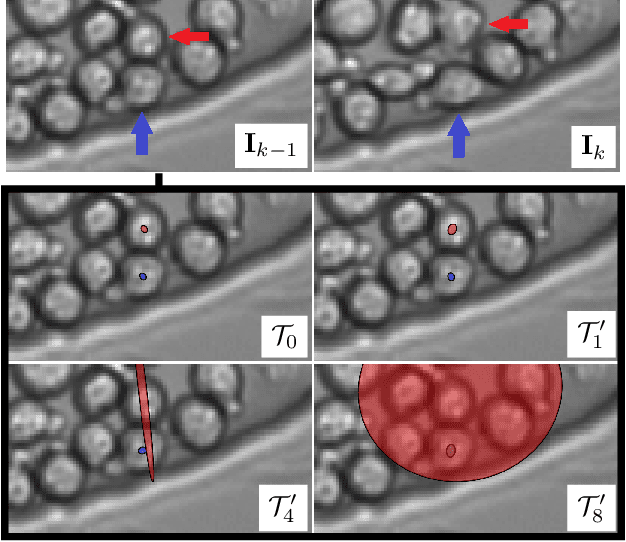
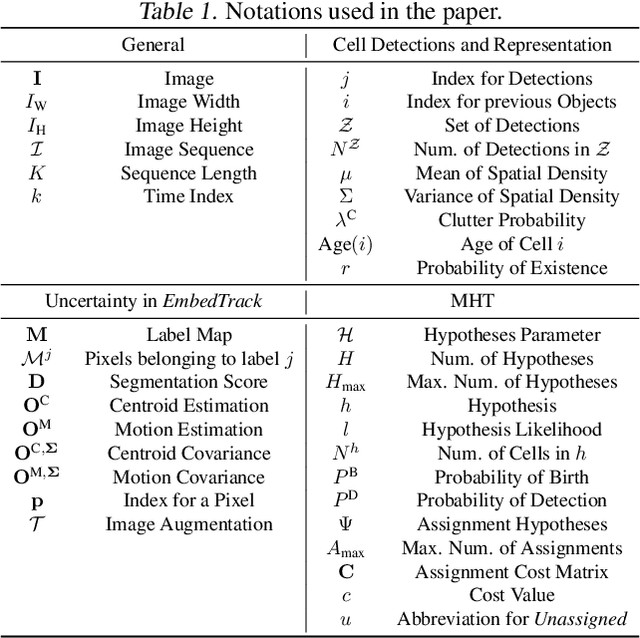
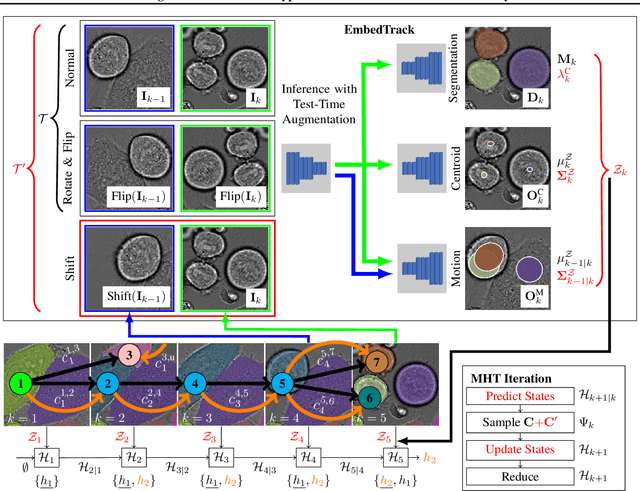
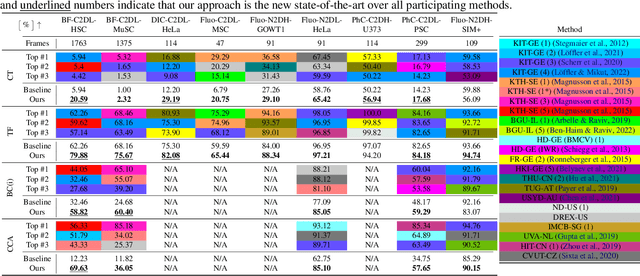
Cell tracking and segmentation assist biologists in extracting insights from large-scale microscopy time-lapse data. Driven by local accuracy metrics, current tracking approaches often suffer from a lack of long-term consistency. To address this issue, we introduce an uncertainty estimation technique for neural tracking-by-regression frameworks and incorporate it into our novel extended Poisson multi-Bernoulli mixture tracker. Our uncertainty estimation identifies uncertain associations within high-performing tracking-by-regression methods using problem-specific test-time augmentations. Leveraging this uncertainty, along with a novel mitosis-aware assignment problem formulation, our tracker resolves false associations and mitosis detections stemming from long-term conflicts. We evaluate our approach on nine competitive datasets and demonstrate that it outperforms the current state-of-the-art on biologically relevant metrics substantially, achieving improvements by a factor of approximately $5.75$. Furthermore, we uncover new insights into the behavior of tracking-by-regression uncertainty.