 Add to Chrome
 Add to Firefox
 Add to Edge
Integrity of peer-to-peer distributed LLM inference under malicious nodes
Jul 21, 2026
Peer-to-peer distributed inference executes a Large Language Model (LLM) on pooled consumer hardware by spreading its layers across many nodes. Every request passes through nodes that are owned and controlled by multiple independent parties. However, in this setting, any party can tamper with the output of its layers to corrupt the end result. Recomputing the forward pass on trusted hardware can catch this, but it introduces additional computational cost. The scientific literature includes several prior integrity-checking approaches, such as known-answer traps for image classifiers and cryptographic commitments. However, these solutions test only the exact correctness and do not account for the ordinary variation that may arise between benign nodes. In this paper, we propose a method that checks the output integrity by measuring the variation in the activations that each node passes to the next. A peer who wants to use the network selects a small set of secret canary inputs whose correct activations are known in advance and mixes them into regular traffic. Because the peers cannot tell a canary from a real query, any tampering node corrupts them as well. The deviation from the known reference then reveals malicious activity: benign nodes exhibit only minor variation from hardware-induced noise, whereas tampered nodes deviate far more. We treat the identification of malicious nodes as a probabilistic test that separates two drift distributions, without relying on a fixed threshold. We study 408 configurations with metrics and success criteria fixed before any experiment ran; the detector reaches AUROC 1.0, correctly ranking the malicious shard above every benign shard on every canary in every configuration.

An AI-Based Solution for Secure Service Provisioning in IoT
Jun 29, 2026As the Internet of Things (IoT) continues its rapid expansion, the attack surface grows accordingly, with emerging threats targeting smart objects and their interactions. In this evolving landscape, securing service provisioning is crucial to ensure the proper functioning, security, and reliability of the IoT ecosystem. Service provisioning encompasses key tasks such as device registration, configuration, authentication, authorization, and software deployment, all of which are essential for seamless and secure IoT operations. In this paper, we present a comprehensive framework designed to select the most suitable smart objects to deliver a target service within a given IoT environment while also monitoring the behavior of the entities involved during the service provisioning phase. To achieve this, we employ a Deep Reinforcement Learning (DRL) approach in which an intelligent agent learns, through interaction with a complex, dynamic environment, how to adapt to changes while adhering to predefined security constraints. For behavioral monitoring, we leverage Federated Learning (FL) to develop a global Behavioral Fingerprinting (BF) model that is fully distributed and can analyze how IoT devices interact within the network. In addition, the BF is used to compute a reliability score for each service provider, reflecting its degree of compliance with the defined security constraints. This score is then incorporated into the service provisioning process, allowing smart objects to select providers not only according to functional suitability but also to their reliability level. Finally, we conduct an extensive experimental evaluation to assess the robustness and scalability of our approach. The results demonstrate that our solution can be effectively deployed even on resource-constrained IoT devices, making it a viable and scalable security-enhancing mechanism for modern IoT ecosystems.
LightSplit: Practical Privacy-Preserving Split Learning via Orthogonal Projections
May 13, 2026Split learning (SL) enables collaborative training by partitioning a neural network across clients and a central server, but the cut-layer interface introduces a key challenge: high-dimensional activations incur substantial communication overhead while exposing representations vulnerable to reconstruction attacks. Existing approaches typically address efficiency or privacy in isolation, relying on additional mechanisms such as sparsification, quantization, or noise injection. We propose LightSplit, which limits information exposure and reduces communication overhead by applying a lightweight fixed orthogonal random projection at the cut layer. Based on Shannon's information theory, this projection acts as an information bottleneck that restricts instance-specific information and suppresses exploitable per-sample signals. By transmitting low-dimensional projections instead of raw activations, the server operates on lifted representations without requiring architectural modifications, ensuring compatibility with existing SL architectures. By avoiding additional trainable components on the client, the method remains lightweight and suitable for edge devices while preserving end-to-end differentiability via exact gradient propagation. As the projection is non-invertible, part of the original representation is irreversibly discarded at the client, LightSplit reduces the information available for reconstruction and limits information exposure. We extensively evaluate LightSplit on state-of-the-art benchmarks in both IID and non-IID settings across varying projection dimensions and client scales. Our results show that the method retains more than 95% of the baseline accuracy at up to 32x reduction in transmitted dimensionality while maintaining stable training dynamics.
Security in LLM-as-a-Judge: A Comprehensive SoK
Mar 31, 2026LLM-as-a-Judge (LaaJ) is a novel paradigm in which powerful language models are used to assess the quality, safety, or correctness of generated outputs. While this paradigm has significantly improved the scalability and efficiency of evaluation processes, it also introduces novel security risks and reliability concerns that remain largely unexplored. In particular, LLM-based judges can become both targets of adversarial manipulation and instruments through which attacks are conducted, potentially compromising the trustworthiness of evaluation pipelines. In this paper, we present the first Systematization of Knowledge (SoK) focusing on the security aspects of LLM-as-a-Judge systems. We perform a comprehensive literature review across major academic databases, analyzing 863 works and selecting 45 relevant studies published between 2020 and 2026. Based on this study, we propose a taxonomy that organizes recent research according to the role played by LLM-as-a-Judge in the security landscape, distinguishing between attacks targeting LaaJ systems, attacks performed through LaaJ, defenses leveraging LaaJ for security purposes, and applications where LaaJ is used as an evaluation strategy in security-related domains. We further provide a comparative analysis of existing approaches, highlighting current limitations, emerging threats, and open research challenges. Our findings reveal significant vulnerabilities in LLM-based evaluation frameworks, as well as promising directions for improving their robustness and reliability. Finally, we outline key research opportunities that can guide the development of more secure and trustworthy LLM-as-a-Judge systems.
Privacy Preserving and Robust Aggregation for Cross-Silo Federated Learning in Non-IID Settings
Mar 06, 2025

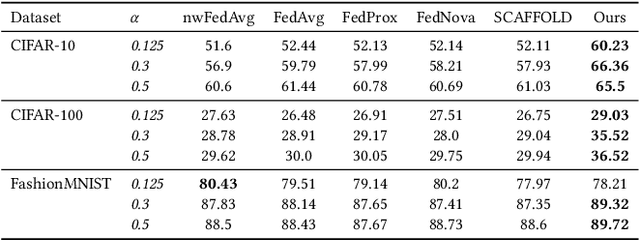

Federated Averaging remains the most widely used aggregation strategy in federated learning due to its simplicity and scalability. However, its performance degrades significantly in non-IID data settings, where client distributions are highly imbalanced or skewed. Additionally, it relies on clients transmitting metadata, specifically the number of training samples, which introduces privacy risks and may conflict with regulatory frameworks like the European GDPR. In this paper, we propose a novel aggregation strategy that addresses these challenges by introducing class-aware gradient masking. Unlike traditional approaches, our method relies solely on gradient updates, eliminating the need for any additional client metadata, thereby enhancing privacy protection. Furthermore, our approach validates and dynamically weights client contributions based on class-specific importance, ensuring robustness against non-IID distributions, convergence prevention, and backdoor attacks. Extensive experiments on benchmark datasets demonstrate that our method not only outperforms FedAvg and other widely accepted aggregation strategies in non-IID settings but also preserves model integrity in adversarial scenarios. Our results establish the effectiveness of gradient masking as a practical and secure solution for federated learning.
Secure Federated Data Distillation
Feb 19, 2025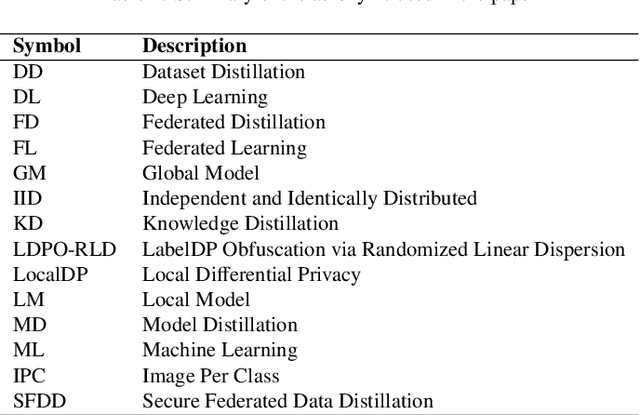
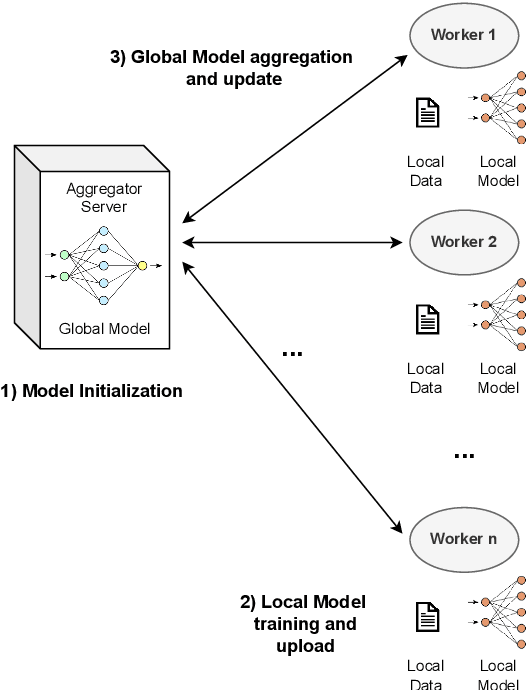
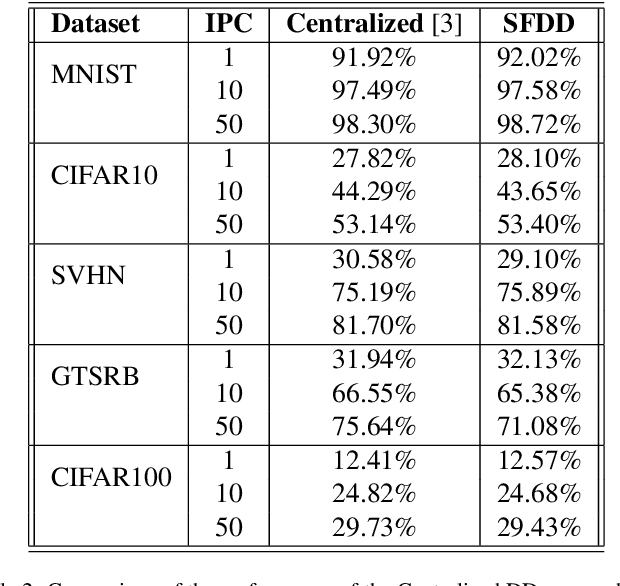
Dataset Distillation (DD) is a powerful technique for reducing large datasets into compact, representative synthetic datasets, accelerating Machine Learning training. However, traditional DD methods operate in a centralized manner, which poses significant privacy threats and reduces its applicability. To mitigate these risks, we propose a Secure Federated Data Distillation framework (SFDD) to decentralize the distillation process while preserving privacy.Unlike existing Federated Distillation techniques that focus on training global models with distilled knowledge, our approach aims to produce a distilled dataset without exposing local contributions. We leverage the gradient-matching-based distillation method, adapting it for a distributed setting where clients contribute to the distillation process without sharing raw data. The central aggregator iteratively refines a synthetic dataset by integrating client-side updates while ensuring data confidentiality. To make our approach resilient to inference attacks perpetrated by the server that could exploit gradient updates to reconstruct private data, we create an optimized Local Differential Privacy approach, called LDPO-RLD (Label Differential Privacy Obfuscation via Randomized Linear Dispersion). Furthermore, we assess the framework's resilience against malicious clients executing backdoor attacks and demonstrate robustness under the assumption of a sufficient number of participating clients. Our experimental results demonstrate the effectiveness of SFDD and that the proposed defense concretely mitigates the identified vulnerabilities, with minimal impact on the performance of the distilled dataset. By addressing the interplay between privacy and federation in dataset distillation, this work advances the field of privacy-preserving Machine Learning making our SFDD framework a viable solution for sensitive data-sharing applications.