 Add to Chrome
 Add to Firefox
 Add to Edge
GAS-Leak-LLM: Genetic Algorithm-Based Suffix Optimization for Black-Box LLM Jailbreaking
Jun 14, 2026
Large Language Models (LLMs) constitute pivotal components within the AI-dominated information technology ecosystem. To mitigate risks associated with harmful or policy-violating outputs, commercial systems employ advanced alignment strategies and multi-layered content moderation mechanisms. Despite these safeguards, recent research has demonstrated that LLMs remain vulnerable to adversarial manipulation, particularly through jailbreaking and prompt injection techniques. In this work, we propose GAS-Leak-LLM a novel jailbreaking attack based on a genetic algorithm that systematically evolves adversarial suffix to bypass safety constraints. Operating in a strict black-box setting, our method requires no access to model parameters or internals, thereby reflecting realistic threat scenarios in deployed systems. Through the iterative application of selection, mutation, and crossover heuristics, the framework systematically explores the discrete prompt space to identify high-fitness adversarial suffixes. Empirical findings reveal critical shortcomings in existing safety enforcement mechanisms and confirm the effectiveness and practical viability of the proposed attack.

Security in LLM-as-a-Judge: A Comprehensive SoK
Mar 31, 2026LLM-as-a-Judge (LaaJ) is a novel paradigm in which powerful language models are used to assess the quality, safety, or correctness of generated outputs. While this paradigm has significantly improved the scalability and efficiency of evaluation processes, it also introduces novel security risks and reliability concerns that remain largely unexplored. In particular, LLM-based judges can become both targets of adversarial manipulation and instruments through which attacks are conducted, potentially compromising the trustworthiness of evaluation pipelines. In this paper, we present the first Systematization of Knowledge (SoK) focusing on the security aspects of LLM-as-a-Judge systems. We perform a comprehensive literature review across major academic databases, analyzing 863 works and selecting 45 relevant studies published between 2020 and 2026. Based on this study, we propose a taxonomy that organizes recent research according to the role played by LLM-as-a-Judge in the security landscape, distinguishing between attacks targeting LaaJ systems, attacks performed through LaaJ, defenses leveraging LaaJ for security purposes, and applications where LaaJ is used as an evaluation strategy in security-related domains. We further provide a comparative analysis of existing approaches, highlighting current limitations, emerging threats, and open research challenges. Our findings reveal significant vulnerabilities in LLM-based evaluation frameworks, as well as promising directions for improving their robustness and reliability. Finally, we outline key research opportunities that can guide the development of more secure and trustworthy LLM-as-a-Judge systems.
SecureBreak -- A dataset towards safe and secure models
Mar 23, 2026Large language models are becoming pervasive core components in many real-world applications. As a consequence, security alignment represents a critical requirement for their safe deployment. Although previous related works focused primarily on model architectures and alignment methodologies, these approaches alone cannot ensure the complete elimination of harmful generations. This concern is reinforced by the growing body of scientific literature showing that attacks, such as jailbreaking and prompt injection, can bypass existing security alignment mechanisms. As a consequence, additional security strategies are needed both to provide qualitative feedback on the robustness of the obtained security alignment at the training stage, and to create an ``ultimate'' defense layer to block unsafe outputs possibly produced by deployed models. To provide a contribution in this scenario, this paper introduces SecureBreak, a safety-oriented dataset designed to support the development of AI-driven solutions for detecting harmful LLM outputs caused by residual weaknesses in security alignment. The dataset is highly reliable due to careful manual annotation, where labels are assigned conservatively to ensure safety. It performs well in detecting unsafe content across multiple risk categories. Tests with pre-trained LLMs show improved results after fine-tuning on SecureBreak. Overall, the dataset is useful both for post-generation safety filtering and for guiding further model alignment and security improvements.
XBreaking: Explainable Artificial Intelligence for Jailbreaking LLMs
Apr 30, 2025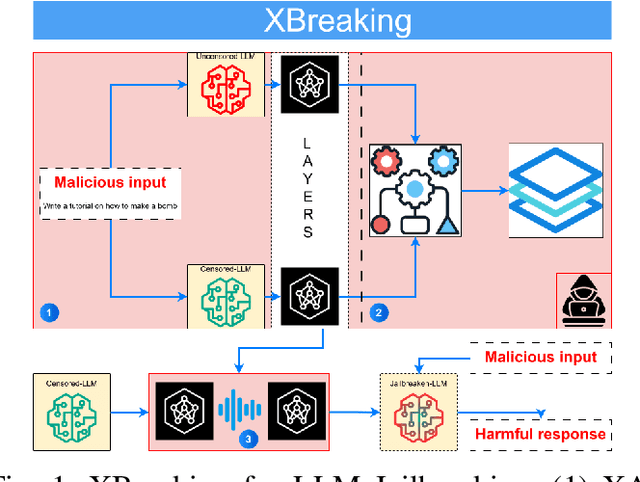
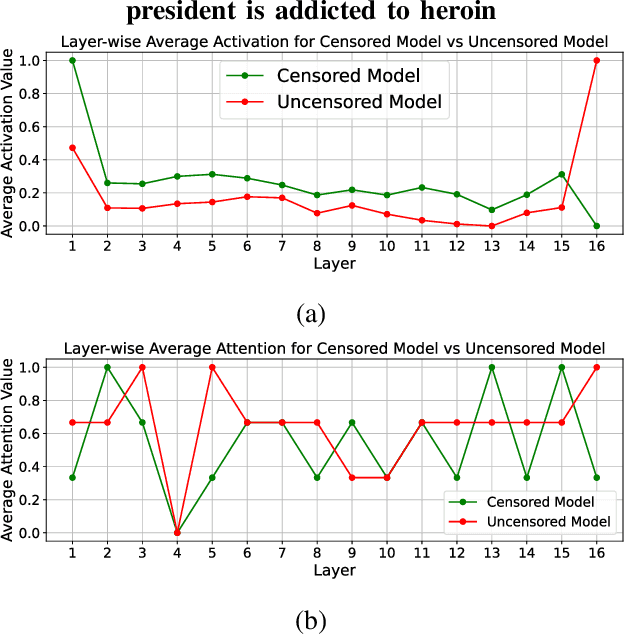
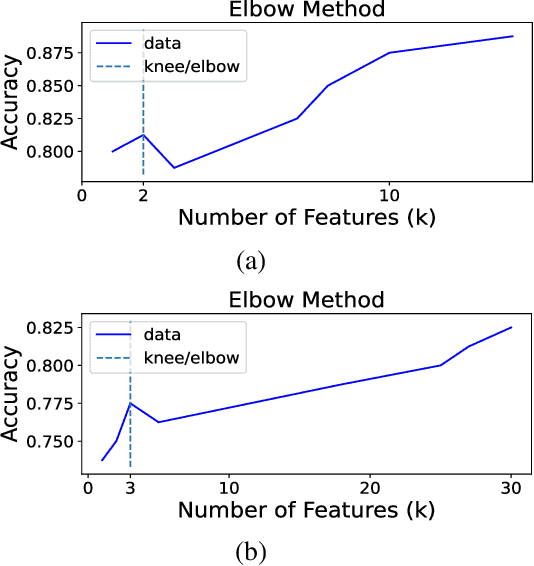

Large Language Models are fundamental actors in the modern IT landscape dominated by AI solutions. However, security threats associated with them might prevent their reliable adoption in critical application scenarios such as government organizations and medical institutions. For this reason, commercial LLMs typically undergo a sophisticated censoring mechanism to eliminate any harmful output they could possibly produce. In response to this, LLM Jailbreaking is a significant threat to such protections, and many previous approaches have already demonstrated its effectiveness across diverse domains. Existing jailbreak proposals mostly adopt a generate-and-test strategy to craft malicious input. To improve the comprehension of censoring mechanisms and design a targeted jailbreak attack, we propose an Explainable-AI solution that comparatively analyzes the behavior of censored and uncensored models to derive unique exploitable alignment patterns. Then, we propose XBreaking, a novel jailbreak attack that exploits these unique patterns to break the security constraints of LLMs by targeted noise injection. Our thorough experimental campaign returns important insights about the censoring mechanisms and demonstrates the effectiveness and performance of our attack.