 Add to Chrome
 Add to Firefox
 Add to Edge
Regularized joint reconstruction and slab combination for accelerated three-dimensional multi-slab diffusion-weighted imaging using multi-scale energy models
Jun 01, 2026
This work presents Energy-based Profile Encoding, EPEN, a joint reconstruction framework for high-resolution diffusion-weighted MRI from undersampled 3D multi-slab k-space acquisitions, designed to suppress slab-boundary artifacts while preserving fine anatomical detail. EPEN formulates the multi-slab acquisition process using a bilinear forward model in which both the diffusion-weighted image volume and slab excitation profiles are treated as unknown variables. Reconstruction is posed as a maximum a posteriori optimization problem with three components: a Gaussian data-fidelity term enforcing consistency with the acquired k-space measurements, a CNN-based deep energy prior that represents the negative log distribution of clean diffusion-weighted images, and a quadratic regularization term that constrains the estimated slab profiles toward an initial profile estimate. The gradient of the learned energy prior guides accelerated reconstruction toward an artifact-free image distribution. The resulting nonconvex objective is solved using alternating minimization, with image-volume updates performed through a majorize-minimize scheme using conjugate-gradient optimization and slab-profile updates estimated by regularized least squares. Across multiple acceleration factors and slab configurations, EPEN substantially reduced slab-boundary artifacts compared with conventional slab-boundary correction methods, while improving structural consistency and preserving diffusion-weighted contrast. These results demonstrate that EPEN enables robust joint 3D multi-slab diffusion MRI reconstruction and slab-profile correction within a unified optimization framework supported by deep energy-based image priors.

Three-Dimensional Diffusion-Weighted Multi-Slab MRI With Slice Profile Compensation Using Deep Energy Model
Jan 28, 2025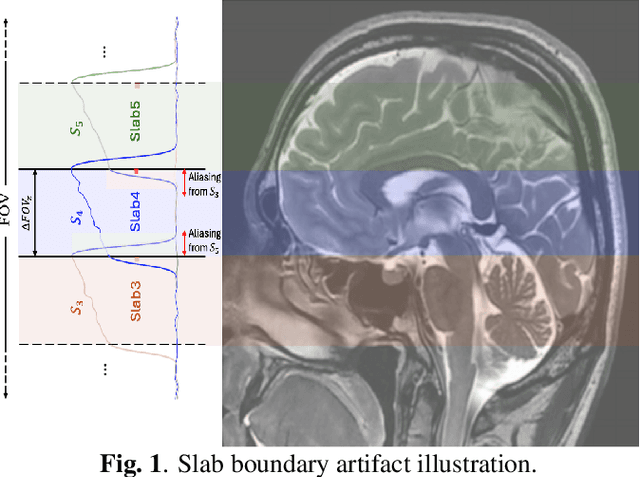
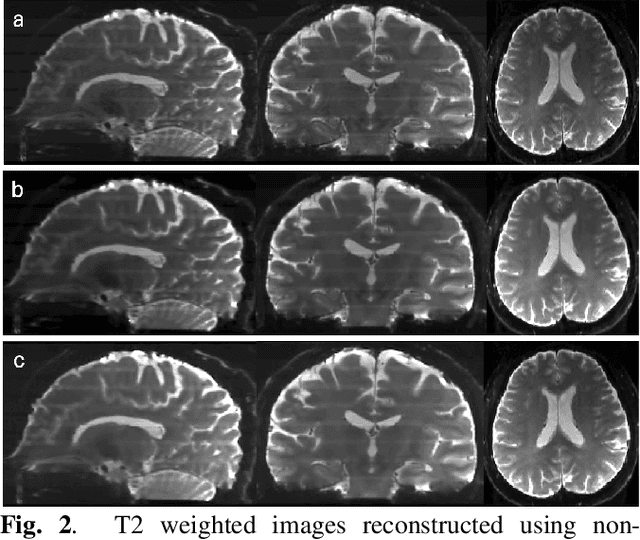
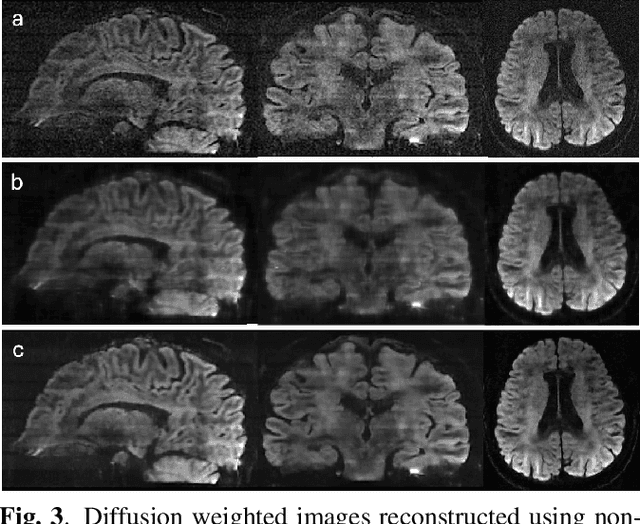
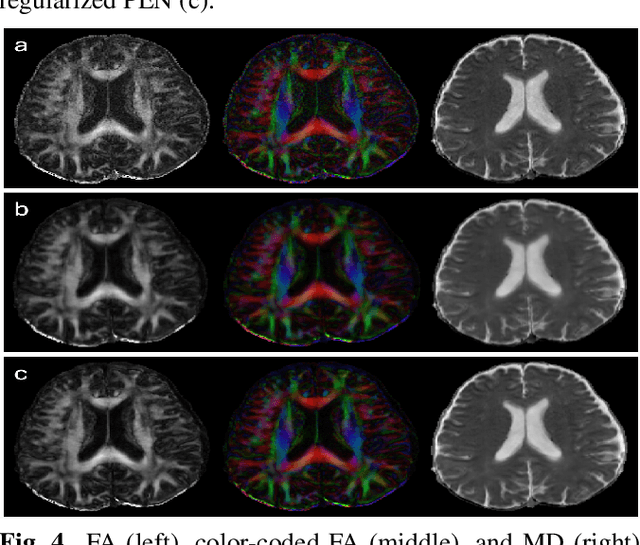
Three-dimensional (3D) multi-slab acquisition is a technique frequently employed in high-resolution diffusion-weighted MRI in order to achieve the best signal-to-noise ratio (SNR) efficiency. However, this technique is limited by slab boundary artifacts that cause intensity fluctuations and aliasing between slabs which reduces the accuracy of anatomical imaging. Addressing this issue is crucial for advancing diffusion MRI quality and making high-resolution imaging more feasible for clinical and research applications. In this work, we propose a regularized slab profile encoding (PEN) method within a Plug-and-Play ADMM framework, incorporating multi-scale energy (MuSE) regularization to effectively improve the slab combined reconstruction. Experimental results demonstrate that the proposed method significantly improves image quality compared to non-regularized and TV-regularized PEN approaches. The regularized PEN framework provides a more robust and efficient solution for high-resolution 3D diffusion MRI, potentially enabling clearer, more reliable anatomical imaging across various applications.
Calibration-free B0 correction of EPI data using structured low rank matrix recovery
Apr 20, 2018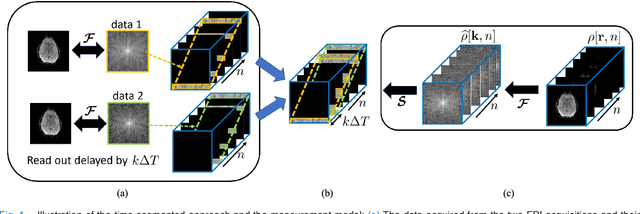
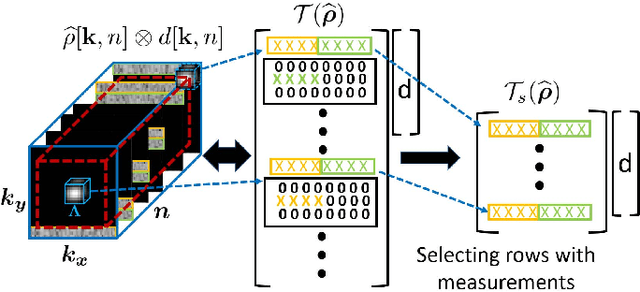
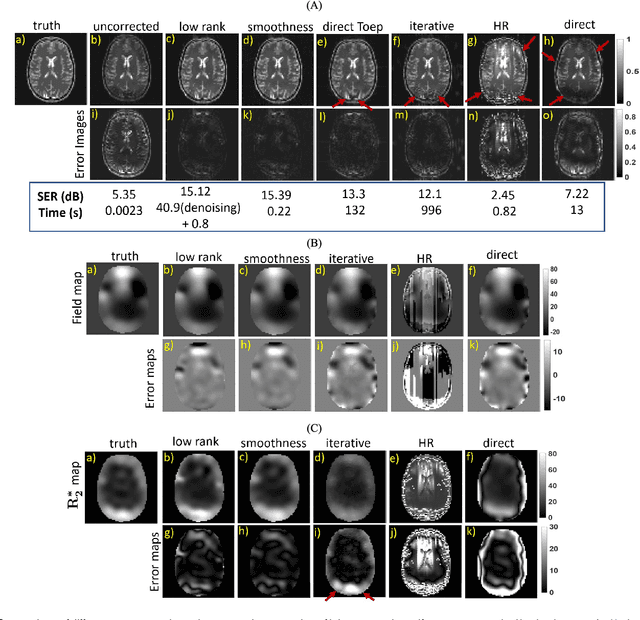
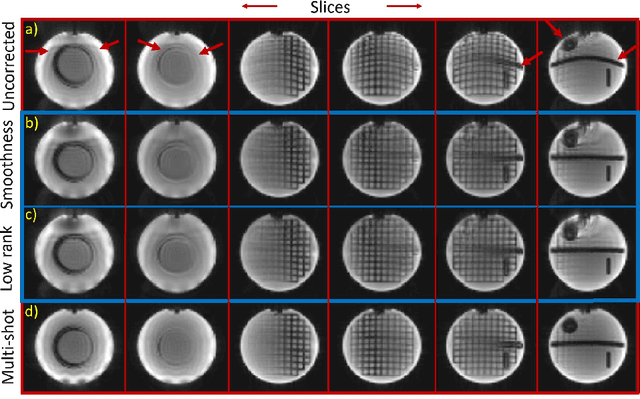
We introduce a structured low rank algorithm for the calibration-free compensation of field inhomogeneity artifacts in Echo Planar Imaging (EPI) MRI data. We acquire the data using two EPI readouts that differ in echo-time (TE). Using time segmentation, we reformulate the field inhomogeneity compensation problem as the recovery of an image time series from highly undersampled Fourier measurements. The temporal profile at each pixel is modeled as a single exponential, which is exploited to fill in the missing entries. We show that the exponential behavior at each pixel, along with the spatial smoothness of the exponential parameters, can be exploited to derive a 3D annihilation relation in the Fourier domain. This relation translates to a low rank property on a structured multi-fold Toeplitz matrix, whose entries correspond to the measured k-space samples. We introduce a fast two-step algorithm for the completion of the Toeplitz matrix from the available samples. In the first step, we estimate the null space vectors of the Toeplitz matrix using only its fully sampled rows. The null space is then used to estimate the signal subspace, which facilitates the efficient recovery of the time series of images. We finally demonstrate the proposed approach on spherical MR phantom data and human data and show that the artifacts are significantly reduced. The proposed approach could potentially be used to compensate for time varying field map variations in dynamic applications such as functional MRI.