 Add to Chrome
 Add to Firefox
 Add to Edge
CMHL: Contrastive Multi-Head Learning for Emotionally Consistent Text Classification
Mar 14, 2026
Textual Emotion Classification (TEC) is one of the most difficult NLP tasks. State of the art approaches rely on Large language models (LLMs) and multi-model ensembles. In this study, we challenge the assumption that larger scale or more complex models are necessary for improved performance. In order to improve logical consistency, We introduce CMHL, a novel single-model architecture that explicitly models the logical structure of emotions through three key innovations: (1) multi-task learning that jointly predicts primary emotions, valence, and intensity, (2) psychologically-grounded auxiliary supervision derived from Russell's circumplex model, and (3) a novel contrastive contradiction loss that enforces emotional consistency by penalizing mutually incompatible predictions (e.g., simultaneous high confidence in joy and anger). With just 125M parameters, our model outperforms 56x larger LLMs and sLM ensembles with a new state-of-the-art F1 score of 93.75\% compared to (86.13\%-93.2\%) on the dair-ai Emotion dataset. We further show cross domain generalization on the Reddit Suicide Watch and Mental Health Collection dataset (SWMH), outperforming domain-specific models like MentalBERT and MentalRoBERTa with an F1 score of 72.50\% compared to (68.16\%-72.16\%) + a 73.30\% recall compared to (67.05\%-70.89\%) that translates to enhanced sensitivity for detecting mental health distress. Our work establishes that architectural intelligence (not parameter count) drives progress in TEC. By embedding psychological priors and explicit consistency constraints, a well-designed single model can outperform both massive LLMs and complex ensembles, offering a efficient, interpretable, and clinically-relevant paradigm for affective computing.

Enhancing Mental Health Classification with Layer-Attentive Residuals and Contrastive Feature Learning
Mar 14, 2026The classification of mental health is challenging for a variety of reasons. For one, there is overlap between the mental health issues. In addition, the signs of mental health issues depend on the context of the situation, making classification difficult. Although fine-tuning transformers has improved the performance for mental health classification, standard cross-entropy training tends to create entangled feature spaces and fails to utilize all the information the transformers contain. We present a new framework that focuses on representations to improve mental health classification. This is done using two methods. First, \textbf{layer-attentive residual aggregation} which works on residual connections to to weigh and fuse representations from all transformer layers while maintaining high-level semantics. Second, \textbf{supervised contrastive feature learning} uses temperature-scaled supervised contrastive learning with progressive weighting to increase the geometric margin between confusable mental health problems and decrease class overlap by restructuring the feature space. With a score of \textbf{74.36\%}, the proposed method is the best performing on the SWMH benchmark and outperforms models that are domain-specialized, such as \textit{MentalBERT} and \textit{MentalRoBERTa} by margins of (3.25\% - 2.2\%) and 2.41 recall points over the highest achieving model. These findings show that domain-adaptive pretraining for mental health text classification can be surpassed by carefully designed representation geometry and layer-aware residual integration, which also provide enhanced interpretability through learnt layer importance.
Confidence-Credibility Aware Weighted Ensembles of Small LLMs Outperform Large LLMs in Emotion Detection
Dec 19, 2025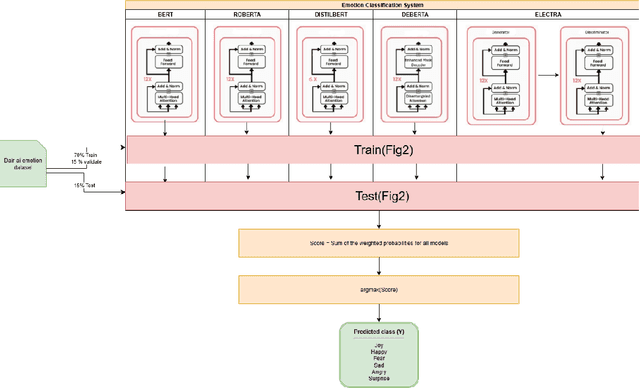
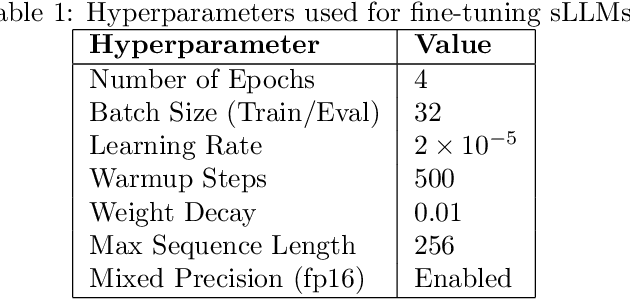
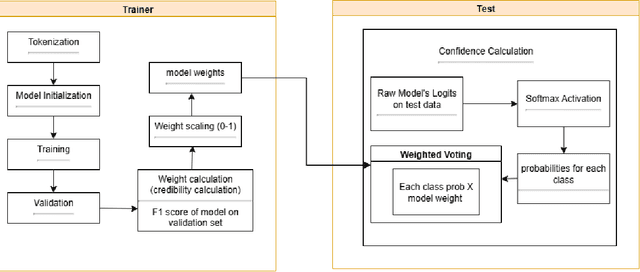
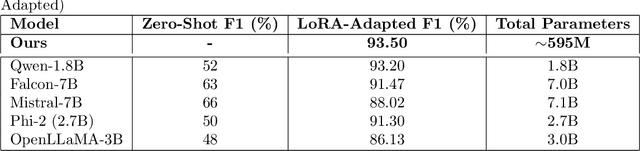
This paper introduces a confidence-weighted, credibility-aware ensemble framework for text-based emotion detection, inspired by Condorcet's Jury Theorem (CJT). Unlike conventional ensembles that often rely on homogeneous architectures, our approach combines architecturally diverse small transformer-based large language models (sLLMs) - BERT, RoBERTa, DistilBERT, DeBERTa, and ELECTRA, each fully fine-tuned for emotion classification. To preserve error diversity, we minimize parameter convergence while taking advantage of the unique biases of each model. A dual-weighted voting mechanism integrates both global credibility (validation F1 score) and local confidence (instance-level probability) to dynamically weight model contributions. Experiments on the DAIR-AI dataset demonstrate that our credibility-confidence ensemble achieves a macro F1 score of 93.5 percent, surpassing state-of-the-art benchmarks and significantly outperforming large-scale LLMs, including Falcon, Mistral, Qwen, and Phi, even after task-specific Low-Rank Adaptation (LoRA). With only 595M parameters in total, our small LLMs ensemble proves more parameter-efficient and robust than models up to 7B parameters, establishing that carefully designed ensembles of small, fine-tuned models can outperform much larger LLMs in specialized natural language processing (NLP) tasks such as emotion detection.