 Add to Chrome
 Add to Firefox
 Add to Edge
Bayesian Cramér-Rao Bound for Sensing Performance in Meta-Backscatter Systems
Apr 13, 2026
Meta-backscatter system that utilizes meta-material sensors is a promising enabler for future environmental sensing, offering distinct advantages such as low cost, zero-power consumption, and robustness. Specifically, the electromagnetic response of the sensor, typically characterized by a frequency-selective absorption profile, is affected by the environmental conditions, allowing the estimation of these conditions from the reflected signal. However, it remains unclear what estimation accuracy can be achieved fundamentally. Motivated by this gap, we quantify this accuracy limit using the Bayesian Cramér-Rao bound (BCRB), which provides a lower bound on the mean-squared error for the environmental condition. Establishing this limit is challenging because the electromagnetic response of the sensor is distorted by the channel fading, while the channel estimation is infeasible since the sensors cannot be configured to predefined states to generate training data. To address this challenge, we consider the joint BCRB of the channel coefficient and the environmental condition in a multicarrier framework. The BCRB of the environmental condition is then obtained by selecting the corresponding element from the joint BCRB. An analysis of the derived BCRB reveals the impact of the absorption peak shape and the number of subcarriers. The derivation and analysis of the BCRB are verified through simulations.

Hybrid Near-Field and Far-Field Localization with Multiple Holographic MIMO Surfaces
Feb 05, 2025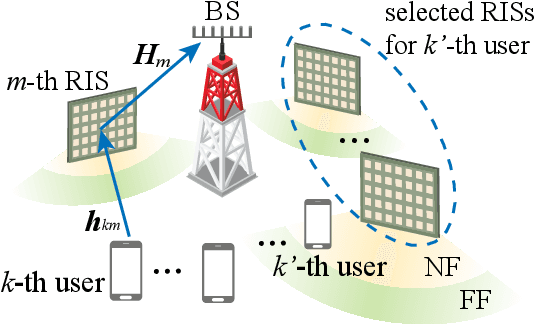
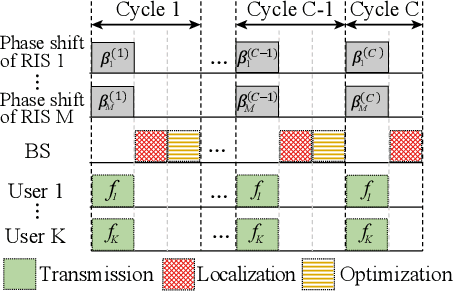
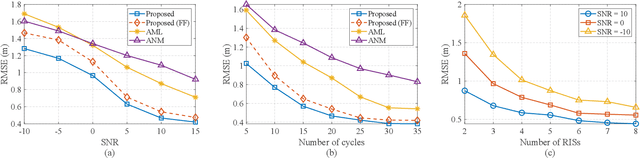
Localization methods based on holographic multiple input multiple output (HMIMO) have gained much attention for its potential to achieve high accuracy. By deploying multiple HMIMOs, we can improve the link quality and system coverage. As the scale of HMIMO increases to improve beam control capability, the near-field (NF) region of each HMIMO expands. However, existing multiple HMIMO-enabled methods mainly focus on the far-field (FF) of each HMIMO, which leads to low localization accuracy when applied in the NF. In this paper, a hybrid NF and FF localization method aided by multiple RISs, a low cost implementation of HMIMO, is proposed. In such a scenario, it is difficult to achieve user localization and RIS optimization since the equivalent NF of all RISs expands, which results in high complexity, and we need to handle the interference caused by multiple RISs. To tackle this challenge, we propose a two-phase RIS-enabled localization method that first estimate the relative locations of the user to each RIS and fuse the results to obtain the global estimation. In this way, the algorithm complexity is reduced. We formulate the RIS optimization problem to keep the RIS sidelobe as low as possible to minimize the interference. The effectiveness of the proposed method is verified through simulations.
Unified Near-field and Far-field Localization with Holographic MIMO
Jan 12, 2024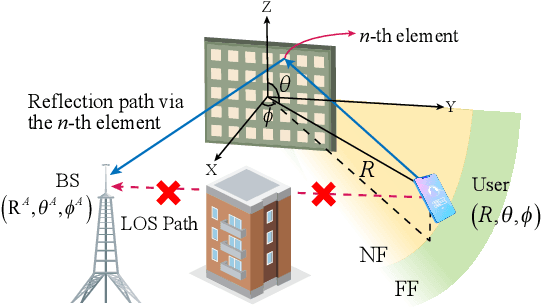
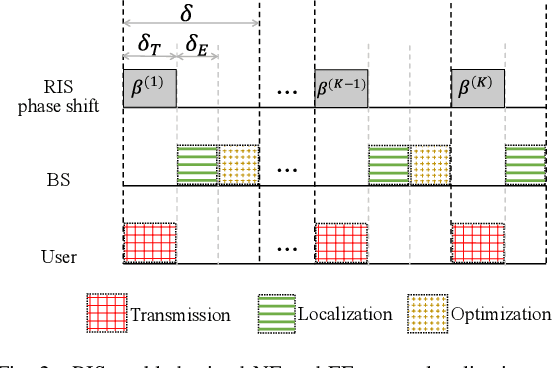

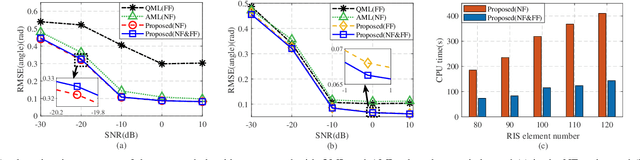
Localization which uses holographic multiple input multiple output surface such as reconfigurable intelligent surface (RIS) has gained increasing attention due to its ability to accurately localize users in non-line-of-sight conditions. However, existing RIS-enabled localization methods assume the users at either the near-field (NF) or the far-field (FF) region, which results in high complexity or low localization accuracy, respectively, when they are applied in the whole area. In this paper, a unified NF and FF localization method is proposed for the RIS-enabled localization system to overcome the above issue. Specifically, the NF and FF regions are both divided into grids. The RIS reflects the signals from the user to the base station~(BS), and then the BS uses the received signals to determine the grid where the user is located. Compared with existing NF- or FF-only schemes, the design of the location estimation method and the RIS phase shift optimization algorithm is more challenging because they are based on a hybrid NF and FF model. To tackle these challenges, we formulate the optimization problems for location estimation and RIS phase shifts, and design two algorithms to effectively solve the formulated problems, respectively. The effectiveness of the proposed method is verified through simulations.