 Add to Chrome
 Add to Firefox
 Add to Edge
An Information-theoretic Propagation Denoising and Fusion Framework for Fake News Detection
May 04, 2026
Incomplete propagation data significantly hinders robust fake news detection. Recent approaches leverage large language models to simulate missing user interactions via role-playing, thereby enriching propagation with synthetic signals. However, such propagation data is intrinsically unreliable, and directly fusing it can lead to biased representations, leading to limited detection performance. In this paper, we alleviate the unreliability of synthetic propagation from the mutual information perspective and propose a novel information-theoretic propagation denoising and fusion (InfoPDF) framework to learn effective representations from both real and synthetic propagation. Specifically, we first generate attribute-specific synthetic propagation using large language models. Then we model each synthetic propagation graph as a probabilistic latent distribution to guide reliability-aware adaptive fusion with real propagation. During training, we design a mutual information-based objective to learn compressed and task-sufficient propagation representations. It jointly suppresses noisy signals across attribute-specific synthetic propagation, maintains consistency between real and synthetic propagation representations, and ensures task sufficiency for fake news detection and attribute prediction. Experiments on three real-world datasets show that InfoPDF consistently achieves superior performance across various fake news detection tasks. Further analysis demonstrates that InfoPDF can estimate attribute-level reliabilities and learn more discriminative propagation representations.

Propagation Structure-Semantic Transfer Learning for Robust Fake News Detection
Apr 27, 2026Fake news generally refers to false information that is spread deliberately to deceive people, which has detrimental social effects. Existing fake news detection methods primarily learn the semantic features from news content or integrate structural features from propagation. However, in practical scenarios, due to the semantic ambiguity of informal language and unreliable user interactive behaviors on social media, there are inherent semantic and structural noises in news content and propagation. Although some recent works consider the effect of irrelevant user interactions in a hybrid-modeling way, they still suffer from the mutual interference between structural noise and semantic noise, leading to limited performance for robust detection. To alleviate this issue, this paper proposes a novel Propagation Structure-Semantic Transfer Learning framework (PSS-TL) for robust fake news detection under a teacher-student architecture. Specifically, we design dual teacher models to learn semantics knowledge and structure knowledge from noisy news content and propagation structure independently. Besides, we design a Multi-channel Knowledge Distillation (MKD) loss to enable the student model to acquire specialized knowledge from the teacher models, thereby avoiding mutual interference. Extensive experiments on two real-world datasets validate the effectiveness and robustness of our method.
Are Large Language Models Good Fact Checkers: A Preliminary Study
Nov 29, 2023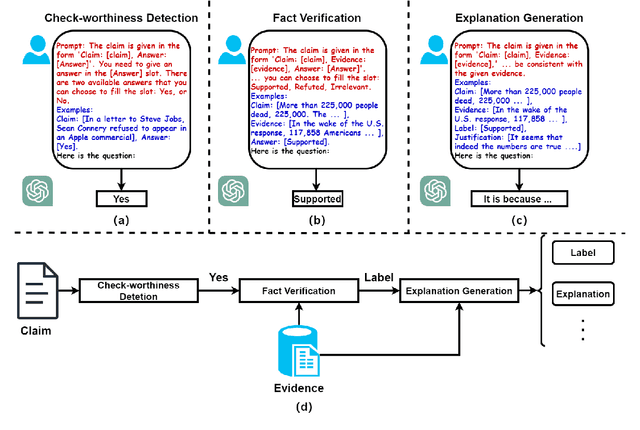
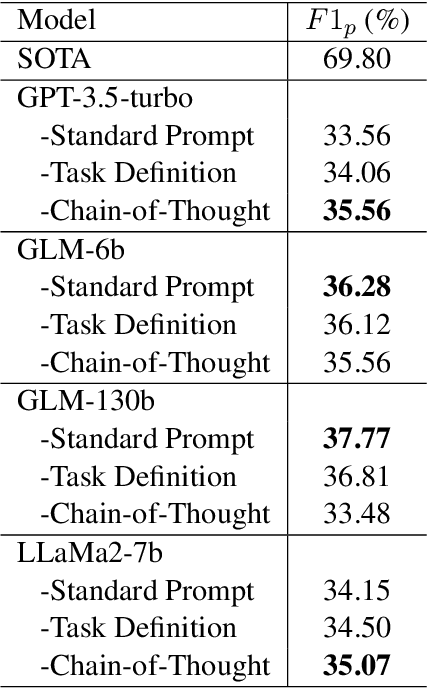
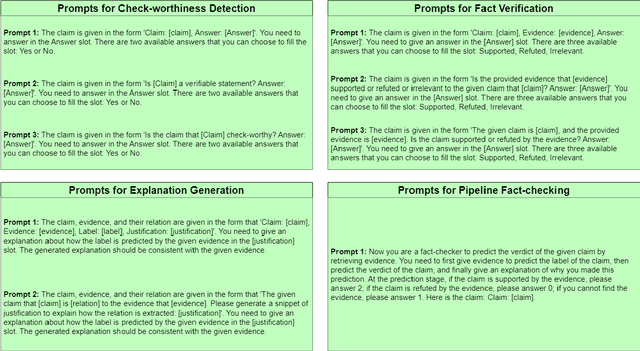
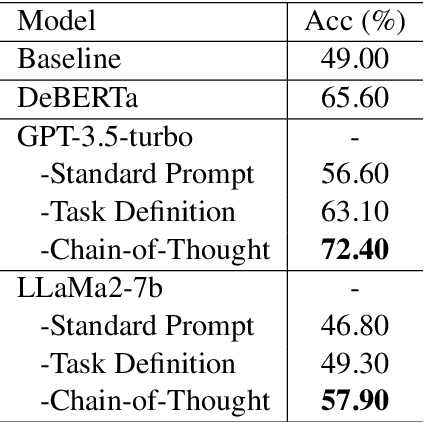
Recently, Large Language Models (LLMs) have drawn significant attention due to their outstanding reasoning capabilities and extensive knowledge repository, positioning them as superior in handling various natural language processing tasks compared to other language models. In this paper, we present a preliminary investigation into the potential of LLMs in fact-checking. This study aims to comprehensively evaluate various LLMs in tackling specific fact-checking subtasks, systematically evaluating their capabilities, and conducting a comparative analysis of their performance against pre-trained and state-of-the-art low-parameter models. Experiments demonstrate that LLMs achieve competitive performance compared to other small models in most scenarios. However, they encounter challenges in effectively handling Chinese fact verification and the entirety of the fact-checking pipeline due to language inconsistencies and hallucinations. These findings underscore the need for further exploration and research to enhance the proficiency of LLMs as reliable fact-checkers, unveiling the potential capability of LLMs and the possible challenges in fact-checking tasks.
Can Large Language Models Understand Content and Propagation for Misinformation Detection: An Empirical Study
Nov 21, 2023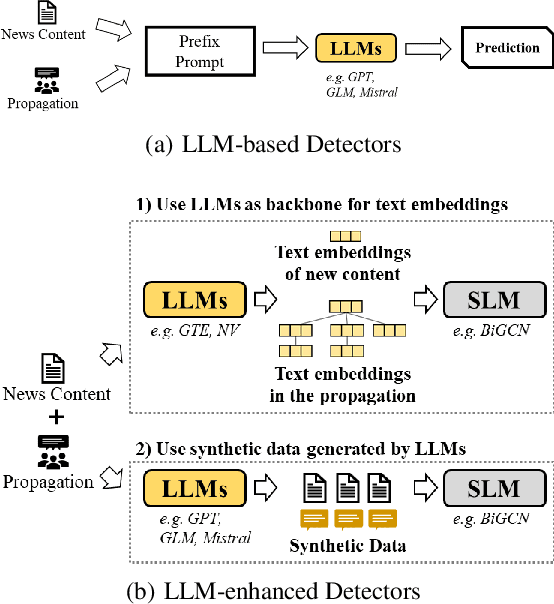
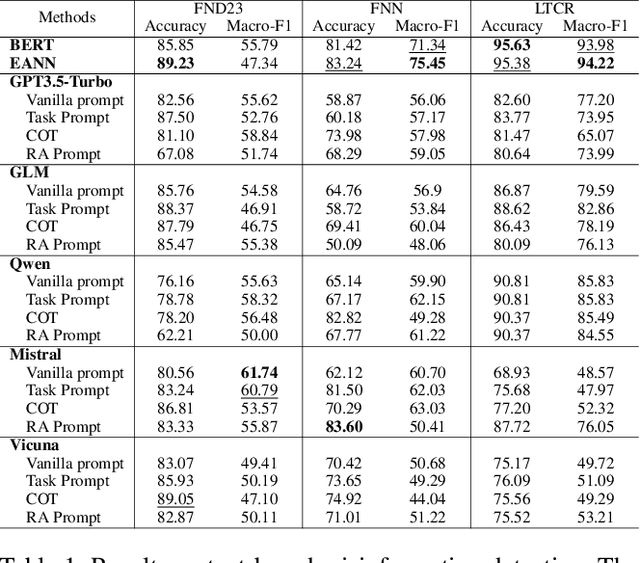
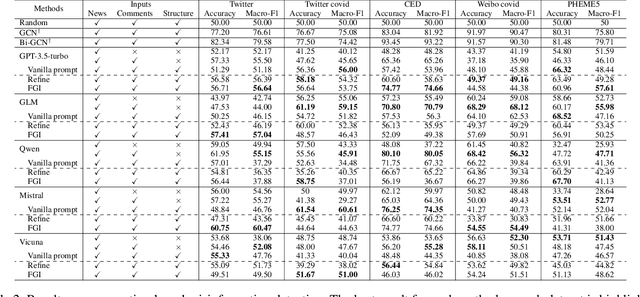
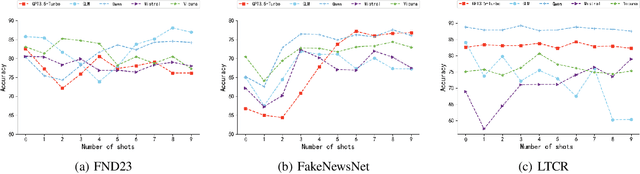
Large Language Models (LLMs) have garnered significant attention for their powerful ability in natural language understanding and reasoning. In this paper, we present a comprehensive empirical study to explore the performance of LLMs on misinformation detection tasks. This study stands as the pioneering investigation into the understanding capabilities of multiple LLMs regarding both content and propagation across social media platforms. Our empirical studies on five misinformation detection datasets show that LLMs with diverse prompts achieve comparable performance in text-based misinformation detection but exhibit notably constrained capabilities in comprehending propagation structure compared to existing models in propagation-based misinformation detection. Besides, we further design four instruction-tuned strategies to enhance LLMs for both content and propagation-based misinformation detection. These strategies boost LLMs to actively learn effective features from multiple instances or hard instances, and eliminate irrelevant propagation structures, thereby achieving better detection performance. Extensive experiments further demonstrate LLMs would play a better capacity in content and propagation structure under these proposed strategies and achieve promising detection performance. These findings highlight the potential ability of LLMs to detect misinformation.
A Self-Attention Joint Model for Spoken Language Understanding in Situational Dialog Applications
May 27, 2019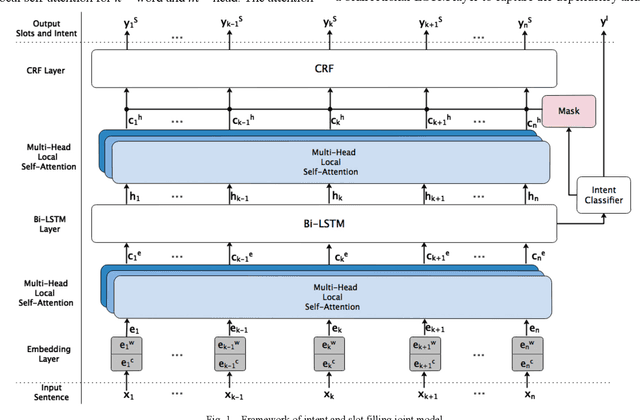
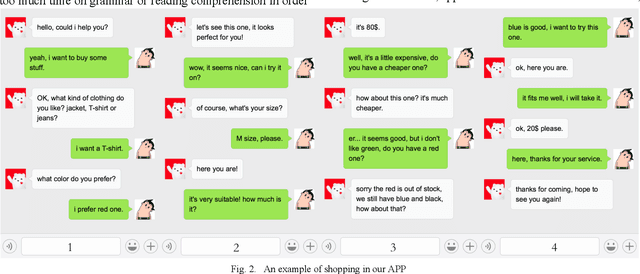
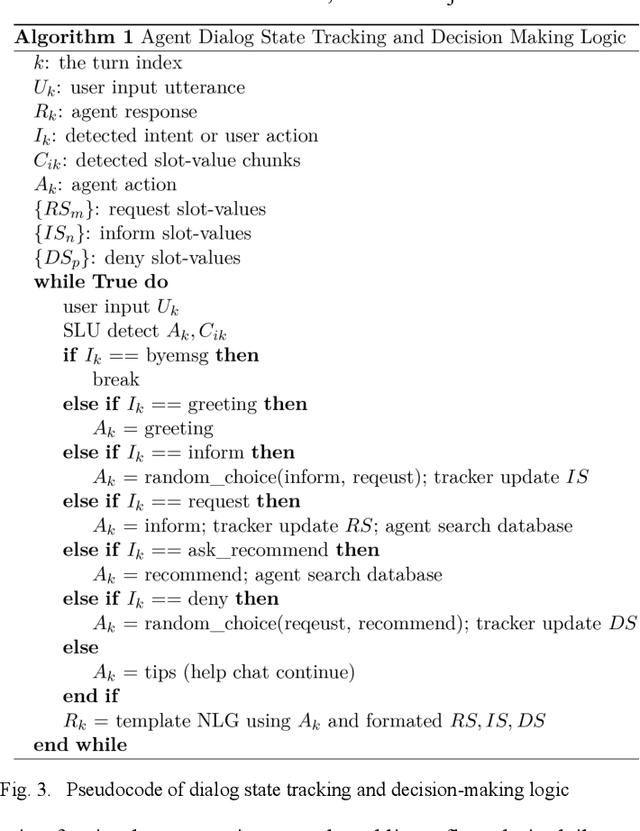
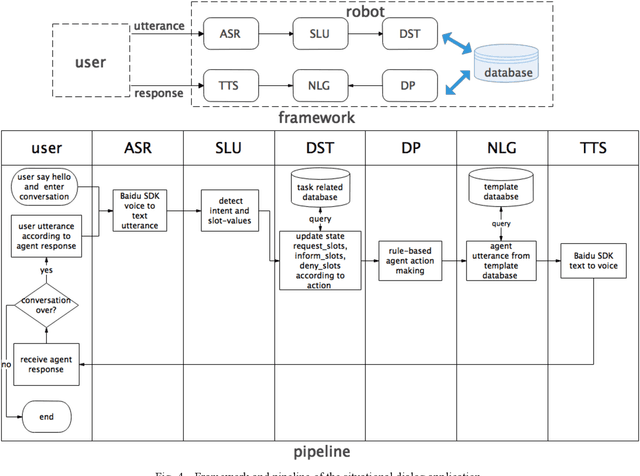
Spoken language understanding (SLU) acts as a critical component in goal-oriented dialog systems. It typically involves identifying the speakers intent and extracting semantic slots from user utterances, which are known as intent detection (ID) and slot filling (SF). SLU problem has been intensively investigated in recent years. However, these methods just constrain SF results grammatically, solve ID and SF independently, or do not fully utilize the mutual impact of the two tasks. This paper proposes a multi-head self-attention joint model with a conditional random field (CRF) layer and a prior mask. The experiments show the effectiveness of our model, as compared with state-of-the-art models. Meanwhile, online education in China has made great progress in the last few years. But there are few intelligent educational dialog applications for students to learn foreign languages. Hence, we design an intelligent dialog robot equipped with different scenario settings to help students learn communication skills.