 Add to Chrome
 Add to Firefox
 Add to Edge
Zero-Ablation Overstates Register Content Dependence in DINO Vision Transformers
Apr 15, 2026
Zero-ablation -- replacing token activations with zero vectors -- is widely used to probe token function in vision transformers. Register zeroing in DINOv2+registers and DINOv3 produces large drops (up to $-36.6$\,pp classification, $-30.9$\,pp segmentation), suggesting registers are functionally indispensable. However, three replacement controls -- mean-substitution, noise-substitution, and cross-image register-shuffling -- preserve performance across classification, correspondence, and segmentation, remaining within ${\sim}1$\,pp of the unmodified baseline. Per-patch cosine similarity shows these replacements genuinely perturb internal representations, while zeroing causes disproportionately large perturbations, consistent with why it alone degrades tasks. We conclude that zero-ablation overstates dependence on exact register content. In the frozen-feature evaluations we test, performance depends on plausible register-like activations rather than on exact image-specific values. Registers nevertheless buffer dense features from \texttt{[CLS]} dependence and are associated with compressed patch geometry. These findings, including the replacement-control results, replicate at ViT-B scale.

Grounding Intelligence in Movement
Jul 03, 2025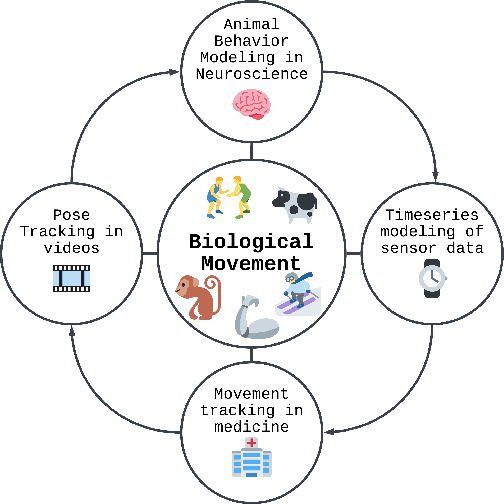
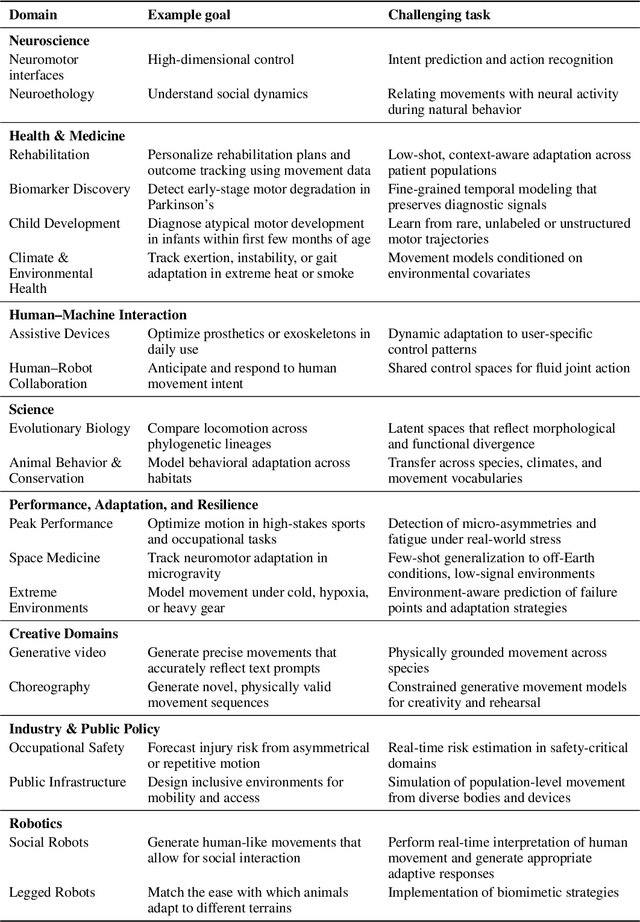
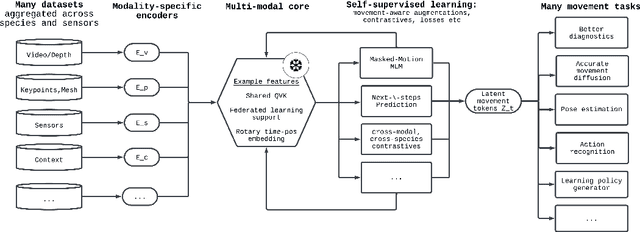
Recent advances in machine learning have dramatically improved our ability to model language, vision, and other high-dimensional data, yet they continue to struggle with one of the most fundamental aspects of biological systems: movement. Across neuroscience, medicine, robotics, and ethology, movement is essential for interpreting behavior, predicting intent, and enabling interaction. Despite its core significance in our intelligence, movement is often treated as an afterthought rather than as a rich and structured modality in its own right. This reflects a deeper fragmentation in how movement data is collected and modeled, often constrained by task-specific goals and domain-specific assumptions. But movement is not domain-bound. It reflects shared physical constraints, conserved morphological structures, and purposeful dynamics that cut across species and settings. We argue that movement should be treated as a primary modeling target for AI. It is inherently structured and grounded in embodiment and physics. This structure, often allowing for compact, lower-dimensional representations (e.g., pose), makes it more interpretable and computationally tractable to model than raw, high-dimensional sensory inputs. Developing models that can learn from and generalize across diverse movement data will not only advance core capabilities in generative modeling and control, but also create a shared foundation for understanding behavior across biological and artificial systems. Movement is not just an outcome, it is a window into how intelligent systems engage with the world.