 Add to Chrome
 Add to Firefox
 Add to Edge
Towards Federated Long-Tailed Graph Learning: An Energy-Guided Dual Decoupling Approach
Jun 23, 2026
Federated Graph Learning facilitates collaborative graph modeling across distributed clients while preserving data privacy. However, real-world data categories frequently exhibit long-tailed distributions. Such statistical scarcity severely degrades performance in two ways: it biases the global model toward majority classes, and it structurally isolates minority nodes by submerging them in heterophilic, head-dominated neighborhoods. While existing methods attempt topology-agnostic statistical compensations, they often fail under data scarcity. Instead of recovering tail nodes, they overfit the structural noise from adjacent dominant classes, leading to representation degradation. To address these limitations, we propose FedEPD, a framework built on a dual decoupling paradigm that separates topological purification from semantic recalibration. Specifically, FedEPD utilizes distribution-aware Dirichlet energy pruning to filter spatial heterophilic edges. It then overcomes Non-IID distribution shifts by extracting robust global prototypes from topologically central nodes, which are incorporated into local representations via a spatial low-pass prototype injection. Furthermore, a two stage alternating optimization strategy strictly protects majority decision boundaries while improving minority accuracy. Extensive experiments demonstrate that FedEPD achieves state-of-the-art performance across diverse long-tailed benchmarks, yielding absolute improvements of up to 4.97% in Accuracy and 5.48% in Macro-F1.

Medical Image Segmentation via Single-Source Domain Generalization with Random Amplitude Spectrum Synthesis
Sep 07, 2024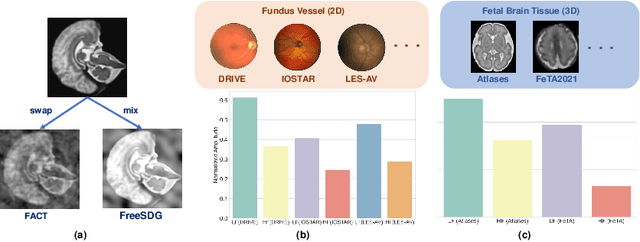
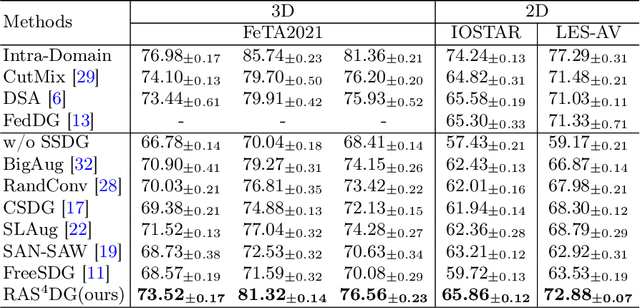
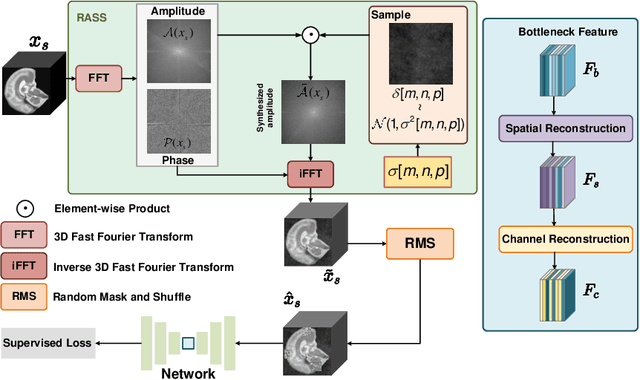
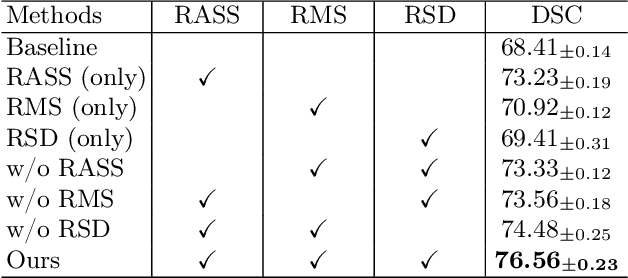
The field of medical image segmentation is challenged by domain generalization (DG) due to domain shifts in clinical datasets. The DG challenge is exacerbated by the scarcity of medical data and privacy concerns. Traditional single-source domain generalization (SSDG) methods primarily rely on stacking data augmentation techniques to minimize domain discrepancies. In this paper, we propose Random Amplitude Spectrum Synthesis (RASS) as a training augmentation for medical images. RASS enhances model generalization by simulating distribution changes from a frequency perspective. This strategy introduces variability by applying amplitude-dependent perturbations to ensure broad coverage of potential domain variations. Furthermore, we propose random mask shuffle and reconstruction components, which can enhance the ability of the backbone to process structural information and increase resilience intra- and cross-domain changes. The proposed Random Amplitude Spectrum Synthesis for Single-Source Domain Generalization (RAS^4DG) is validated on 3D fetal brain images and 2D fundus photography, and achieves an improved DG segmentation performance compared to other SSDG models.
MEEG and AT-DGNN: Advancing EEG Emotion Recognition with Music and Graph Learning
Jul 08, 2024Recent advances in neuroscience have elucidated the crucial role of coordinated brain region activities during cognitive tasks. To explore the complexity, we introduce the MEEG dataset, a comprehensive multi-modal music-induced electroencephalogram (EEG) dataset and the Attention-based Temporal Learner with Dynamic Graph Neural Network (AT-DGNN), a novel framework for EEG-based emotion recognition. The MEEG dataset captures a wide range of emotional responses to music, enabling an in-depth analysis of brainwave patterns in musical contexts. The AT-DGNN combines an attention-based temporal learner with a dynamic graph neural network (DGNN) to accurately model the local and global graph dynamics of EEG data across varying brain network topology. Our evaluations show that AT-DGNN achieves superior performance, with an accuracy (ACC) of 83.06\% in arousal and 85.31\% in valence, outperforming state-of-the-art (SOTA) methods on the MEEG dataset. Comparative analyses with traditional datasets like DEAP highlight the effectiveness of our approach and underscore the potential of music as a powerful medium for emotion induction. This study not only advances our understanding of the brain emotional processing, but also enhances the accuracy of emotion recognition technologies in brain-computer interfaces (BCI), leveraging both graph-based learning and the emotional impact of music. The source code and dataset are available at \textit{https://github.com/xmh1011/AT-DGNN}.