 Add to Chrome
 Add to Firefox
 Add to Edge
Beyond Task-Driven Features for Object Detection
Apr 04, 2026
Task-driven features learned by modern object detectors optimize end task loss yet often capture shortcut correlations that fail to reflect underlying annotation structure. Such representations limit transfer, interpretability, and robustness when task definitions change or supervision becomes sparse. This paper introduces an annotation-guided feature augmentation framework that injects embeddings into an object detection backbone. The method constructs dense spatial feature grids from annotation-guided latent spaces and fuses them with feature pyramid representations to influence region proposal and detection heads. Experiments across wildlife and remote sensing datasets evaluate classification, localization, and data efficiency under multiple supervision regimes. Results show consistent improvements in object focus, reduced background sensitivity, and stronger generalization to unseen or weakly supervised tasks. The findings demonstrate that aligning features with annotation geometry yields more meaningful representations than purely task optimized features.

Task-Guided Multi-Annotation Triplet Learning for Remote Sensing Representations
Apr 04, 2026Prior multi-task triplet loss methods relied on static weights to balance supervision between various types of annotation. However, static weighting requires tuning and does not account for how tasks interact when shaping a shared representation. To address this, the proposed task-guided multi-annotation triplet loss removes this dependency by selecting triplets through a mutual-information criteria that identifies triplets most informative across tasks. This strategy modifies which samples influence the representation rather than adjusting loss magnitudes. Experiments on an aerial wildlife dataset compare the proposed task-guided selection against several triplet loss setups for shaping a representation in an effective multi-task manner. The results show improved classification and regression performance and demonstrate that task-aware triplet selection produces a more effective shared representation for downstream tasks.
Multi-Task Learning with Multi-Annotation Triplet Loss for Improved Object Detection
Apr 10, 2025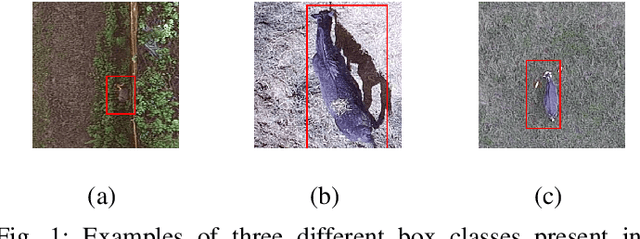
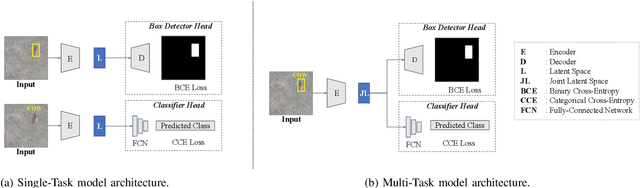
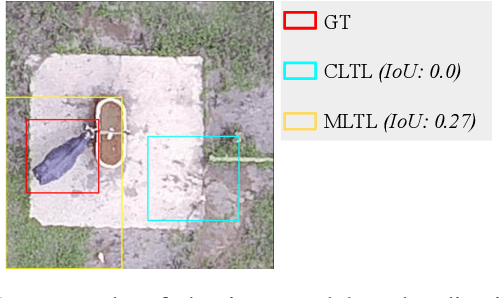
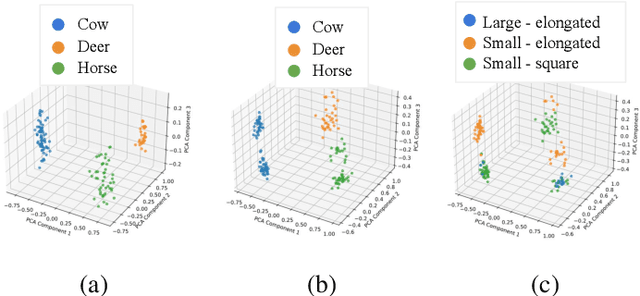
Triplet loss traditionally relies only on class labels and does not use all available information in multi-task scenarios where multiple types of annotations are available. This paper introduces a Multi-Annotation Triplet Loss (MATL) framework that extends triplet loss by incorporating additional annotations, such as bounding box information, alongside class labels in the loss formulation. By using these complementary annotations, MATL improves multi-task learning for tasks requiring both classification and localization. Experiments on an aerial wildlife imagery dataset demonstrate that MATL outperforms conventional triplet loss in both classification and localization. These findings highlight the benefit of using all available annotations for triplet loss in multi-task learning frameworks.