 Add to Chrome
 Add to Firefox
 Add to Edge
PCoA: A New Benchmark for Medical Aspect-Based Summarization With Phrase-Level Context Attribution
Jan 06, 2026
Verifying system-generated summaries remains challenging, as effective verification requires precise attribution to the source context, which is especially crucial in high-stakes medical domains. To address this challenge, we introduce PCoA, an expert-annotated benchmark for medical aspect-based summarization with phrase-level context attribution. PCoA aligns each aspect-based summary with its supporting contextual sentences and contributory phrases within them. We further propose a fine-grained, decoupled evaluation framework that independently assesses the quality of generated summaries, citations, and contributory phrases. Through extensive experiments, we validate the quality and consistency of the PCoA dataset and benchmark several large language models on the proposed task. Experimental results demonstrate that PCoA provides a reliable benchmark for evaluating system-generated summaries with phrase-level context attribution. Furthermore, comparative experiments show that explicitly identifying relevant sentences and contributory phrases before summarization can improve overall quality. The data and code are available at https://github.com/chubohao/PCoA.

Give Me the Facts! A Survey on Factual Knowledge Probing in Pre-trained Language Models
Oct 25, 2023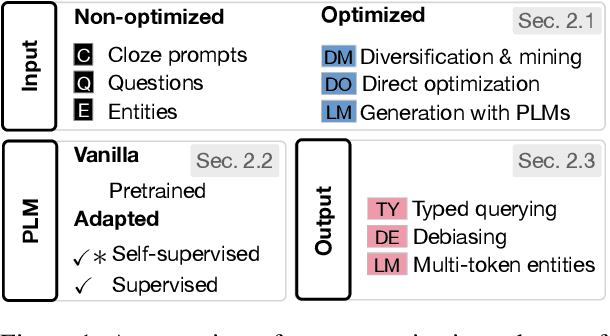
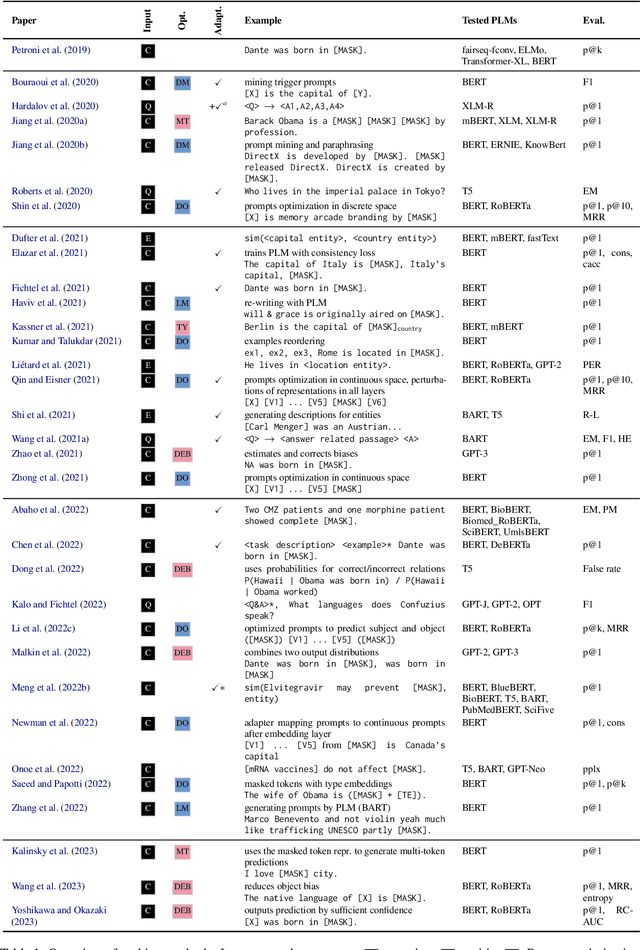
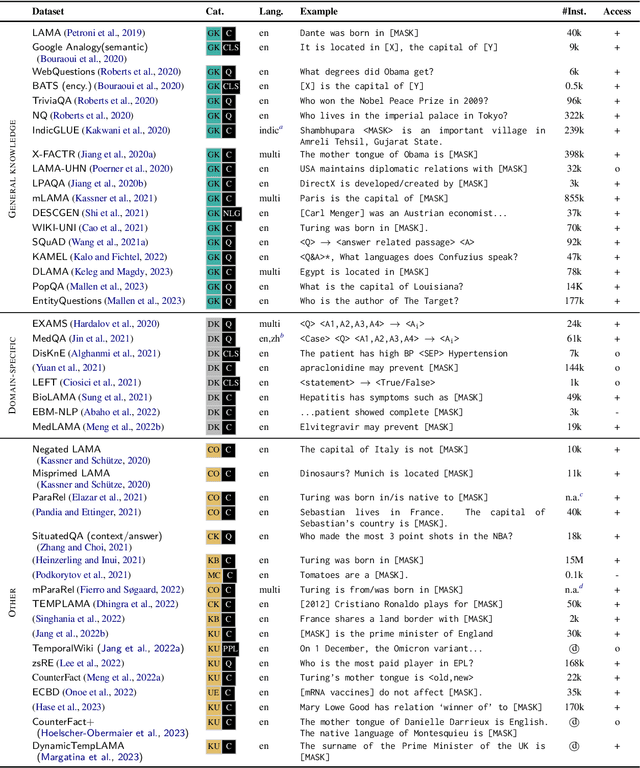
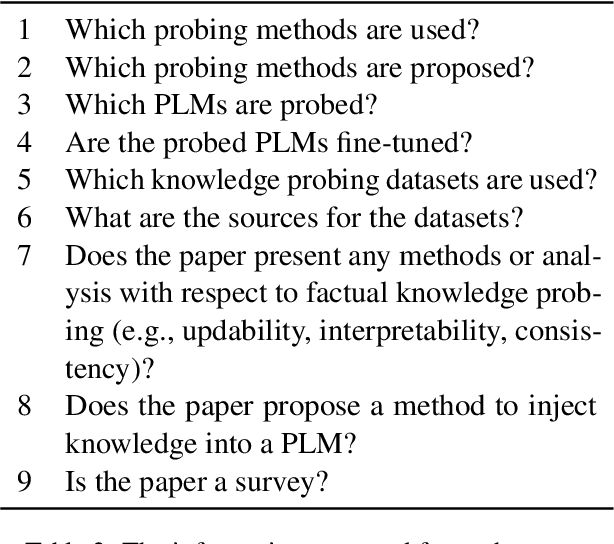
Pre-trained Language Models (PLMs) are trained on vast unlabeled data, rich in world knowledge. This fact has sparked the interest of the community in quantifying the amount of factual knowledge present in PLMs, as this explains their performance on downstream tasks, and potentially justifies their use as knowledge bases. In this work, we survey methods and datasets that are used to probe PLMs for factual knowledge. Our contributions are: (1) We propose a categorization scheme for factual probing methods that is based on how their inputs, outputs and the probed PLMs are adapted; (2) We provide an overview of the datasets used for factual probing; (3) We synthesize insights about knowledge retention and prompt optimization in PLMs, analyze obstacles to adopting PLMs as knowledge bases and outline directions for future work.