 Add to Chrome
 Add to Firefox
 Add to Edge
Intent-First Aerial V2V for Tactical Coordination and Separation: Protocol and Performance Under Density and Disturbance
May 20, 2026
Dense low-altitude aerial operations require more than pre-flight route coordination and last-resort collision avoidance. Once aircraft are airborne, disturbances can emerge on timescales shorter than strategic reauthorization can absorb, while collision avoidance is too late and disruptive to serve as routine traffic management. Although tactical separation is recognized as the intermediate layer, realizing it at scale requires a deployable neighborhood communication mechanism that provides fresh, trusted information for local coordination. This paper presents what is, to our knowledge, the first controller-coupled characterization of an all-airborne, sidelink-class, intent-first vehicle-to-vehicle (V2V) tactical neighborhood exchange stack for dense Unmanned Aircraft System Traffic Management (UTM) operations. Unlike awareness-only broadcast, the proposed exchange combines refreshed state and intent beacons for local awareness, cooperative perception, and degraded-mode assessment with event-triggered messages for yielding, sequencing, release, and contingency coordination. We implement and evaluate this model on an all-airborne V2V stack using sidelink-class C-V2X modules with authenticated freshness checks. Evaluation uses a scenario-driven, high-volume stress campaign supported by real-time, field-anchored infrastructure. Results show that V2V reduces stale-belief divergence, preserves observability through cooperative perception, rejects invalid tactical messages, suppresses false local inference, and structures shared-resource coordination. The implemented stack provides a viable communication layer for tactical separation in lower-to-moderate regimes, but transitions toward guarded fallback as density, impairment, and complexity increase. These findings position intent-first aerial V2V as a bounded enabler for scaling tactical coordination in disturbance-driven urban airspace.

Scalable Modular Synthetic Data Generation for Advancing Aerial Autonomy
Nov 10, 2022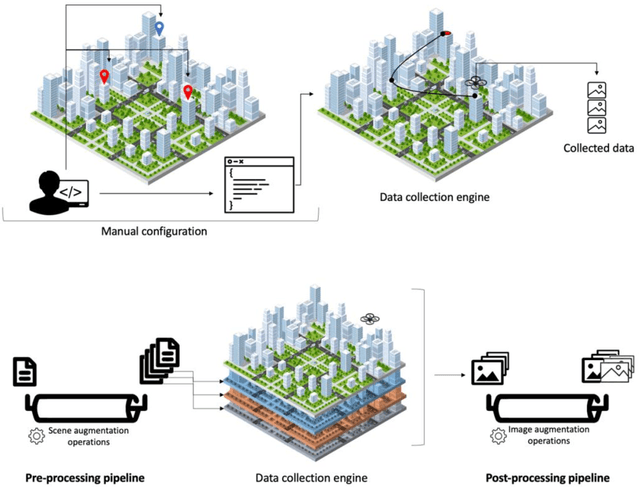
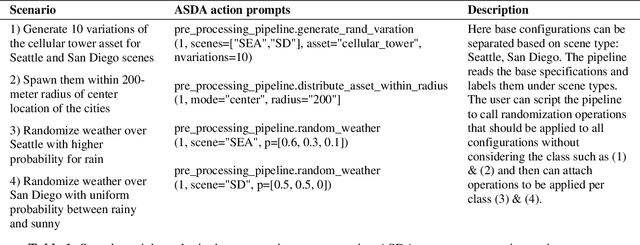
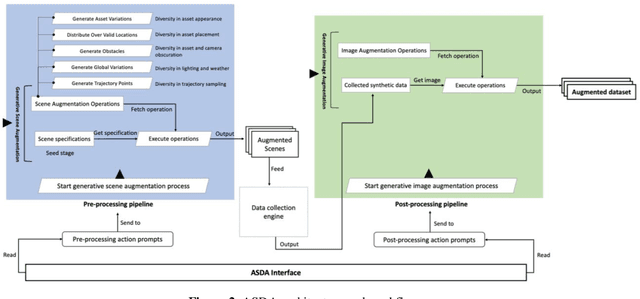
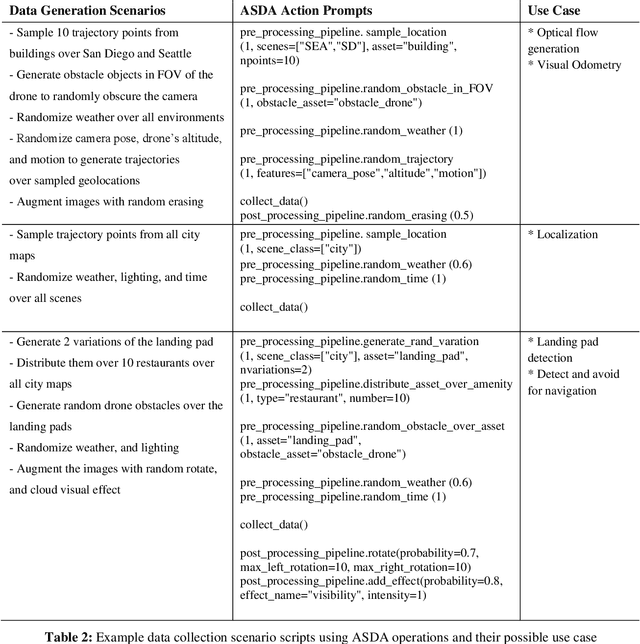
Harnessing the benefits of drones for urban innovation at scale requires reliable aerial autonomy. One major barrier to advancing aerial autonomy has been collecting large-scale aerial datasets for training machine learning models. Due to costly and time-consuming real-world data collection through deploying drones, there has been an increasing shift towards using synthetic data for training models in drone applications. However, to increase generalizability of trained policies on synthetic data, incorporating domain randomization into the data generation workflow for addressing the sim-to-real problem becomes crucial. Current synthetic data generation tools either lack domain randomization or rely heavily on manual workload or real samples for configuring and generating diverse realistic simulation scenes. These dependencies limit scalability of the data generation workflow. Accordingly, there is a major challenge in balancing generalizability and scalability in synthetic data generation. To address these gaps, we introduce a modular scalable data generation workflow tailored to aerial autonomy applications. To generate realistic configurations of simulation scenes while increasing diversity, we present an adaptive layered domain randomization approach that creates a type-agnostic distribution space for assets over the base map of the environments before pose generation for drone trajectory. We leverage high-level scene structures to automatically place assets in valid configurations and then extend the diversity through obstacle generation and global parameter randomization. We demonstrate the effectiveness of our method in automatically generating diverse configurations and datasets and show its potential for downstream performance optimization. Our work contributes to generating enhanced benchmark datasets for training models that can generalize better to real-world situations.