 Add to Chrome
 Add to Firefox
 Add to Edge
Models for minimalist RAG: B1ade 335M Embedding and 1B Parameter Small Language Models
Jul 29, 2026
Language and embedding models used in RAG systems are conventionally assumed to require large-scale pretraining and explicit grounding supervision. We present B1ade, an efficient RAG architecture comprising two purpose-built components: a compact embedding model and a purpose-built SLM. B1ade-embed, a 335M parameter retrieval model constructed via parameter-free fusion of five pretrained encoders achieves top MTEB scores among sub-500M models with zero additional training, and B1ade-1B, an SLM trained on low-cost GPUs using Group Relative Policy Optimization (GRPO) on 723M tokens (2.2M examples) of curated context-question pairs with rewards that optimize only answer similarity. Our central finding is emergent attribution: despite receiving no explicit supervision for source citation, B1ade-1B cites retrieved passages in 42.4% of responses, exceeding the attribution rate of its training distribution by 5.5 percentage points. This demonstrates that grounding behavior can emerge as an accuracy-maximizing strategy under RL training, without explicit reward engineering. On standard QA benchmarks, B1ade-1B achieves 81.82% on PopQA, 65.8% on PubMedQA, and 51.09% on FEVER. In end-to-end RAG evaluation, B1ade-1B achieves an average score of 0.654 across correctness, completeness, coherence, and faithfulness, a 10.8% improvement over the SFT, while closing the gap with models 1.5x its size. These results show that strategic model composition and reward design suffice for resource-efficient RAG, without large-scale pretraining.

Small Language Models (SLMs) Can Still Pack a Punch: A survey
Jan 03, 2025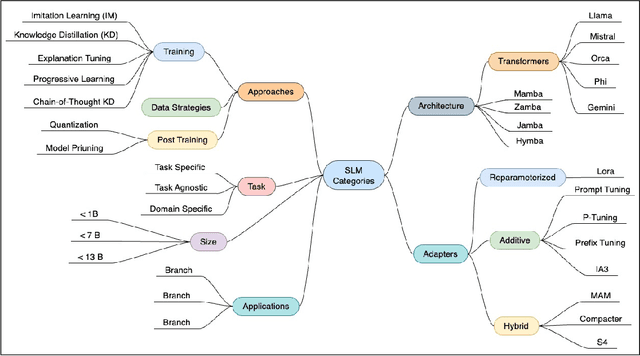
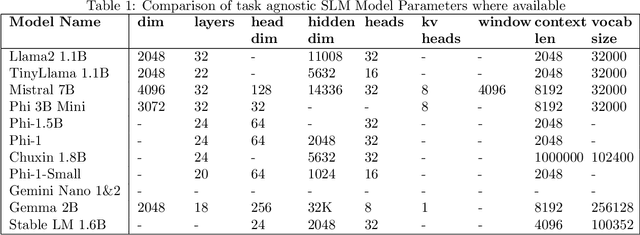
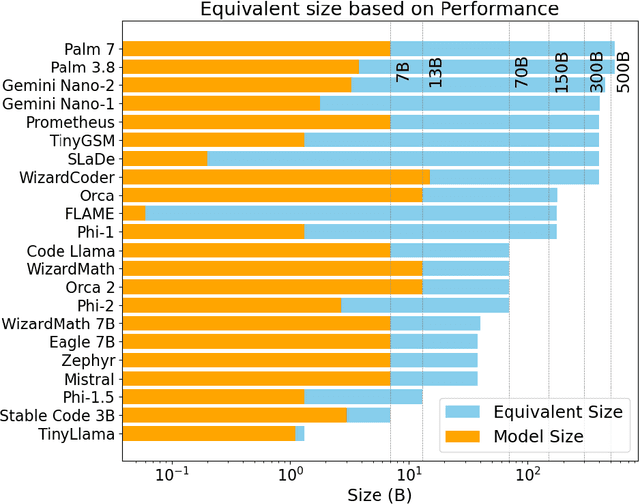
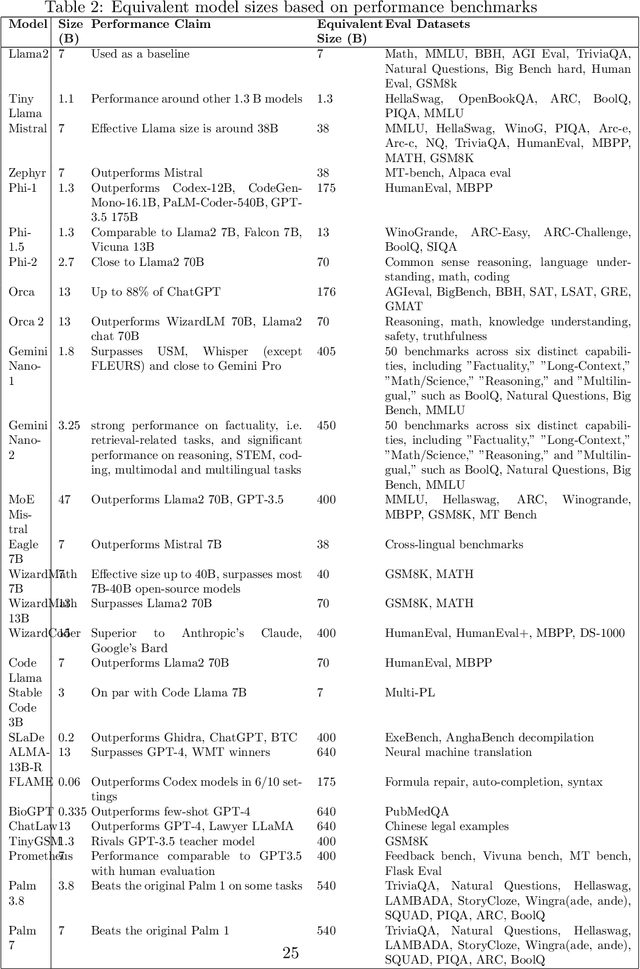
As foundation AI models continue to increase in size, an important question arises - is massive scale the only path forward? This survey of about 160 papers presents a family of Small Language Models (SLMs) in the 1 to 8 billion parameter range that demonstrate smaller models can perform as well, or even outperform large models. We explore task agnostic, general purpose SLMs, task-specific SLMs and techniques to create SLMs that can guide the community to build models while balancing performance, efficiency, scalability and cost. Furthermore we define and characterize SLMs' effective sizes, representing increased capability with respect to LLMs.