 Add to Chrome
 Add to Firefox
 Add to Edge
Aligning Dense Retrievers with LLM Utility via DistillationAligning Dense Retrievers with LLM Utility via Distillation
Apr 24, 2026
Dense vector retrieval is the practical backbone of Retrieval- Augmented Generation (RAG), but similarity search can suffer from precision limitations. Conversely, utility-based approaches leveraging LLM re-ranking often achieve superior performance but are computationally prohibitive and prone to noise inherent in perplexity estimation. We propose Utility-Aligned Embeddings (UAE), a framework designed to merge these advantages into a practical, high-performance retrieval method. We formulate retrieval as a distribution matching problem, training a bi-encoder to imitate a utility distribution derived from perplexity reduction using a Utility-Modulated InfoNCE objective. This approach injects graded utility signals directly into the embedding space without requiring test-time LLM inference. On the QASPER benchmark, UAE improves retrieval Recall@1 by 30.59%, MAP by 30.16% and Token F1 by 17.3% over the strong semantic baseline BGE-Base. Crucially, UAE is over 180x faster than the efficient LLM re-ranking methods preserving competitive performance, demonstrating that aligning retrieval with generative utility yields reliable contexts at scale.

Leveraging Smartphone Sensors for Detecting Abnormal Gait for Smart Wearable Mobile Technologies
Aug 03, 2022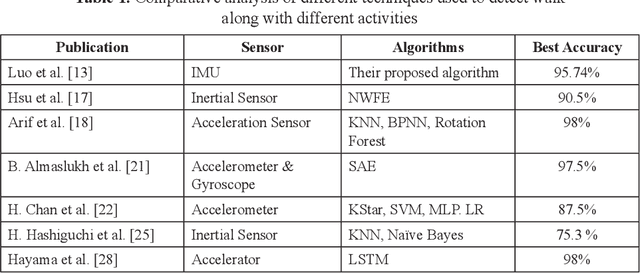
Walking is one of the most common modes of terrestrial locomotion for humans. Walking is essential for humans to perform most kinds of daily activities. When a person walks, there is a pattern in it, and it is known as gait. Gait analysis is used in sports and healthcare. We can analyze this gait in different ways, like using video captured by the surveillance cameras or depth image cameras in the lab environment. It also can be recognized by wearable sensors. e.g., accelerometer, force sensors, gyroscope, flexible goniometer, magneto resistive sensors, electromagnetic tracking system, force sensors, and electromyography (EMG). Analysis through these sensors required a lab condition, or users must wear these sensors. For detecting abnormality in gait action of a human, we need to incorporate the sensors separately. We can know about one's health condition by abnormal human gait after detecting it. Understanding a regular gait vs. abnormal gait may give insights to the health condition of the subject using the smart wearable technologies. Therefore, in this paper, we proposed a way to analyze abnormal human gait through smartphone sensors. Though smart devices like smartphones and smartwatches are used by most of the person nowadays. So, we can track down their gait using sensors of these intelligent wearable devices.