 Add to Chrome
 Add to Firefox
 Add to Edge
Expanding the extreme-k dielectric materials space through physics-validated generative reasoning
Apr 22, 2026
The most technologically consequential materials are often the rarest: they occupy narrow regions of chemical space, obey competing physical constraints, and appear only sparsely in existing databases. High-kappa dielectrics, high-Tc superconductors, and ferromagnetic insulators are to name a few. This scarcity fundamentally limits today's data-driven materials discovery, where machine-learning models excel at interpolation but struggle to generate genuinely new candidates. Here, we introduce DielecMIND, an artificial intelligence framework that reframes materials discovery as a reasoning-driven exploration instead of a database-screening problem. Using high-kappa dielectrics as a data-scarce and technologically stringent test case, DielecMIND combines large-language-model hypothesis generation for the first time with physics validated first-principles calculation to navigate chemical space beyond known compounds. Prior to our work, only 14 experimentally or computationally validated materials with kappa > 150 were known. Our framework discovers and validates 5 new such compounds, expanding this rare-materials class by a remarkable = 35% in a single study. Among them, we find that Ba2TiHfO6 exhibits a dielectric constant of 637, minimal loss at low optical frequencies, and stability up to 800 K. Beyond dielectrics, this work demonstrates a new paradigm for artificial-intelligence-guided discovery: one that generates a small number of physically grounded, experimentally plausible candidates yet measurably expands sparsely populated functional materials spaces. Thus, DielecMIND points toward a general strategy for discovering rare, high-impact functional materials where data scarcity has long constrained progress.

Generative Discovery of Magnetic Insulators under Competing Physical Constraints
Apr 22, 2026Discovering materials that must simultaneously satisfy multiple competing constraints remains a central challenge in computational materials design, particularly in data-scarce regimes where conventional data-driven approaches are least effective. Magnetic insulators represent a stringent example: the electronic conditions that favor magnetic order often also promote metallicity, while insulating behavior suppresses the interactions that stabilize magnetism. As a result, experimentally viable magnetic insulators are rare and difficult to identify through conventional screening. Here, we introduce MagMatLLM, a constraint-guided generative discovery framework that integrates language-model-based crystal generation with evolutionary selection, surrogate screening, and first-principles validation to target simultaneous stability, magnetism, and insulating behavior. Unlike stability-first approaches, the framework enforces functional constraints during generation and selection, steering the search toward sparsely populated regions of materials space defined by competing physical requirements. Using this workflow, we identify twelve previously unreported candidate magnetic insulators, including Tm$_4$Co$_2$Cr$_2$O$_{12}$ and Cr$_4$Nb$_2$O$_{12}$. Of these, ten are dynamically stable by phonon analysis and exhibit finite band gaps and nonzero magnetic moments in spin-polarized density functional theory calculations. Beyond the specific compounds identified here, this work establishes a general constraint-guided paradigm for multi-objective materials discovery in sparse chemical spaces and provides a transferable strategy for the design of quantum materials under competing physical constraints.
Topological, or Non-topological? A Deep Learning Based Prediction
Oct 29, 2023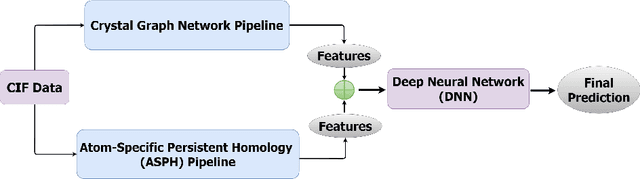
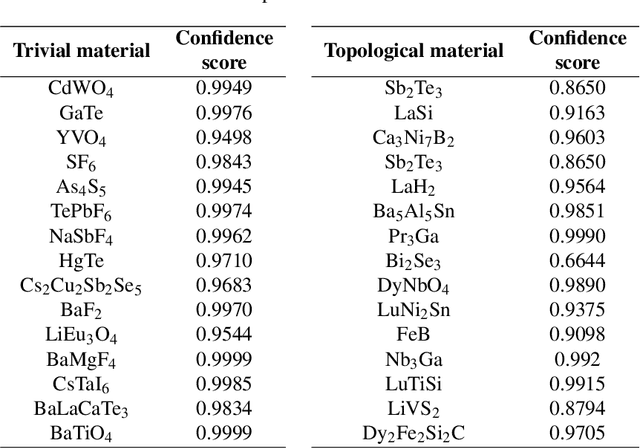
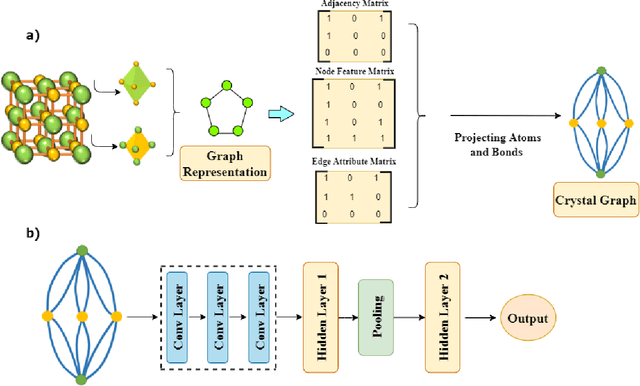
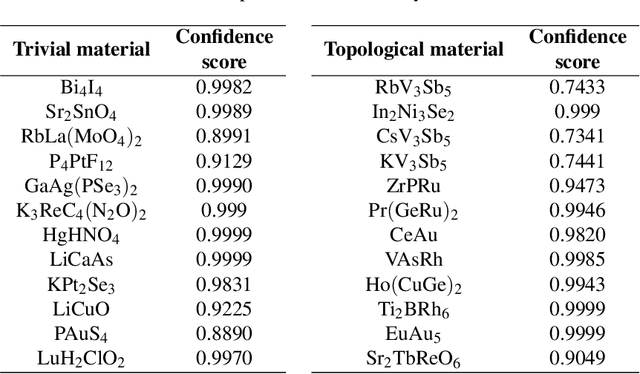
Prediction and discovery of new materials with desired properties are at the forefront of quantum science and technology research. A major bottleneck in this field is the computational resources and time complexity related to finding new materials from ab initio calculations. In this work, an effective and robust deep learning-based model is proposed by incorporating persistent homology and graph neural network which offers an accuracy of 91.4% and an F1 score of 88.5% in classifying topological vs. non-topological materials, outperforming the other state-of-the-art classifier models. The incorporation of the graph neural network encodes the underlying relation between the atoms into the model based on their own crystalline structures and thus proved to be an effective method to represent and process non-euclidean data like molecules with a relatively shallow network. The persistent homology pipeline in the suggested neural network is capable of integrating the atom-specific topological information into the deep learning model, increasing robustness, and gain in performance. It is believed that the presented work will be an efficacious tool for predicting the topological class and therefore enable the high-throughput search for novel materials in this field.
A Deep Dive into the Design Space of a Dynamically Reconfigurable Cryogenic Spiking Neuron
Aug 30, 2023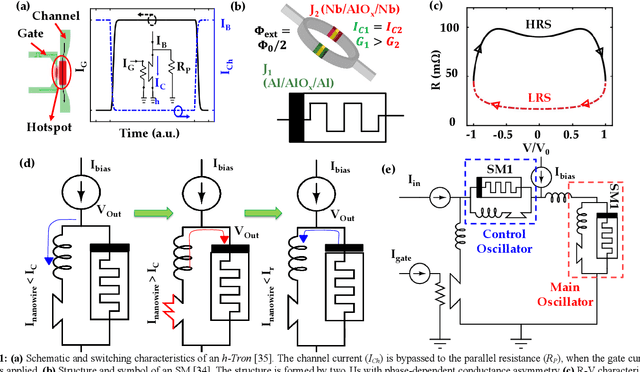
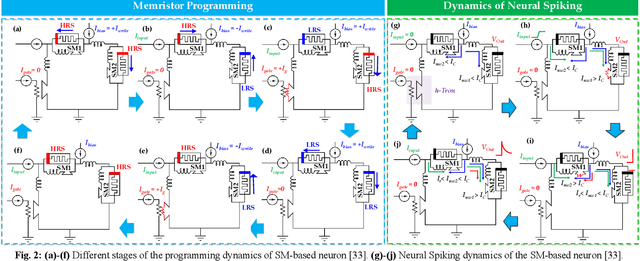
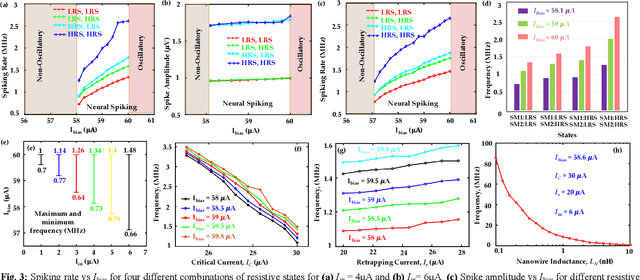
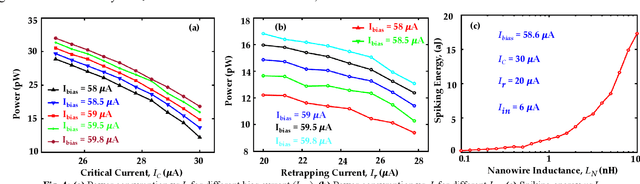
Spiking neural network offers the most bio-realistic approach to mimic the parallelism and compactness of the human brain. A spiking neuron is the central component of an SNN which generates information-encoded spikes. We present a comprehensive design space analysis of the superconducting memristor (SM)-based electrically reconfigurable cryogenic neuron. A superconducting nanowire (SNW) connected in parallel with an SM function as a dual-frequency oscillator and two of these oscillators can be coupled to design a dynamically tunable spiking neuron. The same neuron topology was previously proposed where a fixed resistance was used in parallel with the SNW. Replacing the fixed resistance with the SM provides an additional tuning knob with four distinct combinations of SM resistances, which improves the reconfigurability by up to ~70%. Utilizing an external bias current (Ibias), the spike frequency can be modulated up to ~3.5 times. Two distinct spike amplitudes (~1V and ~1.8 V) are also achieved. Here, we perform a systematic sensitivity analysis and show that the reconfigurability can be further tuned by choosing a higher input current strength. By performing a 500-point Monte Carlo variation analysis, we find that the spike amplitude is more variation robust than spike frequency and the variation robustness can be further improved by choosing a higher Ibias. Our study provides valuable insights for further exploration of materials and circuit level modification of the neuron that will be useful for system-level incorporation of the neuron circuit
Cryogenic Neuromorphic Hardware
Mar 25, 2022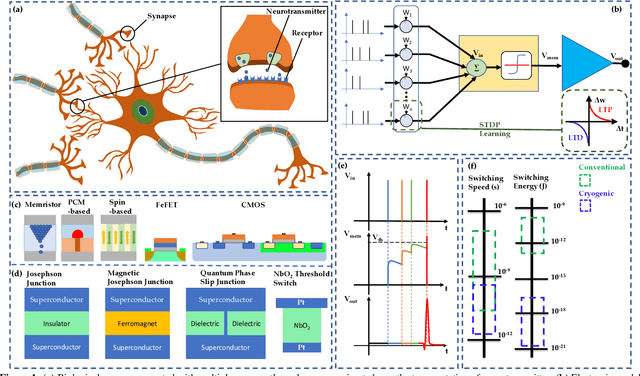
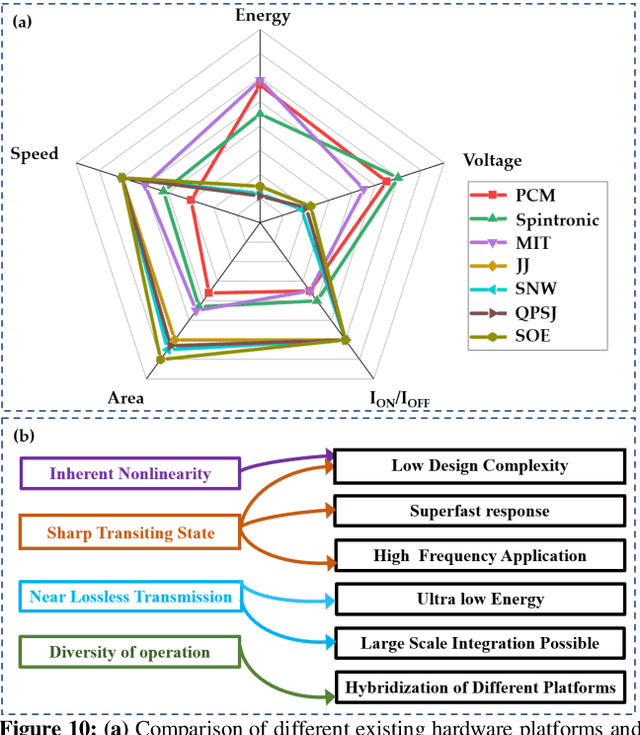
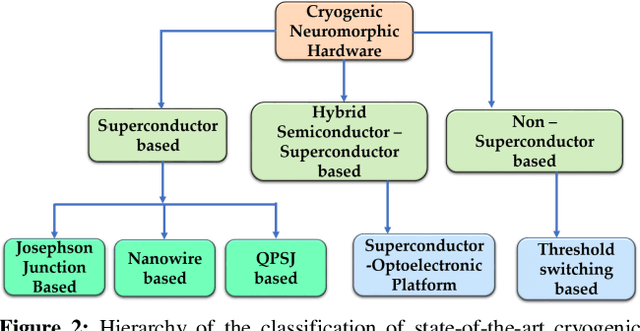
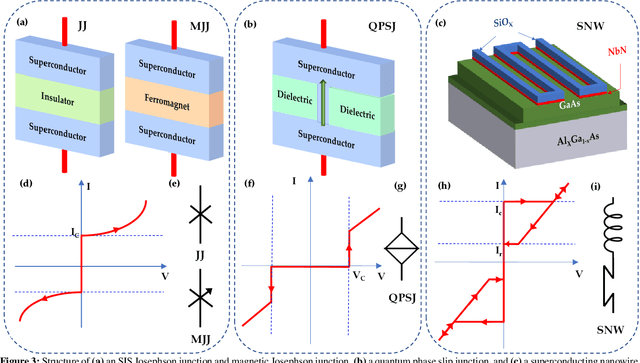
The revolution in artificial intelligence (AI) brings up an enormous storage and data processing requirement. Large power consumption and hardware overhead have become the main challenges for building next-generation AI hardware. Therefore, it is imperative to look for a new architecture capable of circumventing these bottlenecks of conventional von Neumann architecture. Since the human brain is the most compact and energy-efficient intelligent device known, it was intuitive to attempt to build an architecture that could mimic our brain, and so the chase for neuromorphic computing began. While relentless research has been underway for years to minimize the power consumption in neuromorphic hardware, we are still a long way off from reaching the energy efficiency of the human brain. Besides, design complexity, process variation, etc. hinder the large-scale implementation of current neuromorphic platforms. Recently, the concept of implementing neuromorphic computing systems in cryogenic temperature has garnered immense attention. Several cryogenic devices can be engineered to work as neuromorphic primitives with ultra-low demand for power. Cryogenic electronics has therefore become a promising exploratory platform for an energy-efficient and bio-realistic neuromorphic system. Here we provide a comprehensive overview of the reported cryogenic neuromorphic hardware. We carefully classify the existing cryogenic neuromorphic hardware into different categories and draw a comparative analysis based on several performance metrics. Finally, we explore the future research prospects to circumvent the challenges associated with the current technologies.