 Add to Chrome
 Add to Firefox
 Add to Edge
DANCE: Dynamic 3D CNN Pruning: Joint Frame, Channel, and Feature Adaptation for Energy Efficiency on the Edge
Mar 18, 2026
Modern convolutional neural networks (CNNs) are workhorses for video and image processing, but fail to adapt to the computational complexity of input samples in a dynamic manner to minimize energy consumption. In this research, we propose DANCE, a fine-grained, input-aware, dynamic pruning framework for 3D CNNs to maximize power efficiency with negligible to zero impact on performance. In the proposed two-step approach, the first step is called activation variability amplification (AVA), and the 3D CNN model is retrained to increase the variance of the magnitude of neuron activations across the network in this step, facilitating pruning decisions across diverse CNN input scenarios. In the second step, called adaptive activation pruning (AAP), a lightweight activation controller network is trained to dynamically prune frames, channels, and features of 3D convolutional layers of the network (different for each layer), based on statistics of the outputs of the first layer of the network. Our method achieves substantial savings in multiply-accumulate (MAC) operations and memory accesses by introducing sparsity within convolutional layers. Hardware validation on the NVIDIA Jetson Nano GPU and the Qualcomm Snapdragon 8 Gen 1 platform demonstrates respective speedups of 1.37X and 2.22X, achieving up to 1.47X higher energy efficiency compared to the state of the art.

Topological, or Non-topological? A Deep Learning Based Prediction
Oct 29, 2023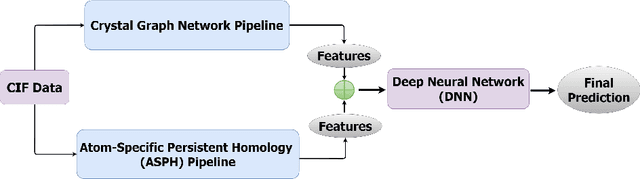
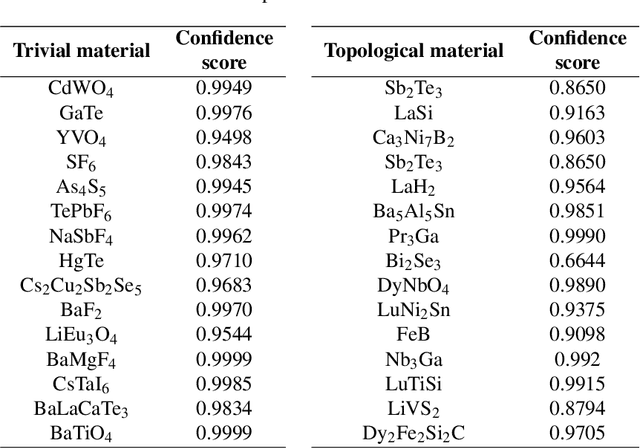
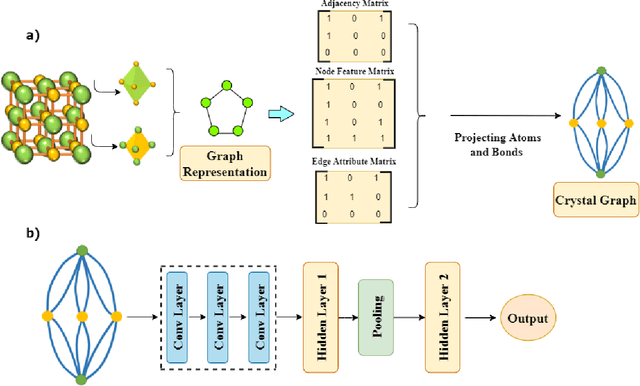
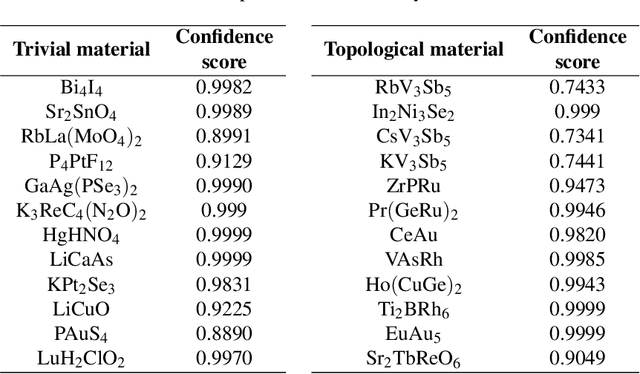
Prediction and discovery of new materials with desired properties are at the forefront of quantum science and technology research. A major bottleneck in this field is the computational resources and time complexity related to finding new materials from ab initio calculations. In this work, an effective and robust deep learning-based model is proposed by incorporating persistent homology and graph neural network which offers an accuracy of 91.4% and an F1 score of 88.5% in classifying topological vs. non-topological materials, outperforming the other state-of-the-art classifier models. The incorporation of the graph neural network encodes the underlying relation between the atoms into the model based on their own crystalline structures and thus proved to be an effective method to represent and process non-euclidean data like molecules with a relatively shallow network. The persistent homology pipeline in the suggested neural network is capable of integrating the atom-specific topological information into the deep learning model, increasing robustness, and gain in performance. It is believed that the presented work will be an efficacious tool for predicting the topological class and therefore enable the high-throughput search for novel materials in this field.