 Add to Chrome
 Add to Firefox
 Add to Edge
MambaLiteUNet: Cross-Gated Adaptive Feature Fusion for Robust Skin Lesion Segmentation
Apr 22, 2026
Recent segmentation models have demonstrated promising efficiency by aggressively reducing parameter counts and computational complexity. However, these models often struggle to accurately delineate fine lesion boundaries and texture patterns essential for early skin cancer diagnosis and treatment planning. In this paper, we propose MambaLiteUNet, a compact yet robust segmentation framework that integrates Mamba state space modeling into a U-Net architecture, along with three key modules: Adaptive Multi-Branch Mamba Feature Fusion (AMF), Local-Global Feature Mixing (LGFM), and Cross-Gated Attention (CGA). These modules are designed to enhance local-global feature interaction, preserve spatial details, and improve the quality of skip connections. MambaLiteUNet achieves an average IoU of 87.12% and average Dice score of 93.09% across ISIC2017, ISIC2018, HAM10000, and PH2 benchmarks, outperforming state-of-the-art models. Compared to U-Net, our model improves average IoU and Dice by 7.72 and 4.61 points, respectively, while reducing parameters by 93.6% and GFLOPs by 97.6%. Additionally, in domain generalization with six unseen lesion categories, MambaLiteUNet achieves 77.61% IoU and 87.23% Dice, performing best among all evaluated models. Our extensive experiments demonstrate that MambaLiteUNet achieves a strong balance between accuracy and efficiency, making it a competitive and practical solution for dermatological image segmentation. Our code is publicly available at: https://github.com/maklachur/MambaLiteUNet.

Mamba in Vision: A Comprehensive Survey of Techniques and Applications
Oct 04, 2024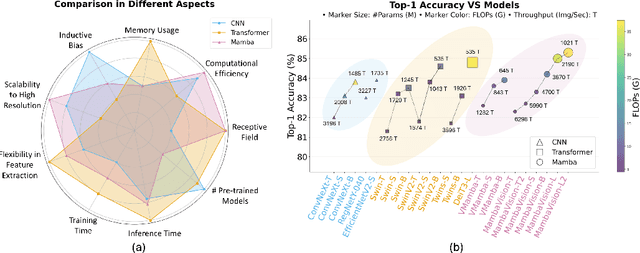
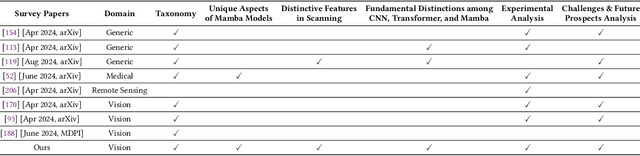
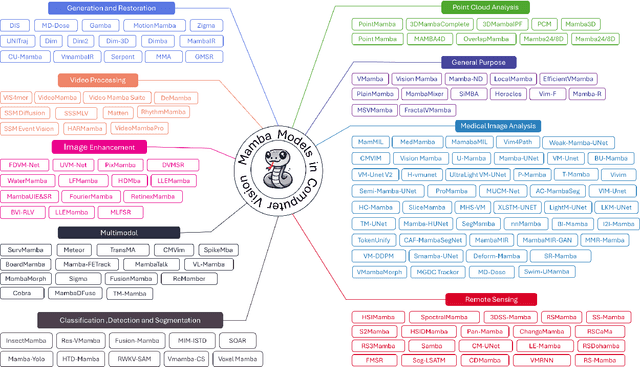
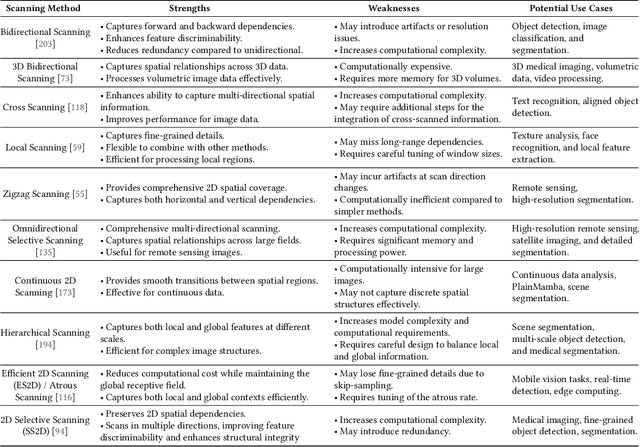
Mamba is emerging as a novel approach to overcome the challenges faced by Convolutional Neural Networks (CNNs) and Vision Transformers (ViTs) in computer vision. While CNNs excel at extracting local features, they often struggle to capture long-range dependencies without complex architectural modifications. In contrast, ViTs effectively model global relationships but suffer from high computational costs due to the quadratic complexity of their self-attention mechanisms. Mamba addresses these limitations by leveraging Selective Structured State Space Models to effectively capture long-range dependencies with linear computational complexity. This survey analyzes the unique contributions, computational benefits, and applications of Mamba models while also identifying challenges and potential future research directions. We provide a foundational resource for advancing the understanding and growth of Mamba models in computer vision. An overview of this work is available at https://github.com/maklachur/Mamba-in-Computer-Vision.