 Add to Chrome
 Add to Firefox
 Add to Edge
Does Latent Context Help? A Controlled Evaluation of Inverse Reinforcement Learning in Arctic Shipping
Aug 06, 2026
Artificial Intelligence (AI)-assisted navigation can help Arctic shipping adapt to rapidly changing sea-ice conditions, but reliable deployment requires reward models that are interpretable and robust to changing environments. Inverse reinforcement learning (IRL) provides a framework for recovering such rewards from vessel trajectories, while recent meta-IRL methods introduce latent context variables to capture behavioral heterogeneity. However, it remains unclear whether these latent representations recover genuinely hidden preferences or simply re-encode information already available in the observed state. We conduct a controlled evaluation on 3,186 AIS-derived voyages from 202 vessels across nine Arctic shipping seasons, comparing a linear shared reward, a nonlinear shared reward, and a latent-context model built on the same nonlinear architecture. The nonlinear reward improves held-out likelihood by 50.9% over the linear baseline, whereas adding vessel-specific latent context reduces performance by 16.5%. Behavioral analysis, context probes, and a pre-registered feature-hiding ablation show that apparent vessel-level variation is largely explained by observable route and environmental conditions rather than hidden vessel-specific factors. Moreover, predictive accuracy, route fidelity, and reward transfer yield different model rankings, demonstrating that no single metric is sufficient to evaluate learned rewards. These findings motivate testing whether the observed route, environmental, and vessel features already explain behavioral variation before adding per-vessel latent context. This supports more trustworthy AI deployment in safety-critical domains.

Transferable Dual-Stream Representations for Mesoscale-Preserving Sea Surface Temperature Downscaling
Aug 04, 2026Deep learning models for scientific spatio-temporal downscaling often minimize reconstruction error while failing to preserve physically meaningful multi-scale structure. For sea surface temperature prediction, this can yield outputs that are numerically plausible yet overly smooth, missing mesoscale variability critical to regional ocean dynamics. Existing methods often focus on pixel-wise objectives or single-context conditioning, which limits their ability to preserve spectral fidelity and generalize across regions. To address this, we propose EddyFlow, a representation learning framework for kilometer-scale sea surface temperature downscaling that balances predictive accuracy, scale-dependent structure, and regional generalization. EddyFlow is trained on the Gulf of St.~Lawrence and evaluated in zero-shot and few-shot settings on the Bay of Fundy and the Gulf of Mexico. EddyFlow demonstrates that physics-informed representation learning reduces zero-shot RMSE by 21%, achieves up to 85.6% skill relative to persistence on unseen domains, and maintains near-ideal spectral fidelity with a PSD ratio of $\approx 1.00$.
MoCo-AIS: A Contrastive Learning Framework for Similarity Computation of Vessel Trajectories
Jun 16, 2026Trajectory similarity is a fundamental task in analyzing mobility patterns, essential for applications such as route pattern extraction, mobility prediction, and anomaly detection. Traditional distance-based measures for computing similarity incur high computational cost, driving the adoption of lightweight learning-based approaches. Supervised methods rely on extensive labels derived from traditional distance measures and often reproduce these metrics, which limits generalization. While self-supervised learning addresses this issue through contrastive learning, it lacks a unified framework, making it difficult to compare deep learning (DL) models for consistent trajectory representation. Accordingly, this paper presents MoCo-AIS, a unified framework for learning vessel trajectory embeddings based on the Momentum Contrast (MoCo) paradigm, which formulates similarity learning through positive and negative trajectory pairs. Within this framework, we evaluate a diverse set of leading DL models on large-scale, real-world vessel-tracking AIS datasets that capture diverse navigation behaviors and operating conditions. Results demonstrate that our framework significantly improves similarity learning over existing baselines, while providing a benchmarking platform for evaluating trajectory representation models.
Learning to Weigh Waste: A Physics-Informed Multimodal Fusion Framework and Large-Scale Dataset for Commercial and Industrial Applications
Mar 03, 2026Accurate weight estimation of commercial and industrial waste is important for efficient operations, yet image-based estimation remains difficult because similar-looking objects may have different densities, and the visible size changes with camera distance. Addressing this problem, we propose Multimodal Weight Predictor (MWP) framework that estimates waste weight by combining RGB images with physics-informed metadata, including object dimensions, camera distance, and camera height. We also introduce Waste-Weight-10K, a real-world dataset containing 10,421 synchronized image-metadata collected from logistics and recycling sites. The dataset covers 11 waste categories and a wide weight range from 3.5 to 3,450 kg. Our model uses a Vision Transformer for visual features and a dedicated metadata encoder for geometric and category information, combining them with Stacked Mutual Attention Fusion that allows visual and physical cues guide each other. This helps the model manage perspective effects and link objects to material properties. To ensure stable performance across the wide weight range, we train the model using Mean Squared Logarithmic Error. On the test set, the proposed method achieves 88.06 kg Mean Absolute Error (MAE), 6.39% Mean Absolute Percentage Error (MAPE), and an R2 coefficient of 0.9548. The model shows strong accuracy for light objects in the 0-100 kg range with 2.38 kg MAE and 3.1% MAPE, maintaining reliable performance for heavy waste in the 1000-2000 kg range with 11.1% MAPE. Finally, we incorporate a physically grounded explanation module using Shapley Additive Explanations (SHAP) and a large language model to provide clear, human-readable explanations for each prediction.
A Survey on Spatio-temporal Data Analytics Systems
Mar 17, 2021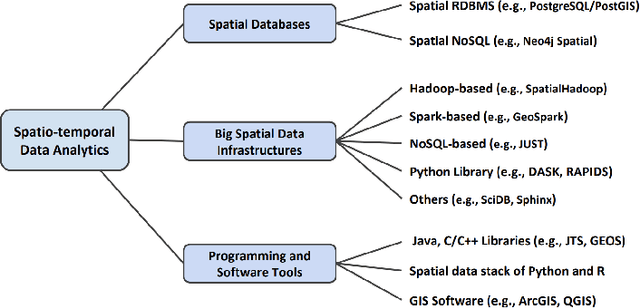


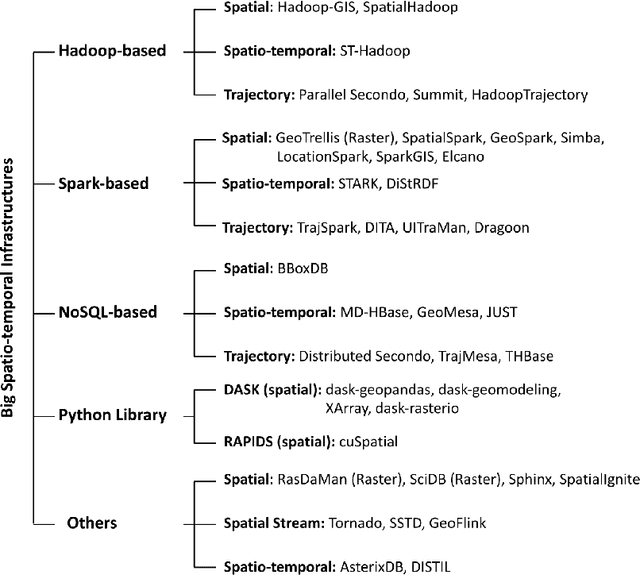
Due to the surge of spatio-temporal data volume, the popularity of location-based services and applications, and the importance of extracted knowledge from spatio-temporal data to solve a wide range of real-world problems, a plethora of research and development work has been done in the area of spatial and spatio-temporal data analytics in the past decade. The main goal of existing works was to develop algorithms and technologies to capture, store, manage, analyze, and visualize spatial or spatio-temporal data. The researchers have contributed either by adding spatio-temporal support with existing systems, by developing a new system from scratch for processing spatio-temporal data, or by implementing algorithms for mining spatio-temporal data. The existing ecosystem of spatial and spatio-temporal data analytics can be categorized into three groups, (1) spatial databases (SQL and NoSQL), (2) big spatio-temporal data processing infrastructures, and (3) programming languages and software tools for processing spatio-temporal data. Since existing surveys mostly investigated big data infrastructures for processing spatial data, this survey has explored the whole ecosystem of spatial and spatio-temporal analytics along with an up-to-date review of big spatial data processing systems. This survey also portrays the importance and future of spatial and spatio-temporal data analytics.