 Add to Chrome
 Add to Firefox
 Add to Edge
Learning to Weigh Waste: A Physics-Informed Multimodal Fusion Framework and Large-Scale Dataset for Commercial and Industrial Applications
Mar 03, 2026
Accurate weight estimation of commercial and industrial waste is important for efficient operations, yet image-based estimation remains difficult because similar-looking objects may have different densities, and the visible size changes with camera distance. Addressing this problem, we propose Multimodal Weight Predictor (MWP) framework that estimates waste weight by combining RGB images with physics-informed metadata, including object dimensions, camera distance, and camera height. We also introduce Waste-Weight-10K, a real-world dataset containing 10,421 synchronized image-metadata collected from logistics and recycling sites. The dataset covers 11 waste categories and a wide weight range from 3.5 to 3,450 kg. Our model uses a Vision Transformer for visual features and a dedicated metadata encoder for geometric and category information, combining them with Stacked Mutual Attention Fusion that allows visual and physical cues guide each other. This helps the model manage perspective effects and link objects to material properties. To ensure stable performance across the wide weight range, we train the model using Mean Squared Logarithmic Error. On the test set, the proposed method achieves 88.06 kg Mean Absolute Error (MAE), 6.39% Mean Absolute Percentage Error (MAPE), and an R2 coefficient of 0.9548. The model shows strong accuracy for light objects in the 0-100 kg range with 2.38 kg MAE and 3.1% MAPE, maintaining reliable performance for heavy waste in the 1000-2000 kg range with 11.1% MAPE. Finally, we incorporate a physically grounded explanation module using Shapley Additive Explanations (SHAP) and a large language model to provide clear, human-readable explanations for each prediction.

Methods to Measure the Broncho-Arterial Ratio and Wall Thickness in the Right Lower Lobe for Defining Radiographic Reversibility of Bronchiectasis
Jul 18, 2024
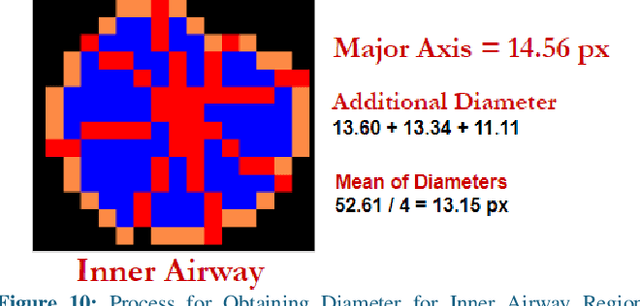
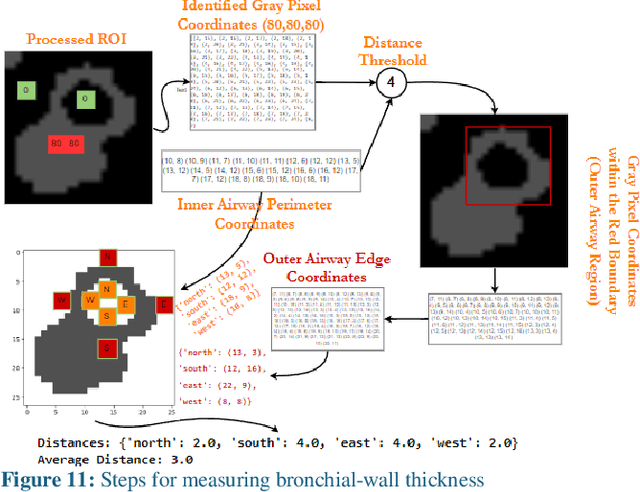
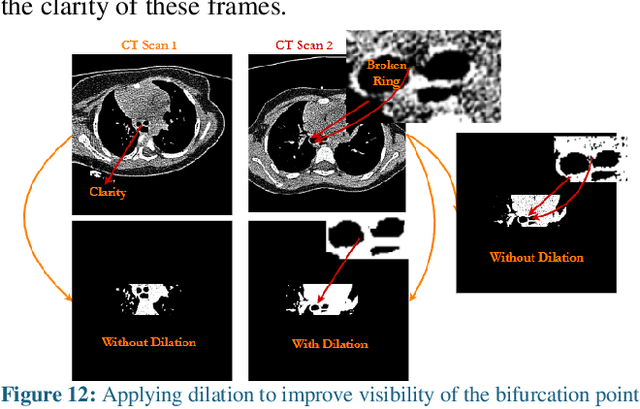
The diagnosis of bronchiectasis requires measuring abnormal bronchial dilation. It is confirmed using a chest CT scan, where the key feature is an increased broncho-arterial ratio (BAR) (>0.8 in children), often with bronchial wall thickening. Image processing methods facilitate quicker interpretation and detailed evaluations by lobes and segments. Challenges like inclined nature, oblique orientation, and partial volume effect make it difficult to obtain accurate measurements in the upper and middle lobes using the same algorithms. Therefore, accurate detection and measurement of airway and artery regions for BAR and wall thickness in each lobe require different image processing/machine learning methods. We propose methods for: 1. Separating the right lower lobe (RLL) region from full-length CT scans using the tracheal bifurcation (Carina) point as a central marker; 2. Locating the inner diameter of airways and outer diameter of arteries for BAR measurement; and 3. Measuring airway wall thickness (WT) by identifying the outer and inner diameters of airway boundaries. Analysis of 13 HRCT scans with varying thicknesses (0.67mm, 1mm, 2mm) shows the tracheal bifurcation frame can be detected accurately, with a deviation of +/- 2 frames in some cases. A Windows app was developed for measuring inner airway diameter, artery diameter, BAR, and wall thickness, allowing users to draw boundaries around visible BA pairs in the RLL region. Measurements of 10 BA pairs revealed accurate results comparable to those of a human reader, with deviations of +/- 0.10-0.15mm. Additional studies and validation are needed to consolidate inter- and intra-rater variability and enhance the methods.