 Add to Chrome
 Add to Firefox
 Add to Edge
Your Multimodal Speech Model Says I Have a Face for Radio
May 28, 2026
As large neural models have become better at language tasks, researchers are increasingly building multi- and omnimodal models that handle more modalities of data. One example is the expansion of speech recognition models to audio-visual data for noise mitigation and multimodal subtitling. While performance and bias have been studied extensively in the single-modality regime, it is unknown how new modalities affect this, even though they produce biases in humans. We therefore propose the first bias evaluation of multimodal speech recognition, where we create videos pairing different faces with the same audio, and measure changes in speech transcription accuracy. We find large quality-of-service differences across mWhisper-Flamingo and Gemini models, with drops of up to 4.05 word error rate points, across self-declared gender, ethnicity, and their intersection. Our findings point to a priority for developers to evaluate, fix, and communicate such limitations, as providing more signals through additional modalities is not necessarily better, and may even lead to biased outcomes.

Representation Collapse in Machine Translation Through the Lens of Angular Dispersion
Feb 19, 2026Modern neural translation models based on the Transformer architecture are known for their high performance, particularly when trained on high-resource datasets. A standard next-token prediction training strategy, while widely adopted in practice, may lead to overlooked artifacts such as representation collapse. Previous works have shown that this problem is especially pronounced in the representation of the deeper Transformer layers, where it often fails to efficiently utilize the geometric space. Representation collapse is even more evident in end-to-end training of continuous-output neural machine translation, where the trivial solution would be to set all vectors to the same value. In this work, we analyze the dynamics of representation collapse at different levels of discrete and continuous NMT transformers throughout training. We incorporate an existing regularization method based on angular dispersion and demonstrate empirically that it not only mitigates collapse but also improves translation quality. Furthermore, we show that quantized models exhibit similar collapse behavior and that the benefits of regularization are preserved even after quantization.
We Augmented Whisper With kNN and You Won't Believe What Came Next
Oct 24, 2024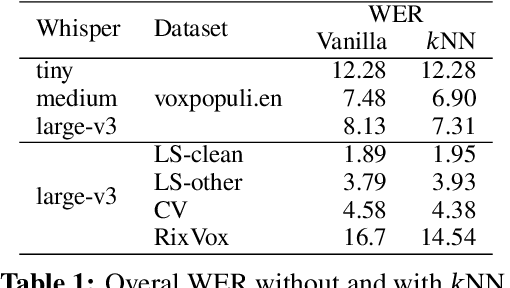

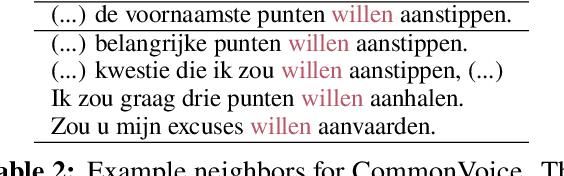
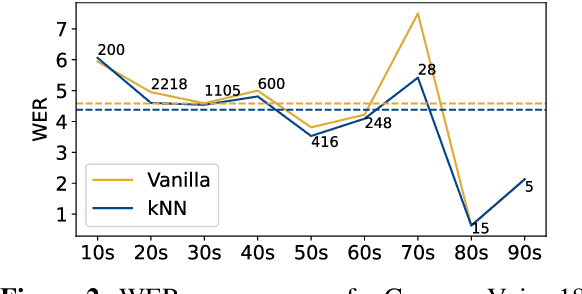
Speech recognition performance varies by language, domain, and speaker characteristics such as accent, and fine-tuning a model on any of these categories may lead to catastrophic forgetting. $k$ nearest neighbor search ($k$NN), first proposed for neural sequence decoders for natural language generation (NLG) and machine translation (MT), is a non-parametric method that can instead adapt by building an external datastore that can then be searched during inference time, without training the underlying model. We show that Whisper, a transformer end-to-end speech model, benefits from $k$NN. We investigate the differences between the speech and text setups. We discuss implications for speaker adaptation, and analyze improvements by gender, accent, and age.