 Add to Chrome
 Add to Firefox
 Add to Edge
Enhancing Tabular Learners with Context-Aware Semantic Embeddings
Aug 04, 2026
While modern tabular learners excel at capturing statistical patterns, they frequently operate in a semantic vacuum, treating textual features as discrete symbols, ignoring the rich semantics inherent in feature names or cell entries. We propose CASE (Context-Aware Semantic Embeddings), a novel framework that bridges the gap between the semantic understanding of Large Language Models (LLMs) and the statistical capabilities of tabular learners. Unlike existing methods that embed rows in isolation, CASE utilizes a contextualization strategy: we pre-fill the KV cache of a custom-trained Gemma 3-based Tabular Language Model with a representative sample of rows to establish a persistent anchor of the dataset's semantics. This ensures that generated row embeddings are dynamically contextualized, resolving semantic ambiguities and anchoring representations in domain-specific context. Our experiments across several benchmarks (CARTE, TextTab, and TabArena) demonstrate that CASE substantially improves the performance of tabular learners on semantically rich datasets, particularly in low-data regimes.

FlexTab: A Flexible Encoder-Decoder Architecture for In-Context Learning Across Diverse Tabular Tasks
Jun 30, 2026We introduce FlexTab, a flexible encoder-decoder architecture for in-context learning on tabular data that pairs a single, task-agnostic encoder with a suite of task-specific decoders. Unlike existing tabular in-context learners, which entangle feature representations with a specific prediction target, our design produces target-agnostic row embeddings that can be leveraged across a wide range of downstream tasks within a table-native in-context learning setup. We demonstrate this flexibility on six distinct problems: classification, regression, anomaly detection, clustering, entity matching, and entity classification in relational databases. Both the encoder and the task-specific decoders are trained on a large corpus of real-world, unlabeled tables. FlexTab achieves state-of-the-art performance on classification, regression, anomaly detection and entity matching, while remaining competitive with specialized models on entity classification in a relational setting. These results demonstrate that a single shared encoder, paired with task-specific decoders, can serve as an effective general-purpose backbone for diverse tabular prediction problems. The inference code and checkpoints will be made publicly available at https://github.com/SAP-samples/flextab.
Exploring Differences Between Tabular Enterprise Data and Public Benchmarks
Jun 29, 2026Tabular data dominate the landscape of data science, increasingly attracting innovative machine learning models and tailored benchmarks. Yet, little is known for enterprise data, where tables constitute the backbone of business operations. To broaden the benchmarking landscape for business applications, this work aims to actualize the characteristics of enterprise data by providing an analysis of data statistics and performance measurements of tabular models such as TabPFN, TabICL and ConTextTab. Through our analysis, we find enterprise data markedly differ from tabular benchmarks and we demonstrate that a tabular model that performs well on typical tabular benchmarks may perform poorly on real world enterprise data -- and vice versa. This lack of generalization underlines the need for additional benchmarks with enterprise-grade characteristics.
TabGemma: Text-Based Tabular ICL via LLM using Continued Pretraining and Retrieval
Nov 05, 2025We study LLMs for tabular prediction with mixed text, numeric, and categorical fields. We introduce TabGemma, a schema-agnostic in-context learner that treats rows as sequences and tackles two practical hurdles when adapting pretrained LLMs for tabular predictions: unstable numeric tokenization and limited context size. We propose to canonicalize numbers via signed scientific notation and continue pretraining of a 12B Gemma 3 model with a target imputation objective using a large-scale real world dataset. For inference, we use a compact n-gram-based retrieval to select informative exemplars that fit within a 128k-token window. On semantically rich benchmarks, TabGemma establishes a new state of the art on classification across low- and high-data regimes and improves monotonically with more context rows. For regression, it is competitive at small sample sizes but trails conventional approaches as data grows. Our results show that LLMs can be effective tabular in-context learners on highly semantic tasks when paired with dedicated numeric handling and context retrieval, while motivating further advances in numeric modeling and long-context scaling.
ConTextTab: A Semantics-Aware Tabular In-Context Learner
Jun 12, 2025Tabular in-context learning (ICL) has recently achieved state-of-the-art (SOTA) performance on several tabular prediction tasks. Previously restricted to classification problems on small tables, recent advances such as TabPFN and TabICL have extended its use to larger datasets. While being architecturally efficient and well-adapted to tabular data structures, current table-native ICL architectures, being trained exclusively on synthetic data, do not fully leverage the rich semantics and world knowledge contained in real-world tabular data. On another end of this spectrum, tabular ICL models based on pretrained large language models such as TabuLa-8B integrate deep semantic understanding and world knowledge but are only able to make use of a small amount of context due to inherent architectural limitations. With the aim to combine the best of both these worlds, we introduce ConTextTab, integrating semantic understanding and alignment into a table-native ICL framework. By employing specialized embeddings for different data modalities and by training on large-scale real-world tabular data, our model is competitive with SOTA across a broad set of benchmarks while setting a new standard on the semantically rich CARTE benchmark.
Scaling Experiments in Self-Supervised Cross-Table Representation Learning
Sep 29, 2023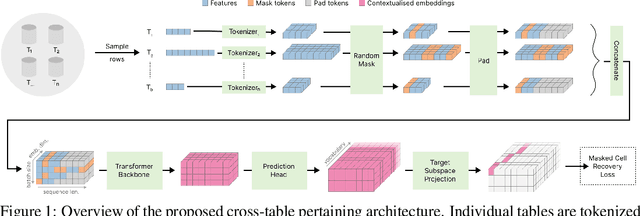
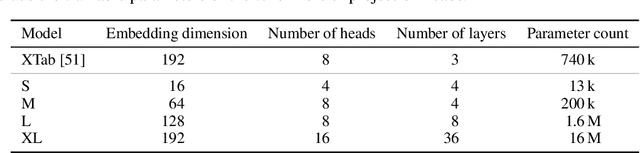
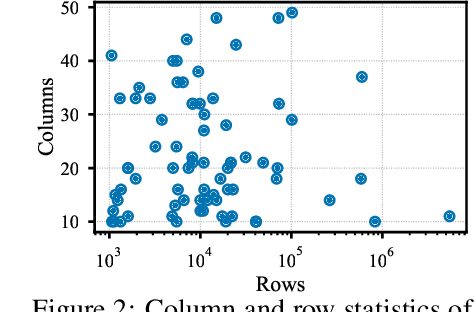
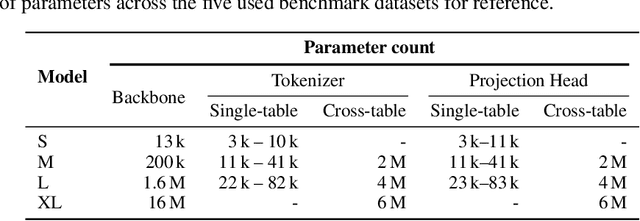
To analyze the scaling potential of deep tabular representation learning models, we introduce a novel Transformer-based architecture specifically tailored to tabular data and cross-table representation learning by utilizing table-specific tokenizers and a shared Transformer backbone. Our training approach encompasses both single-table and cross-table models, trained via missing value imputation through a self-supervised masked cell recovery objective. To understand the scaling behavior of our method, we train models of varying sizes, ranging from approximately $10^4$ to $10^7$ parameters. These models are trained on a carefully curated pretraining dataset, consisting of 135M training tokens sourced from 76 diverse datasets. We assess the scaling of our architecture in both single-table and cross-table pretraining setups by evaluating the pretrained models using linear probing on a curated set of benchmark datasets and comparing the results with conventional baselines.
Curve Your Enthusiasm: Concurvity Regularization in Differentiable Generalized Additive Models
May 19, 2023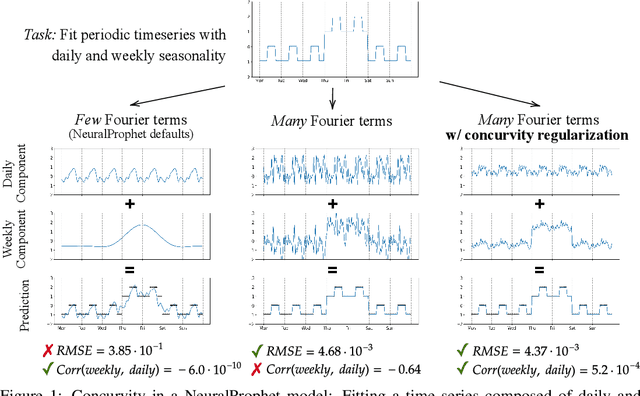
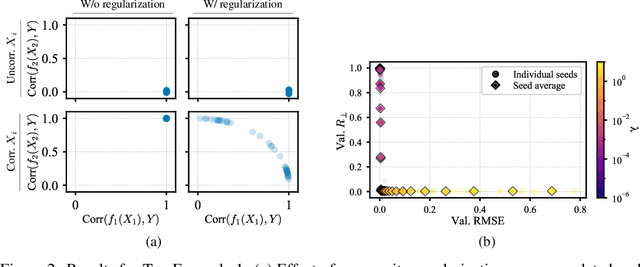
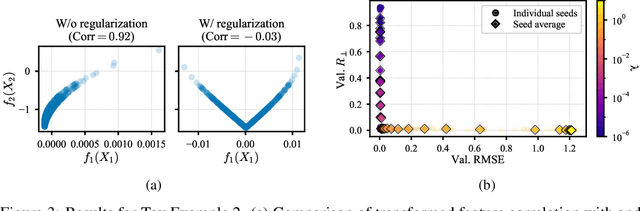
Generalized Additive Models (GAMs) have recently experienced a resurgence in popularity due to their interpretability, which arises from expressing the target value as a sum of non-linear transformations of the features. Despite the current enthusiasm for GAMs, their susceptibility to concurvity - i.e., (possibly non-linear) dependencies between the features - has hitherto been largely overlooked. Here, we demonstrate how concurvity can severly impair the interpretability of GAMs and propose a remedy: a conceptually simple, yet effective regularizer which penalizes pairwise correlations of the non-linearly transformed feature variables. This procedure is applicable to any differentiable additive model, such as Neural Additive Models or NeuralProphet, and enhances interpretability by eliminating ambiguities due to self-canceling feature contributions. We validate the effectiveness of our regularizer in experiments on synthetic as well as real-world datasets for time-series and tabular data. Our experiments show that concurvity in GAMs can be reduced without significantly compromising prediction quality, improving interpretability and reducing variance in the feature importances.
Uncovering the Inner Workings of STEGO for Safe Unsupervised Semantic Segmentation
Apr 14, 2023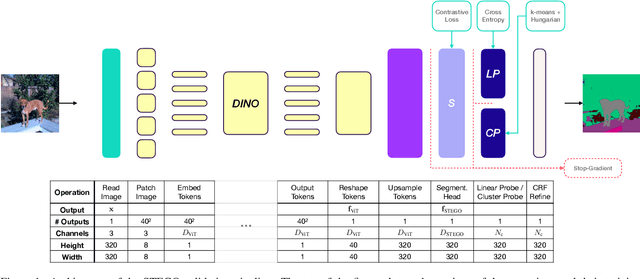

Self-supervised pre-training strategies have recently shown impressive results for training general-purpose feature extraction backbones in computer vision. In combination with the Vision Transformer architecture, the DINO self-distillation technique has interesting emerging properties, such as unsupervised clustering in the latent space and semantic correspondences of the produced features without using explicit human-annotated labels. The STEGO method for unsupervised semantic segmentation contrastively distills feature correspondences of a DINO-pre-trained Vision Transformer and recently set a new state of the art. However, the detailed workings of STEGO have yet to be disentangled, preventing its usage in safety-critical applications. This paper provides a deeper understanding of the STEGO architecture and training strategy by conducting studies that uncover the working mechanisms behind STEGO, reproduce and extend its experimental validation, and investigate the ability of STEGO to transfer to different datasets. Results demonstrate that the STEGO architecture can be interpreted as a semantics-preserving dimensionality reduction technique.
Interpretable Reinforcement Learning via Neural Additive Models for Inventory Management
Mar 22, 2023


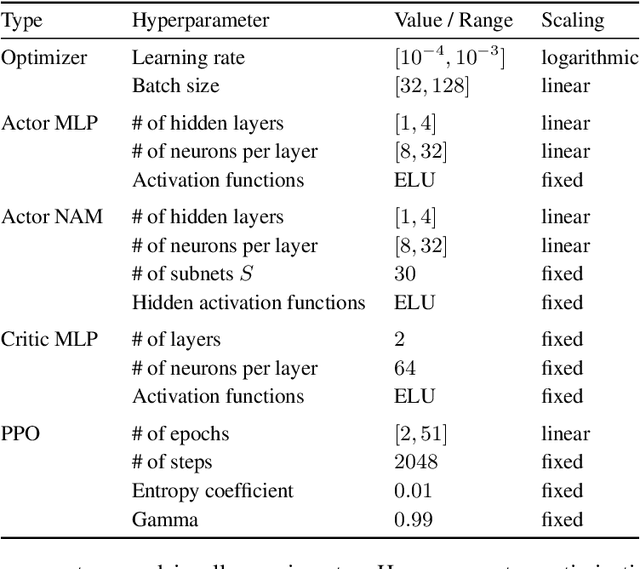
The COVID-19 pandemic has highlighted the importance of supply chains and the role of digital management to react to dynamic changes in the environment. In this work, we focus on developing dynamic inventory ordering policies for a multi-echelon, i.e. multi-stage, supply chain. Traditional inventory optimization methods aim to determine a static reordering policy. Thus, these policies are not able to adjust to dynamic changes such as those observed during the COVID-19 crisis. On the other hand, conventional strategies offer the advantage of being interpretable, which is a crucial feature for supply chain managers in order to communicate decisions to their stakeholders. To address this limitation, we propose an interpretable reinforcement learning approach that aims to be as interpretable as the traditional static policies while being as flexible and environment-agnostic as other deep learning-based reinforcement learning solutions. We propose to use Neural Additive Models as an interpretable dynamic policy of a reinforcement learning agent, showing that this approach is competitive with a standard full connected policy. Finally, we use the interpretability property to gain insights into a complex ordering strategy for a simple, linear three-echelon inventory supply chain.
Spectral Reconstruction and Disparity from Spatio-Spectrally Coded Light Fields via Multi-Task Deep Learning
Mar 18, 2021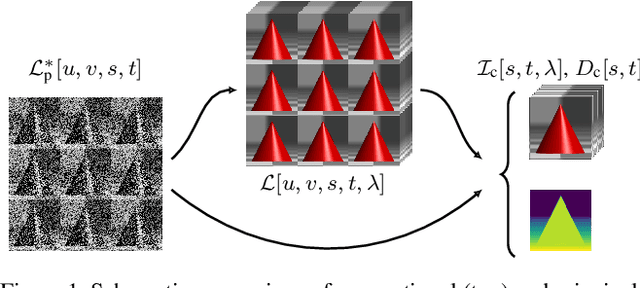
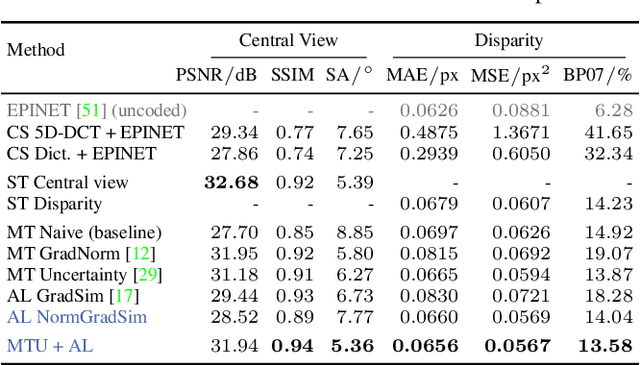
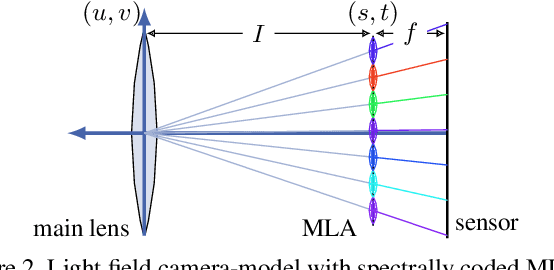
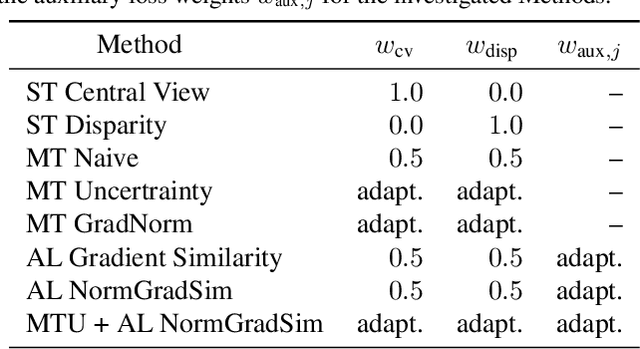
We present a novel method to reconstruct a spectral central view and its aligned disparity map from spatio-spectrally coded light fields. Since we do not reconstruct an intermediate full light field from the coded measurement, we refer to this as principal reconstruction. The coded light fields correspond to those captured by a light field camera in the unfocused design with a spectrally coded microlens array. In this application, the spectrally coded light field camera can be interpreted as a single-shot spectral depth camera. We investigate several multi-task deep learning methods and propose a new auxiliary loss-based training strategy to enhance the reconstruction performance. The results are evaluated using a synthetic as well as a new real-world spectral light field dataset that we captured using a custom-built camera. The results are compared to state-of-the art compressed sensing reconstruction and disparity estimation. We achieve a high reconstruction quality for both synthetic and real-world coded light fields. The disparity estimation quality is on par with or even outperforms state-of-the-art disparity estimation from uncoded RGB light fields.