 Add to Chrome
 Add to Firefox
 Add to Edge
Attention is Case-Sensitive
Aug 04, 2026
In human visual perception, uppercase lettering serves as a natural salience cue that captures attention within lowercase text. In this paper, we present a systematic empirical characterization study revealing that Large Language Models (LLMs) exhibit an analogous property: letter casing modulates internal attention allocation. Through analysis across 13 models, nine LLMs and four Vision-Language Models (VLMs), with diverse tokenization schemes, we show that formatting target information in alternating or uppercase against a lowercase context concentrates attention on those textual spans. In text this effect is universal, holding across every evaluated non-reasoning model. We frame it as a previously under-explored latent property of pretrained transformers rather than a prescriptive method. Our investigation reveals a central attention-performance divergence: while this "casing effect" robustly shifts attention, its impact on downstream accuracy is non-trivial, increased concentration does not inherently improve task accuracy and, in high-entropy contexts like alternating case, can degrade it. We further identify a boundary condition: the deliberative "thinking" phase in reasoning models acts as a semantic buffer that mitigates typographic sensitivity in text. Extending the study to VLMs, we find the effect transfers partially: the same prompt-side casing reorganizes cross-modal attention along two coupled axes, predominantly a macroscopic disengagement from the image toward the text prompt, and secondarily a concentration of the residual visual attention on the target region. By isolating casing as a zero-shot mechanism for attention steering that requires no model access or fine-tuning, we provide a new foundational understanding of how pretraining internalizes typographic emphasis.

Understanding Cross-Rig Generalization in Automotive Perception: a Multi-Rig Benchmark and Rig Variation Metrics
Jun 25, 2026Camera-based perception systems for autonomous driving are typically developed and evaluated using fixed sensor rigs, while real-world vehicle fleets exhibit substantial variation in camera placement, orientation, field of view, and camera count. This mismatch introduces a cross-rig domain gap in which only the geometric observation process changes. To study this effect under controlled conditions, we introduce Plentiful CARLA Camera Rigs, a benchmark that renders identical driving scenes under 14 systematically designed camera rigs. This setup enables direct analysis of cross-rig generalization without confounding changes in scene content or appearance. Using the benchmark, we analyze cross-rig transfer behavior of representative multi-view perception architectures and observe substantial performance shifts induced by geometric rig variation. To facilitate structured analysis, we further introduce two calibration-based descriptors derived from rig metadata: Rig Variance, capturing internal rig diversity, and Rig Contrastive Distance, measuring geometric discrepancy between rigs. Our experiments show that geometric rig differences strongly correlate with relative cross-rig performance shifts and that Rig Contrastive Distance provides a reliable proxy for ranking transfer difficulty between sensor rigs.
Embodied4C: Measuring What Matters for Embodied Vision-Language Navigation
Dec 19, 2025Vision-language navigation requires agents to reason and act under constraints of embodiment. While vision-language models (VLMs) demonstrate strong generalization, current benchmarks provide limited understanding of how embodiment -- i.e., the choice of physical platform, sensor configuration, and modality alignment -- influences perception, reasoning, and control. We introduce Embodied4C, a closed-loop benchmark designed as a Turing test for embodied reasoning. The benchmark evaluates the core embodied capabilities of VLMs across three heterogeneous embodiments -- autonomous vehicles, aerial drones, and robotic manipulators -- through approximately 1.1K one-shot reasoning questions and 58 goal-directed navigation tasks. These tasks jointly assess four foundational dimensions: semantic, spatial, temporal, and physical reasoning. Each embodiment presents dynamic sensor configurations and environment variations to probe generalization beyond platform-specific adaptation. To prevent embodiment overfitting, Embodied4C integrates domain-far queries targeting abstract and cross-context reasoning. Comprehensive evaluation across ten state-of-the-art VLMs and four embodied control baselines shows that cross-modal alignment and instruction tuning matter more than scale, while spatial and temporal reasoning remains the primary bottleneck for reliable embodied competence.
SNOW: Spatio-Temporal Scene Understanding with World Knowledge for Open-World Embodied Reasoning
Dec 18, 2025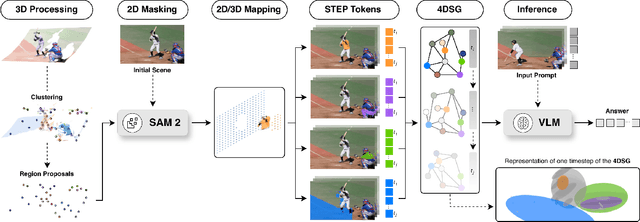
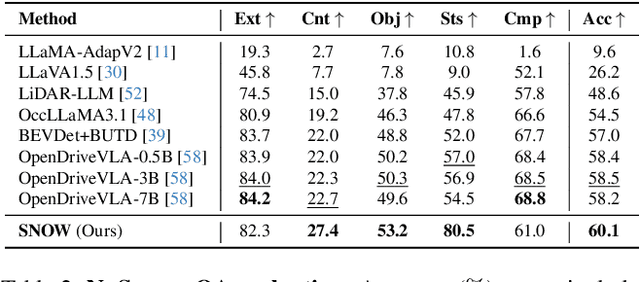
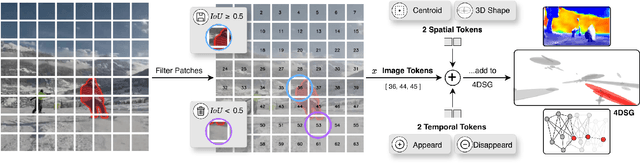
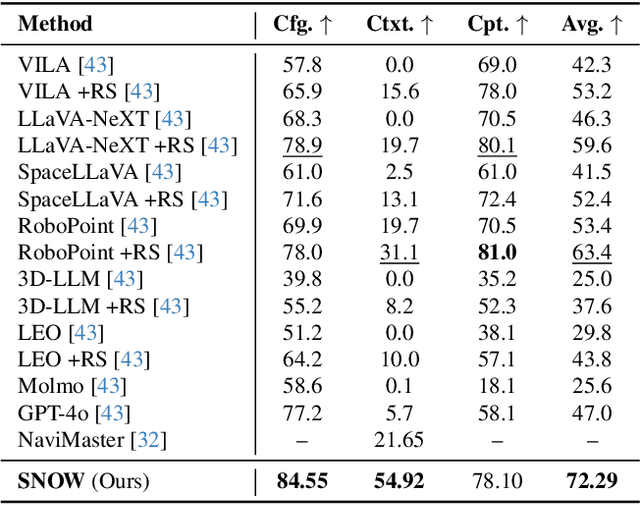
Autonomous robotic systems require spatio-temporal understanding of dynamic environments to ensure reliable navigation and interaction. While Vision-Language Models (VLMs) provide open-world semantic priors, they lack grounding in 3D geometry and temporal dynamics. Conversely, geometric perception captures structure and motion but remains semantically sparse. We propose SNOW (Scene Understanding with Open-World Knowledge), a training-free and backbone-agnostic framework for unified 4D scene understanding that integrates VLM-derived semantics with point cloud geometry and temporal consistency. SNOW processes synchronized RGB images and 3D point clouds, using HDBSCAN clustering to generate object-level proposals that guide SAM2-based segmentation. Each segmented region is encoded through our proposed Spatio-Temporal Tokenized Patch Encoding (STEP), producing multimodal tokens that capture localized semantic, geometric, and temporal attributes. These tokens are incrementally integrated into a 4D Scene Graph (4DSG), which serves as 4D prior for downstream reasoning. A lightweight SLAM backend anchors all STEP tokens spatially in the environment, providing the global reference alignment, and ensuring unambiguous spatial grounding across time. The resulting 4DSG forms a queryable, unified world model through which VLMs can directly interpret spatial scene structure and temporal dynamics. Experiments on a diverse set of benchmarks demonstrate that SNOW enables precise 4D scene understanding and spatially grounded inference, thereby setting new state-of-the-art performance in several settings, highlighting the importance of structured 4D priors for embodied reasoning and autonomous robotics.
R4: Retrieval-Augmented Reasoning for Vision-Language Models in 4D Spatio-Temporal Space
Dec 17, 2025Humans perceive and reason about their surroundings in four dimensions by building persistent, structured internal representations that encode semantic meaning, spatial layout, and temporal dynamics. These multimodal memories enable them to recall past events, infer unobserved states, and integrate new information into context-dependent reasoning. Inspired by this capability, we introduce R4, a training-free framework for retrieval-augmented reasoning in 4D spatio-temporal space that equips vision-language models (VLMs) with structured, lifelong memory. R4 continuously constructs a 4D knowledge database by anchoring object-level semantic descriptions in metric space and time, yielding a persistent world model that can be shared across agents. At inference, natural language queries are decomposed into semantic, spatial, and temporal keys to retrieve relevant observations, which are integrated into the VLM's reasoning. Unlike classical retrieval-augmented generation methods, retrieval in R4 operates directly in 4D space, enabling episodic and collaborative reasoning without training. Experiments on embodied question answering and navigation benchmarks demonstrate that R4 substantially improves retrieval and reasoning over spatio-temporal information compared to baselines, advancing a new paradigm for embodied 4D reasoning in dynamic environments.
A Framework for a Capability-driven Evaluation of Scenario Understanding for Multimodal Large Language Models in Autonomous Driving
Mar 14, 2025Multimodal large language models (MLLMs) hold the potential to enhance autonomous driving by combining domain-independent world knowledge with context-specific language guidance. Their integration into autonomous driving systems shows promising results in isolated proof-of-concept applications, while their performance is evaluated on selective singular aspects of perception, reasoning, or planning. To leverage their full potential a systematic framework for evaluating MLLMs in the context of autonomous driving is required. This paper proposes a holistic framework for a capability-driven evaluation of MLLMs in autonomous driving. The framework structures scenario understanding along the four core capability dimensions semantic, spatial, temporal, and physical. They are derived from the general requirements of autonomous driving systems, human driver cognition, and language-based reasoning. It further organises the domain into context layers, processing modalities, and downstream tasks such as language-based interaction and decision-making. To illustrate the framework's applicability, two exemplary traffic scenarios are analysed, grounding the proposed dimensions in realistic driving situations. The framework provides a foundation for the structured evaluation of MLLMs' potential for scenario understanding in autonomous driving.