 Add to Chrome
 Add to Firefox
 Add to Edge
FAAR: Efficient Frequency-Aware Multi-Task Fine-Tuning via Automatic Rank Selection
Mar 20, 2026
Adapting models pre-trained on large-scale datasets is a proven way to reach strong performance quickly for down-stream tasks. However, the growth of state-of-the-art mod-els makes traditional full fine-tuning unsuitable and difficult, especially for multi-task learning (MTL) where cost scales with the number of tasks. As a result, recent studies investigate parameter-efficient fine-tuning (PEFT) using low-rank adaptation to significantly reduce the number of trainable parameters. However, these existing methods use a single, fixed rank, which may not be optimal for differ-ent tasks or positions in the MTL architecture. Moreover, these methods fail to learn spatial information that cap-tures inter-task relationships and helps to improve diverse task predictions. This paper introduces Frequency-Aware and Automatic Rank (FAAR) for efficient MTL fine-tuning. Our method introduces Performance-Driven Rank Shrink-ing (PDRS) to allocate the optimal rank per adapter location and per task. Moreover, by analyzing the image frequency spectrum, FAAR proposes a Task-Spectral Pyramidal Decoder (TS-PD) that injects input-specific context into spatial bias learning to better reflect cross-task relationships. Experiments performed on dense visual task benchmarks show the superiority of our method in terms of both accuracy and efficiency compared to other PEFT methods in MTL. FAAR reduces the number of parameters by up to 9 times compared to traditional MTL fine-tuning whilst improving overall performance. Our code is available.

Optimizing Dense Visual Predictions Through Multi-Task Coherence and Prioritization
Dec 04, 2024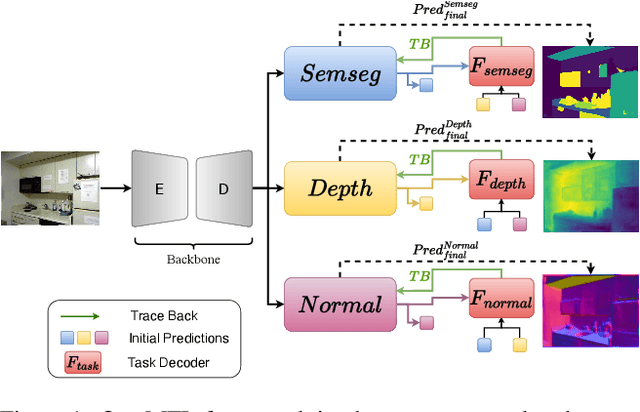
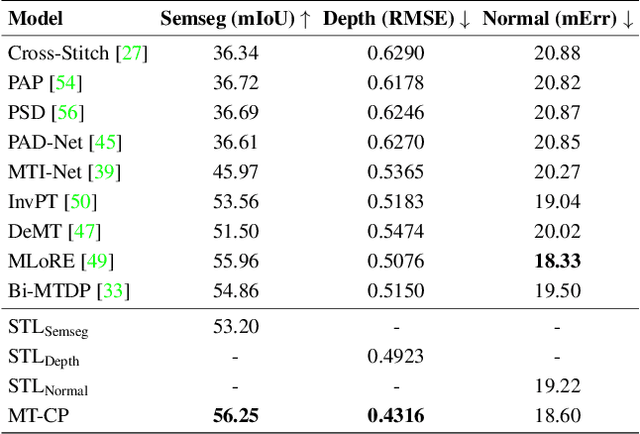
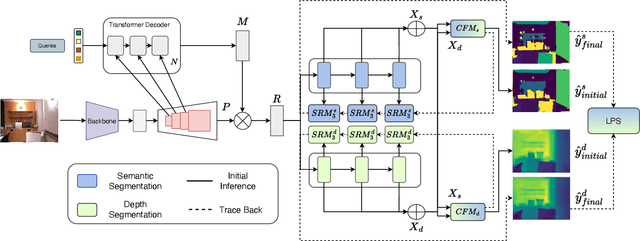
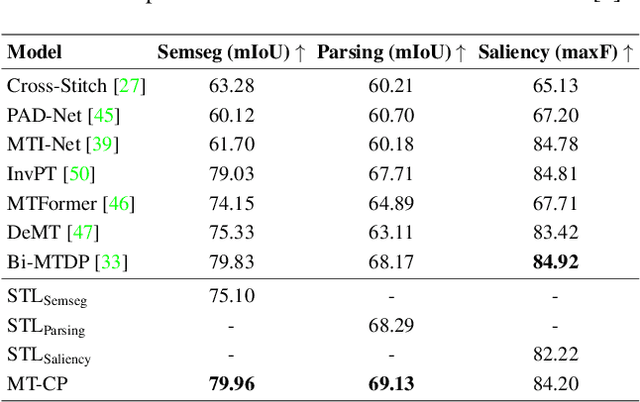
Multi-Task Learning (MTL) involves the concurrent training of multiple tasks, offering notable advantages for dense prediction tasks in computer vision. MTL not only reduces training and inference time as opposed to having multiple single-task models, but also enhances task accuracy through the interaction of multiple tasks. However, existing methods face limitations. They often rely on suboptimal cross-task interactions, resulting in task-specific predictions with poor geometric and predictive coherence. In addition, many approaches use inadequate loss weighting strategies, which do not address the inherent variability in task evolution during training. To overcome these challenges, we propose an advanced MTL model specifically designed for dense vision tasks. Our model leverages state-of-the-art vision transformers with task-specific decoders. To enhance cross-task coherence, we introduce a trace-back method that improves both cross-task geometric and predictive features. Furthermore, we present a novel dynamic task balancing approach that projects task losses onto a common scale and prioritizes more challenging tasks during training. Extensive experiments demonstrate the superiority of our method, establishing new state-of-the-art performance across two benchmark datasets. The code is available at:https://github.com/Klodivio355/MT-CP
When Multi-Task Learning Meets Partial Supervision: A Computer Vision Review
Jul 25, 2023


Multi-Task Learning (MTL) aims to learn multiple tasks simultaneously while exploiting their mutual relationships. By using shared resources to simultaneously calculate multiple outputs, this learning paradigm has the potential to have lower memory requirements and inference times compared to the traditional approach of using separate methods for each task. Previous work in MTL has mainly focused on fully-supervised methods, as task relationships can not only be leveraged to lower the level of data-dependency of those methods but they can also improve performance. However, MTL introduces a set of challenges due to a complex optimisation scheme and a higher labeling requirement. This review focuses on how MTL could be utilised under different partial supervision settings to address these challenges. First, this review analyses how MTL traditionally uses different parameter sharing techniques to transfer knowledge in between tasks. Second, it presents the different challenges arising from such a multi-objective optimisation scheme. Third, it introduces how task groupings can be achieved by analysing task relationships. Fourth, it focuses on how partially supervised methods applied to MTL can tackle the aforementioned challenges. Lastly, this review presents the available datasets, tools and benchmarking results of such methods.