 Add to Chrome
 Add to Firefox
 Add to Edge
Neuro-Relational Programs: Unifying Queries and Neural Computation over Structured Data
Jun 10, 2026
The conventional approach to deep learning over relational databases applies neural models, such as Graph Neural Networks (GNNs), to a graph representation of the database. Recent approaches instead operate on databases directly, associating tuples with embeddings and extending query mechanisms to jointly process embeddings and relational content. Inspired by these developments, we introduce Neuro-Relational Programs (NRPs), a declarative query language for relational databases whose facts carry numeric vector embeddings. NRPs extend Datalog-style rules with operations that combine, aggregate, and transform embeddings, thereby interleaving relational reasoning and learnable neural components within a single formalism. This yields a general approach to neural computation over relational data: an NRP can be read both as a query plan with trainable components and as a neural architecture with relational structure built in. Natural syntactic fragments of NRPs recover existing architectures and query formalisms. Zero-ary NRPs correspond to non-adaptive query algorithms; monadic NRPs generalize GNN-style message passing and precisely capture Deep Homomorphism Networks, a connection that we extend to frontier-guarded NRPs over databases with row-ids. We characterize the expressive power of unrestricted NRPs with ReLU-FFN transformations by FOCQ, an extension of first-order logic with counting interpreted over real-weighted structures, yielding a precise connection with uniform TC$^0$ over ordered databases. Together, these results establish NRPs as a broad declarative framework for querying and neural computation over relational data.

Fitting Description Logic Ontologies to ABox and Query Examples
Aug 12, 2025We study a fitting problem inspired by ontology-mediated querying: given a collection of positive and negative examples of the form $(\mathcal{A},q)$ with $\mathcal{A}$ an ABox and $q$ a Boolean query, we seek an ontology $\mathcal{O}$ that satisfies $\mathcal{A} \cup \mathcal{O} \vDash q$ for all positive examples and $\mathcal{A} \cup \mathcal{O}\not\vDash q$ for all negative examples. We consider the description logics $\mathcal{ALC}$ and $\mathcal{ALCI}$ as ontology languages and a range of query languages that includes atomic queries (AQs), conjunctive queries (CQs), and unions thereof (UCQs). For all of the resulting fitting problems, we provide effective characterizations and determine the computational complexity of deciding whether a fitting ontology exists. This problem turns out to be ${\scriptsize CO}NP$ for AQs and full CQs and $2E{\scriptsize XP}T{\scriptsize IME}$-complete for CQs and UCQs. These results hold for both $\mathcal{ALC}$ and $\mathcal{ALCI}$.
Towards Ontology Construction with Language Models
Sep 18, 2023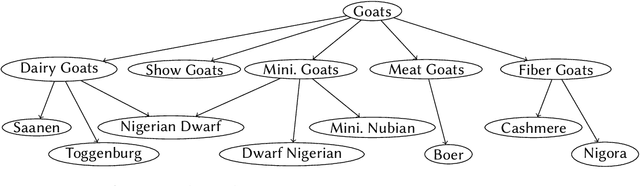

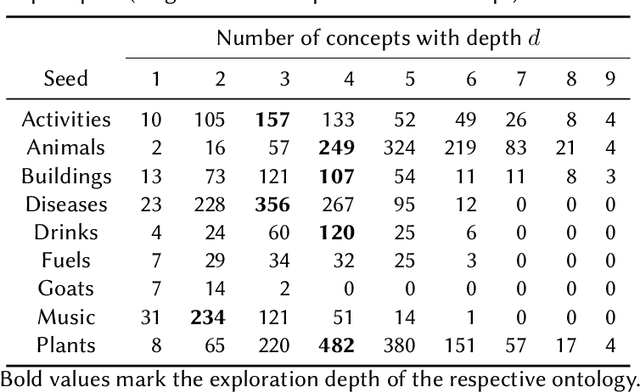

We present a method for automatically constructing a concept hierarchy for a given domain by querying a large language model. We apply this method to various domains using OpenAI's GPT 3.5. Our experiments indicate that LLMs can be of considerable help for constructing concept hierarchies.
SAT-Based PAC Learning of Description Logic Concepts
May 15, 2023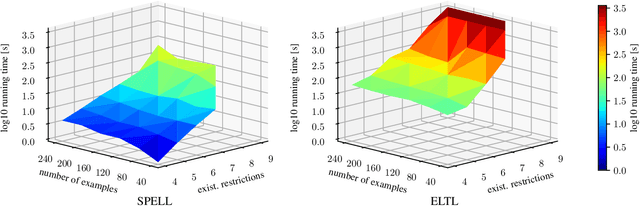

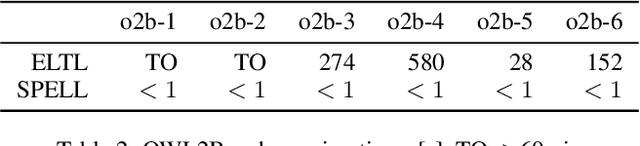
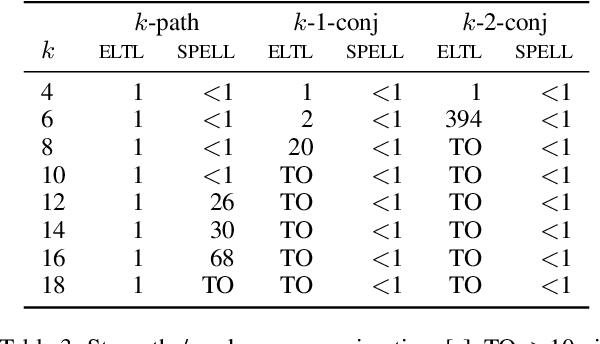
We propose bounded fitting as a scheme for learning description logic concepts in the presence of ontologies. A main advantage is that the resulting learning algorithms come with theoretical guarantees regarding their generalization to unseen examples in the sense of PAC learning. We prove that, in contrast, several other natural learning algorithms fail to provide such guarantees. As a further contribution, we present the system SPELL which efficiently implements bounded fitting for the description logic $\mathcal{ELH}^r$ based on a SAT solver, and compare its performance to a state-of-the-art learner.
On the non-efficient PAC learnability of acyclic conjunctive queries
Aug 22, 2022This note serves three purposes: (i) we provide a self-contained exposition of the fact that conjunctive queries are not efficiently learnable in the Probably-Approximately-Correct (PAC) model, paying clear attention to the complicating fact that this concept class lacks the polynomial-size fitting property, a property that is tacitly assumed in much of the computational learning theory literature; (ii) we establish a strong negative PAC learnability result that applies to many restricted classes of conjunctive queries (CQs), including acyclic CQs for a wide range of notions of "acyclicity"; (iii) we show that CQs are efficiently PAC learnable with membership queries.
Frontiers and Exact Learning of ELI Queries under DL-Lite Ontologies
Apr 29, 2022We study ELI queries (ELIQs) in the presence of ontologies formulated in the description logic DL-Lite. For the dialect DL-LiteH, we show that ELIQs have a frontier (set of least general generalizations) that is of polynomial size and can be computed in polynomial time. In the dialect DL-LiteF, in contrast, frontiers may be infinite. We identify a natural syntactic restriction that enables the same positive results as for DL-LiteH. We use out results on frontiers to show that ELIQs are learnable in polynomial time in the presence of a DL-LiteH / restricted DL-LiteF ontology in Angluin's framework of exact learning with only membership queries.
Actively Learning Concepts and Conjunctive Queries under ELr-Ontologies
May 19, 2021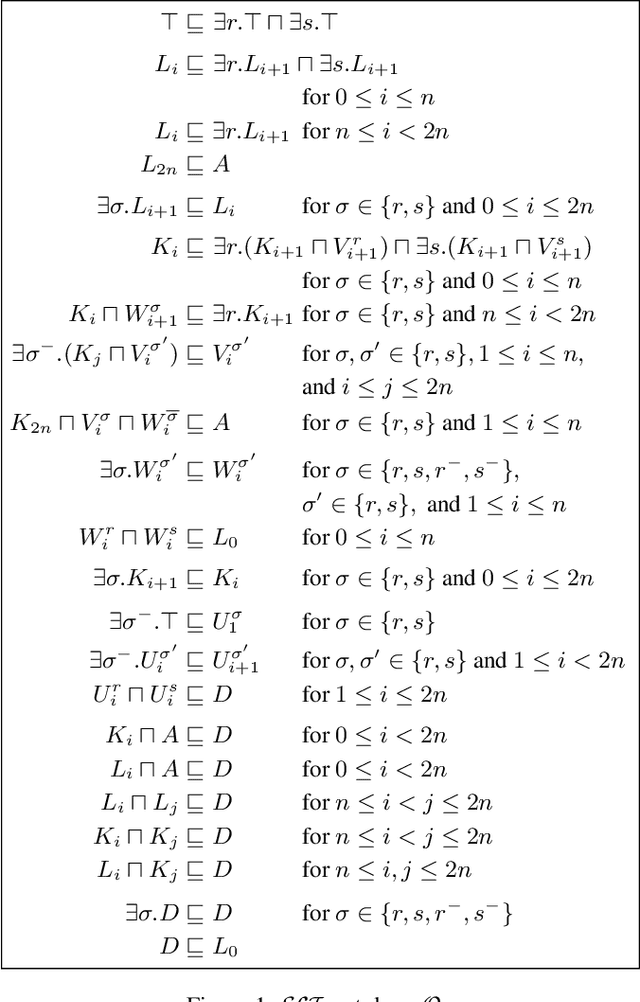
We consider the problem to learn a concept or a query in the presence of an ontology formulated in the description logic ELr, in Angluin's framework of active learning that allows the learning algorithm to interactively query an oracle (such as a domain expert). We show that the following can be learned in polynomial time: (1) EL-concepts, (2) symmetry-free ELI-concepts, and (3) conjunctive queries (CQs) that are chordal, symmetry-free, and of bounded arity. In all cases, the learner can pose to the oracle membership queries based on ABoxes and equivalence queries that ask whether a given concept/query from the considered class is equivalent to the target. The restriction to bounded arity in (3) can be removed when we admit unrestricted CQs in equivalence queries. We also show that EL-concepts are not polynomial query learnable in the presence of ELI-ontologies.