 Add to Chrome
 Add to Firefox
 Add to Edge
Beyond Labels: Information-Efficient Human-in-the-Loop Learning using Ranking and Selection Queries
Feb 17, 2026
Integrating human expertise into machine learning systems often reduces the role of experts to labeling oracles, a paradigm that limits the amount of information exchanged and fails to capture the nuances of human judgment. We address this challenge by developing a human-in-the-loop framework to learn binary classifiers with rich query types, consisting of item ranking and exemplar selection. We first introduce probabilistic human response models for these rich queries motivated by the relationship experimentally observed between the perceived implicit score of an item and its distance to the unknown classifier. Using these models, we then design active learning algorithms that leverage the rich queries to increase the information gained per interaction. We provide theoretical bounds on sample complexity and develop a tractable and computationally efficient variational approximation. Through experiments with simulated annotators derived from crowdsourced word-sentiment and image-aesthetic datasets, we demonstrate significant reductions on sample complexity. We further extend active learning strategies to select queries that maximize information rate, explicitly balancing informational value against annotation cost. This algorithm in the word sentiment classification task reduces learning time by more than 57\% compared to traditional label-only active learning.

Secure Integrated Sensing and Communication
Mar 20, 2023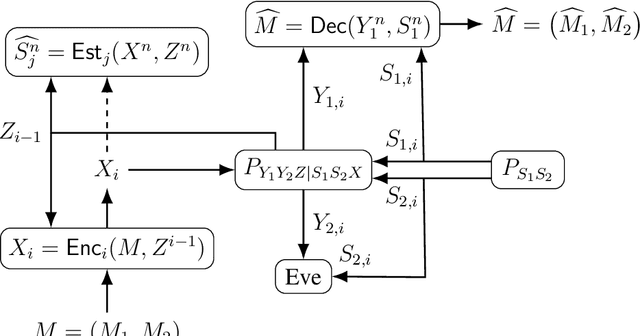
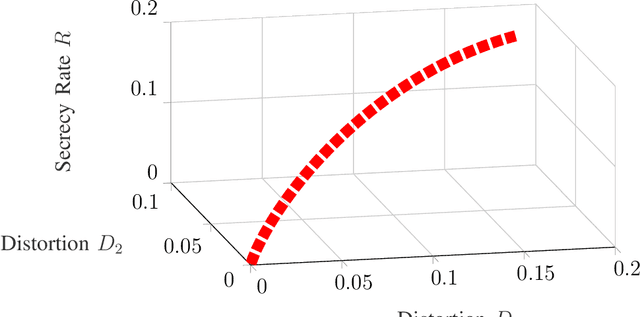
This work considers the problem of mitigating information leakage between communication and sensing in systems jointly performing both operations. Specifically, a discrete memoryless state-dependent broadcast channel model is studied in which (i) the presence of feedback enables a transmitter to convey information, while simultaneously performing channel state estimation; (ii) one of the receivers is treated as an eavesdropper whose state should be estimated but which should remain oblivious to part of the transmitted information. The model abstracts the challenges behind security for joint communication and sensing if one views the channel state as a key attribute, e.g., location. For independent and identically distributed states, perfect output feedback, and when part of the transmitted message should be kept secret, a partial characterization of the secrecy-distortion region is developed. The characterization is exact when the broadcast channel is either physically-degraded or reversely-physically-degraded. The partial characterization is also extended to the situation in which the entire transmitted message should be kept secret. The benefits of a joint approach compared to separation-based secure communication and state-sensing methods are illustrated with binary joint communication and sensing models.