 Add to Chrome
 Add to Firefox
 Add to Edge
From Model-Based Screening to Data-Driven Surrogates: A Multi-Stage Workflow for Exploring Stochastic Agent-Based Models
Apr 03, 2026
Systematic exploration of Agent-Based Models (ABMs) is challenged by the curse of dimensionality and their inherent stochasticity. We present a multi-stage pipeline integrating the systematic design of experiments with machine learning surrogates. Using a predator-prey case study, our methodology proceeds in two steps. First, an automated model-based screening identifies dominant variables, assesses outcome variability, and segments the parameter space. Second, we train Machine Learning models to map the remaining nonlinear interaction effects. This approach automates the discovery of unstable regions where system outcomes are highly dependent on nonlinear interactions between many variables. Thus, this work provides modelers with a rigorous, hands-off framework for sensitivity analysis and policy testing, even when dealing with high-dimensional stochastic simulators.
* Published in MABS 2026 - The 27th International Workshop on Multi-Agent-Based Simulation

Adaptive Agents in Spatial Double-Auction Markets: Modeling the Emergence of Industrial Symbiosis
Dec 19, 2025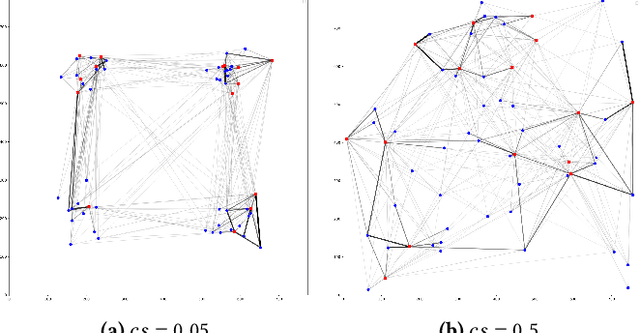
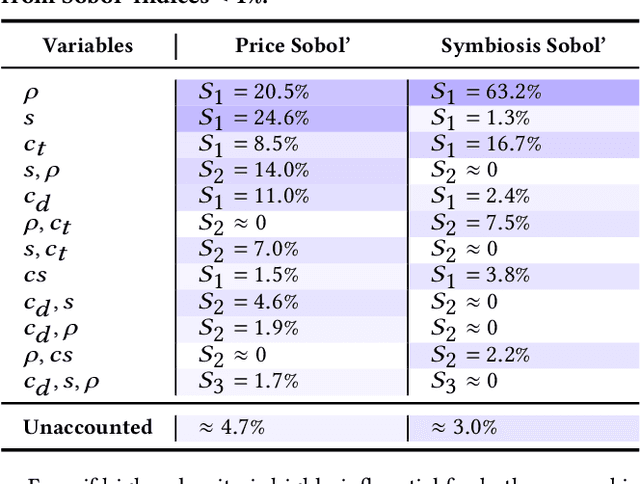
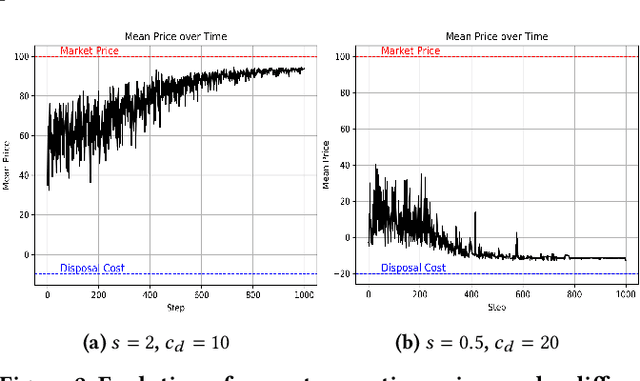
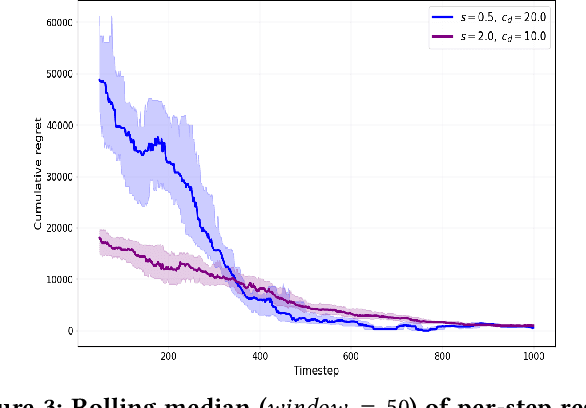
Industrial symbiosis fosters circularity by enabling firms to repurpose residual resources, yet its emergence is constrained by socio-spatial frictions that shape costs, matching opportunities, and market efficiency. Existing models often overlook the interaction between spatial structure, market design, and adaptive firm behavior, limiting our understanding of where and how symbiosis arises. We develop an agent-based model where heterogeneous firms trade byproducts through a spatially embedded double-auction market, with prices and quantities emerging endogenously from local interactions. Leveraging reinforcement learning, firms adapt their bidding strategies to maximize profit while accounting for transport costs, disposal penalties, and resource scarcity. Simulation experiments reveal the economic and spatial conditions under which decentralized exchanges converge toward stable and efficient outcomes. Counterfactual regret analysis shows that sellers' strategies approach a near Nash equilibrium, while sensitivity analysis highlights how spatial structures and market parameters jointly govern circularity. Our model provides a basis for exploring policy interventions that seek to align firm incentives with sustainability goals, and more broadly demonstrates how decentralized coordination can emerge from adaptive agents in spatially constrained markets.
* AAMAS CC-BY 4.0 licence. Adaptive Agents in Spatial Double-Auction Markets: Modeling the Emergence of Industrial Symbiosis. Full paper. In Proc. of the 25th International Conference on Autonomous Agents and Multiagent Systems (AAMAS 2026), Paphos, Cyprus, May 25 - 29, 2026, IFAAMAS, 10 pages