 Add to Chrome
 Add to Firefox
 Add to Edge
Efficient AI-Inspired Reduction of Feynman Integrals via Tube Seeding
Jun 09, 2026
In this paper, we use machine learning to discover a new seeding strategy for integration-by-parts reduction of Feynman integrals, which is a frequent bottleneck in state-of-the-art calculations in theoretical particle and gravitational-wave physics. Our strategy allows us to reduce multi-loop integrals with large numerator powers via essentially the standard Laporta algorithm but with a sparse selection of seed integrals that grows only linearly with the numerator power, whereas existing strategies lead to growth with a polynomial power that increases with the complexity of the integral being reduced. The seeds are restricted to a thin tube-like region that connects the target integral to the master integrals along a zigzag path. We demonstrate the power of our approach by reducing non-planar 2-loop 5-point integrals of rank 20 with numerical kinematics over a finite field, which is prohibitively difficult for the Laporta algorithm with conventional seeding. Going beyond individual integrals, we further demonstrate the reduction of a complete set of top-level rank-10 integrals by dividing the target integrals into several chunks, each of which can be solved by our sparse seeding strategy with considerably less time and a significantly lower memory footprint than other state-of-the-art strategies, making the approach well-suited for phenomenological applications. We provide a proof-of-principle implementation on GitHub at https://github.com/andreslunagodoy/tube_seeding.

Refining Integration-by-Parts Reduction of Feynman Integrals with Machine Learning
Feb 07, 2025Integration-by-parts reductions of Feynman integrals pose a frequent bottle-neck in state-of-the-art calculations in theoretical particle and gravitational-wave physics, and rely on heuristic approaches for selecting integration-by-parts identities, whose quality heavily influences the performance. In this paper, we investigate the use of machine-learning techniques to find improved heuristics. We use funsearch, a genetic programming variant based on code generation by a Large Language Model, in order to explore possible approaches, then use strongly typed genetic programming to zero in on useful solutions. Both approaches manage to re-discover the state-of-the-art heuristics recently incorporated into integration-by-parts solvers, and in one example find a small advance on this state of the art.
Transforming the Bootstrap: Using Transformers to Compute Scattering Amplitudes in Planar N = 4 Super Yang-Mills Theory
May 09, 2024

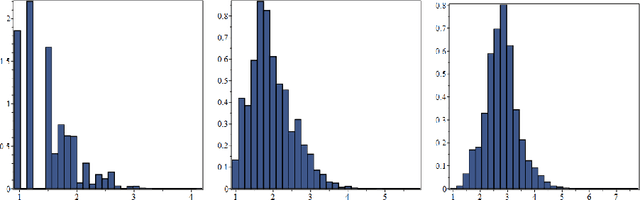
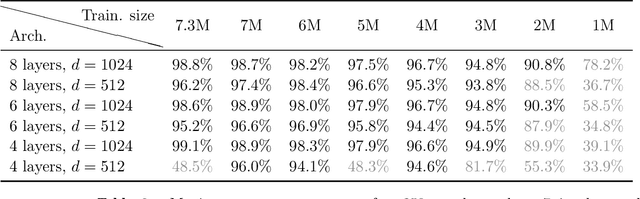
We pursue the use of deep learning methods to improve state-of-the-art computations in theoretical high-energy physics. Planar N = 4 Super Yang-Mills theory is a close cousin to the theory that describes Higgs boson production at the Large Hadron Collider; its scattering amplitudes are large mathematical expressions containing integer coefficients. In this paper, we apply Transformers to predict these coefficients. The problem can be formulated in a language-like representation amenable to standard cross-entropy training objectives. We design two related experiments and show that the model achieves high accuracy (> 98%) on both tasks. Our work shows that Transformers can be applied successfully to problems in theoretical physics that require exact solutions.