 Add to Chrome
 Add to Firefox
 Add to Edge
Identifiability and amortized inference limitations in Kuramoto models
Mar 23, 2026
Bayesian inference is a powerful tool for parameter estimation and uncertainty quantification in dynamical systems. However, for nonlinear oscillator networks such as Kuramoto models, widely used to study synchronization phenomena in physics, biology, and engineering, inference is often computationally prohibitive due to high-dimensional state spaces and intractable likelihood functions. We present an amortized Bayesian inference approach that learns a neural approximation of the posterior from simulated phase dynamics, enabling fast, scalable inference without repeated sampling or optimization. Applied to synthetic Kuramoto networks, the method shows promising results in approximating posterior distributions and capturing uncertainty, with computational savings compared to traditional Bayesian techniques. These findings suggest that amortized inference is a practical and flexible framework for uncertainty-aware analysis of oscillator networks.

Log-Gaussian Gamma Processes for Training Bayesian Neural Networks in Raman and CARS Spectroscopies
Oct 12, 2023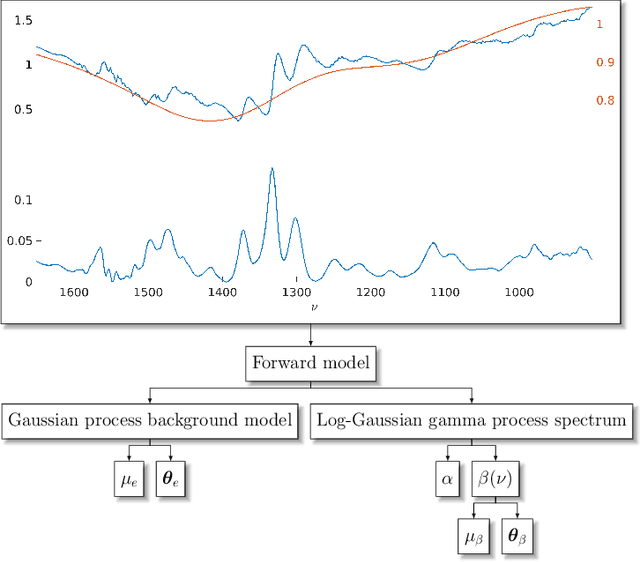
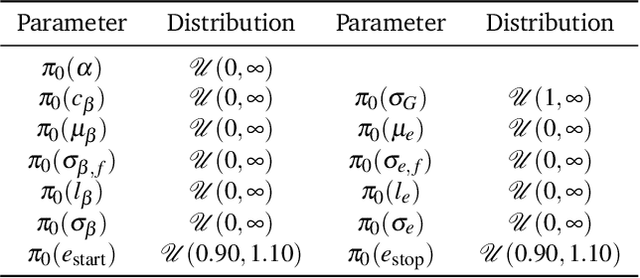
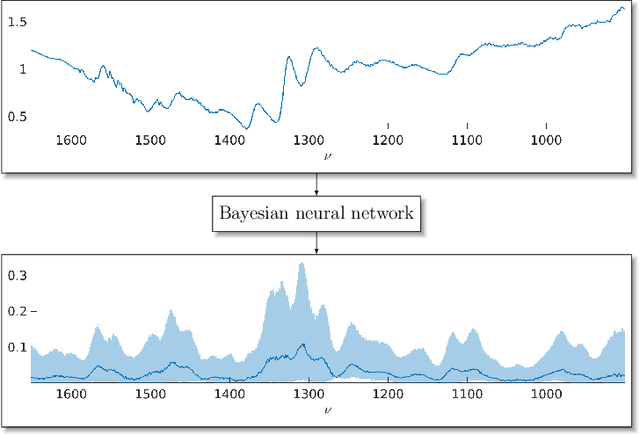
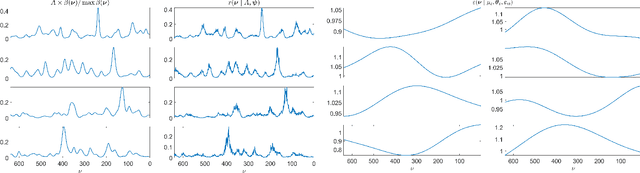
We propose an approach utilizing gamma-distributed random variables, coupled with log-Gaussian modeling, to generate synthetic datasets suitable for training neural networks. This addresses the challenge of limited real observations in various applications. We apply this methodology to both Raman and coherent anti-Stokes Raman scattering (CARS) spectra, using experimental spectra to estimate gamma process parameters. Parameter estimation is performed using Markov chain Monte Carlo methods, yielding a full Bayesian posterior distribution for the model which can be sampled for synthetic data generation. Additionally, we model the additive and multiplicative background functions for Raman and CARS with Gaussian processes. We train two Bayesian neural networks to estimate parameters of the gamma process which can then be used to estimate the underlying Raman spectrum and simultaneously provide uncertainty through the estimation of parameters of a probability distribution. We apply the trained Bayesian neural networks to experimental Raman spectra of phthalocyanine blue, aniline black, naphthol red, and red 264 pigments and also to experimental CARS spectra of adenosine phosphate, fructose, glucose, and sucrose. The results agree with deterministic point estimates for the underlying Raman and CARS spectral signatures.