 Add to Chrome
 Add to Firefox
 Add to Edge
Identifiability and amortized inference limitations in Kuramoto models
Mar 23, 2026
Bayesian inference is a powerful tool for parameter estimation and uncertainty quantification in dynamical systems. However, for nonlinear oscillator networks such as Kuramoto models, widely used to study synchronization phenomena in physics, biology, and engineering, inference is often computationally prohibitive due to high-dimensional state spaces and intractable likelihood functions. We present an amortized Bayesian inference approach that learns a neural approximation of the posterior from simulated phase dynamics, enabling fast, scalable inference without repeated sampling or optimization. Applied to synthetic Kuramoto networks, the method shows promising results in approximating posterior distributions and capturing uncertainty, with computational savings compared to traditional Bayesian techniques. These findings suggest that amortized inference is a practical and flexible framework for uncertainty-aware analysis of oscillator networks.

Filtering with Randomised Observations: Sequential Learning of Relevant Subspace Properties and Accuracy Analysis
Sep 05, 2025State estimation that combines observational data with mathematical models is central to many applications and is commonly addressed through filtering methods, such as ensemble Kalman filters. In this article, we examine the signal-tracking performance of a continuous ensemble Kalman filtering under fixed, randomised, and adaptively varying partial observations. Rigorous bounds are established for the expected signal-tracking error relative to the randomness of the observation operator. In addition, we propose a sequential learning scheme that adaptively determines the dimension of a state subspace sufficient to ensure bounded filtering error, by balancing observation complexity with estimation accuracy. Beyond error control, the adaptive scheme provides a systematic approach to identifying the appropriate size of the filter-relevant subspace of the underlying dynamics.
Bayesian LSTM for indoor temperature modeling
Apr 04, 2025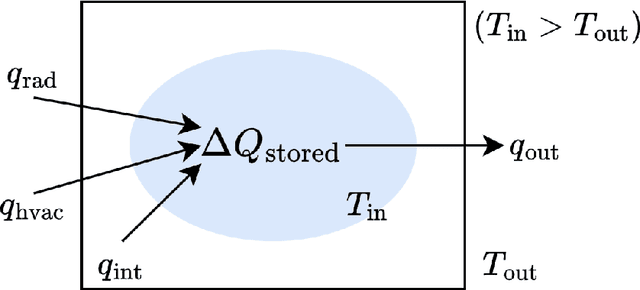
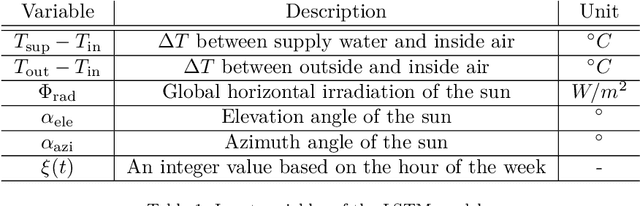
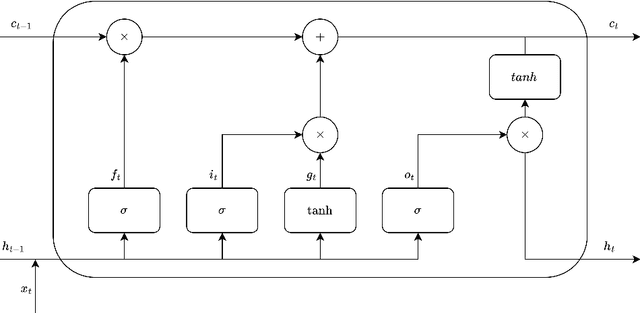
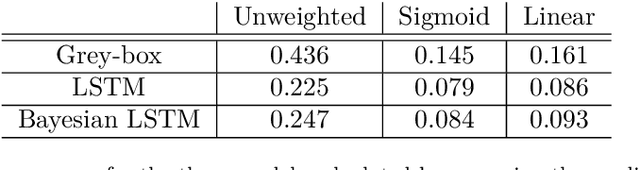
Improving energy efficiency of building heating systems is essential for reducing global energy consumption and greenhouse gas emissions. Traditional control methods in buildings rely on static heating curves based solely on outdoor temperature measurements, neglecting system state and free heat sources like solar gain. Model predictive control (MPC) not only addresses these limitations but further optimizes heating control by incorporating weather forecasts and system state predictions. However, current industrial MPC solutions often use simplified physics-inspired models, which compromise accuracy for interpretability. While purely data-driven models offer better predictive performance, they face challenges like overfitting and lack of transparency. To bridge this gap, we propose a Bayesian Long Short-Term Memory (LSTM) architecture for indoor temperature modeling. Our experiments across 100 real-world buildings demonstrate that the Bayesian LSTM outperforms an industrial physics-based model in predictive accuracy, enabling potential for improved energy efficiency and thermal comfort if deployed in heating MPC solutions. Over deterministic black-box approaches, the Bayesian framework provides additional advantages by improving generalization ability and allowing interpretation of predictions via uncertainty quantification. This work advances data-driven heating control by balancing predictive performance with the transparency and reliability required for real-world heating MPC applications.
Reinforcement learning and Bayesian data assimilation for model-informed precision dosing in oncology
Jun 01, 2020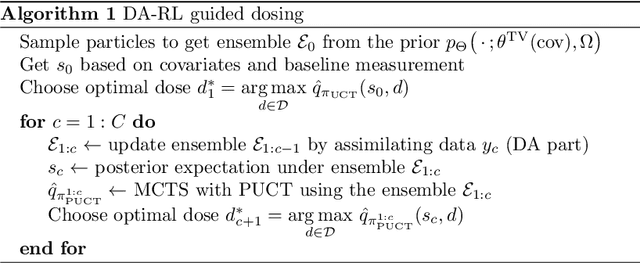
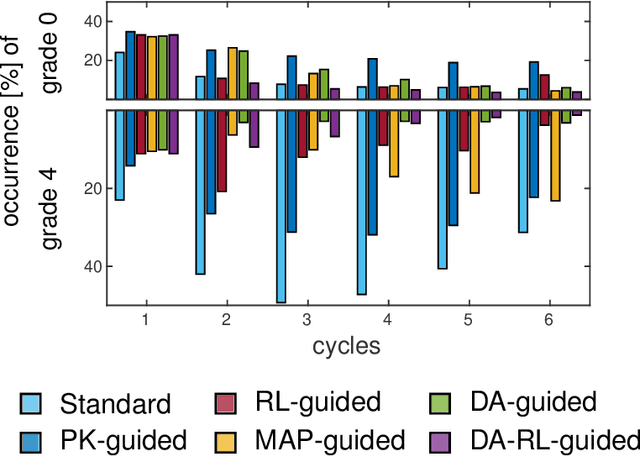
Model-informed precision dosing (MIPD) using therapeutic drug/biomarker monitoring offers the opportunity to significantly improve the efficacy and safety of drug therapies. Current strategies comprise model-informed dosing tables or are based on maximum a-posteriori estimates. These approaches, however, lack a quantification of uncertainty and/or consider only part of the available patient-specific information. We propose three novel approaches for MIPD employing Bayesian data assimilation (DA) and/or reinforcement learning (RL) to control neutropenia, the major dose-limiting side effect in anticancer chemotherapy. These approaches have the potential to substantially reduce the incidence of life-threatening grade 4 and subtherapeutic grade 0 neutropenia compared to existing approaches. We further show that RL allows to gain further insights by identifying patient factors that drive dose decisions. Due to its flexibility, the proposed combined DA-RL approach can easily be extended to integrate multiple endpoints or patient-reported outcomes, thereby promising important benefits for future personalized therapies.