 Add to Chrome
 Add to Firefox
 Add to Edge
Shallower ReLU Network Representations via Exact Linear Algebra
Jul 22, 2026
We prove that the maximum of $n$ real numbers is exactly representable by a ReLU network with two hidden layers for every $n\le 10$. The constructions are obtained by reducing the problem to exact rational linear algebra: after a symmetry reduction, the necessary cancellations are encoded in finite linear systems over $\mathbb{Q}$, which we solve and verify computationally. The representation of $\max_{10}$ has a structured first hidden layer consisting only of pairwise maxima, a feature that allows it to be recursively substituted into larger networks. We use this to show that for every $n>10$, the maximum $\max_{n}$ can be exactly represented with $\lceil{\log_5 (n / 2)\rceil}+1 < \log_5(n) +1.5694$ hidden layers. Via the generalized hinging-hyperplane representation [Wang, Sun, IEEE Trans. Inf. Theory 2005], the same depth bound holds for all continuous piecewise-linear functions on $\mathbb{R}^d$, with $d+1$ in place of $n$. In particular, every continuous piecewise-linear function on $\mathbb{R}^d$ for $d\le 9$ admits a two-hidden-layer ReLU representation. Our results improve on [Bakaev, Brunck, Hertrich, Stade, Yehudayoff, STOC'26]. In that work, the authors established a two-hidden-layer representation for $\max_{5}$ and an upper bound of $\lceil{\log_3 (n-2)\rceil}+1$ hidden layers for $\max_{n}$.

T-RECS: A Simulation Tool to Study the Societal Impact of Recommender Systems
Jul 28, 2021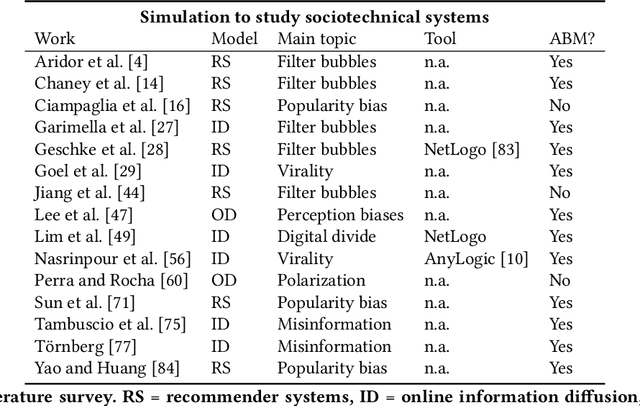
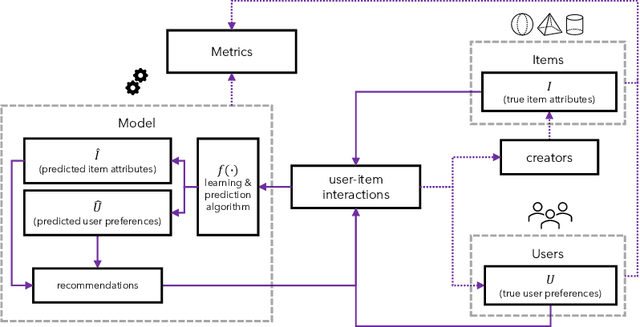
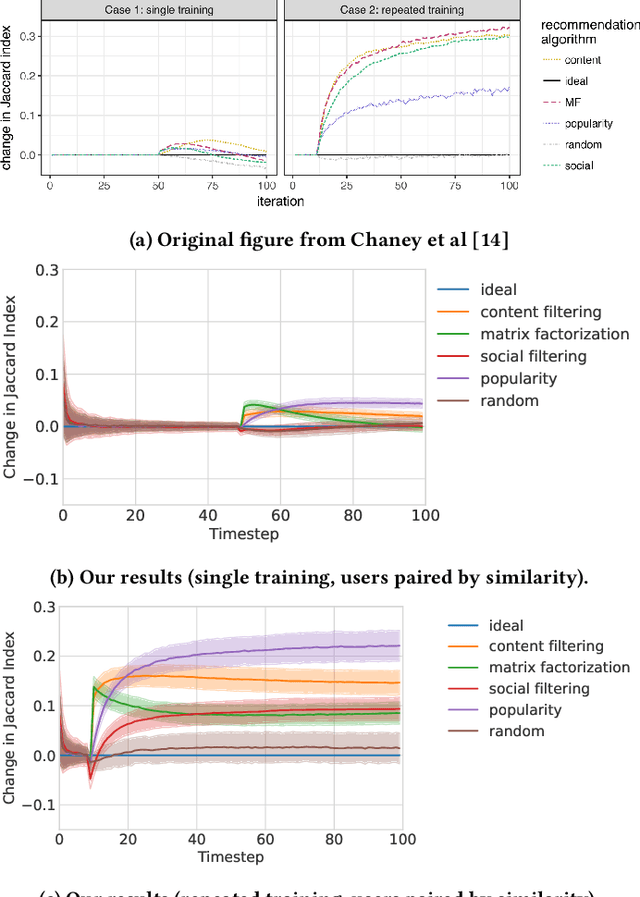
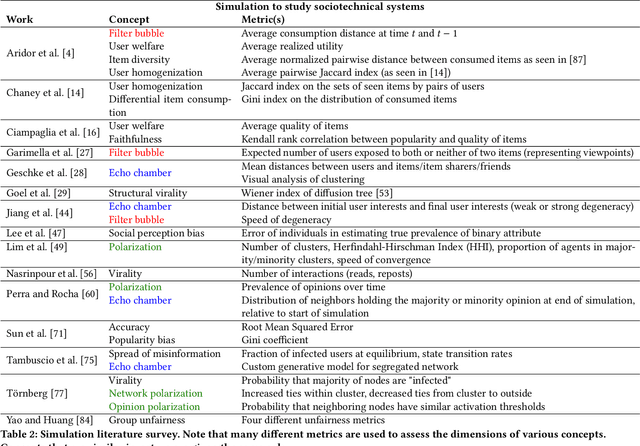
Simulation has emerged as a popular method to study the long-term societal consequences of recommender systems. This approach allows researchers to specify their theoretical model explicitly and observe the evolution of system-level outcomes over time. However, performing simulation-based studies often requires researchers to build their own simulation environments from the ground up, which creates a high barrier to entry, introduces room for implementation error, and makes it difficult to disentangle whether observed outcomes are due to the model or the implementation. We introduce T-RECS, an open-sourced Python package designed for researchers to simulate recommendation systems and other types of sociotechnical systems in which an algorithm mediates the interactions between multiple stakeholders, such as users and content creators. To demonstrate the flexibility of T-RECS, we perform a replication of two prior simulation-based research on sociotechnical systems. We additionally show how T-RECS can be used to generate novel insights with minimal overhead. Our tool promotes reproducibility in this area of research, provides a unified language for simulating sociotechnical systems, and removes the friction of implementing simulations from scratch.