 Add to Chrome
 Add to Firefox
 Add to Edge
Procedural Content Metageneration via Program Search and Continual Abstraction Discovery
Aug 18, 2026
Large language models can generate executable programs, which makes it possible to search directly over procedural content generators rather than individual levels. We study this approach in Sokoban, Zelda, Dangerous Dave, and Lode Runner. Each run evolves complete Python generators through language-model mutation and crossover. We introduce Continual Abstraction Discovery, or CAD, which extracts reusable primitives from high-fitness programs into a run-specific helper module. A 2x2 experiment crosses CAD with access to a fixed hand-written domain API. The completed data set contains 160 complete runs, with at least ten 50-generation runs in every cell. CAD raises mean final best fitness in all eight domain and API comparisons. Across all CAD runs, learned libraries are adopted by most later programs and repeatedly rediscover validation, reachability, and structural utilities. These results support that discovering reusable primitives improves evolutionary program search for content generators.

The Time Value of Evolution
Aug 13, 2026In evolutionary search, a weak child can be a valuable ancestor that makes high-fitness regions reachable. Immediate-return control is blind to this delayed utility, penalizing mutations through their immediate offspring even when they open productive future lineages. We formalize this hidden dynamic as the time value of evolution within a finite-horizon Markov decision process. To exploit it, we introduce Lineage-Value Policy Gradients (LVPG), a long-horizon actor-critic framework for automated trading policy discovery. Our architecture decouples search control into specialized policy heads over a shared generative backbone: a bootstrapped critic head estimates the value of finite-horizon lineage potential from multi-step mutation trees, while an actor head dynamically modulates mutation intensity over the remaining search budget. We isolate the impact of long-horizon credit assignment against immediate-return optimization across 90 paired runs under matched operators, lineage supervision, folds, seeds, and budgets. Path-based credit assignment substantially accelerates finite-budget search, increasing validation best-so-far AUC by 0.394 Sharpe units. LVPG also produces fewer temporary regressions than immediate-return optimization and recovers from them more often. Finite-horizon lineage value yields more selective non-monotonic search and stronger policies within identical resource constraints.
ELMER: Evolutionary Language Model that Explores and Refines
Aug 10, 2026Program evolution can measure whether a mutation helped, but it rarely controls how far the mutation moves in behavior space. Syntactic edit size is an unreliable proxy: a small code change can alter nearly every action, while a larger rewrite can preserve the same execution trace. We introduce an Evolutionary Language Model that searches over natural-language policy descriptions and compiles typed programs for execution. A fully fine-tuned Qwen3-8B model learns three task-conditioned operations: conditional semantic mutation, natural language to domain-specific language (GPTL) compilation, and GPTL to natural language translation. The model is fine-tuned with conditional input on the mutation strength (low, medium, high) using Direct Preference Optimization (oDPO). Across 252 fixed-budget evolutionary searches, oDPO improves both behavioral calibration and finite-budget search efficiency. Natural-language attains the highest observed held-out fitness. Our analysis shows that the condition input (mutation strength) systematically changes semantic edit composition and that language mutations preserve more parent fitness at matched small-to-moderate behavioral displacement. These results show that language can serve as a steerable, execution-grounded search representation over executable program space.
Continuous Program Search
Feb 07, 2026Genetic Programming yields interpretable programs, but small syntactic mutations can induce large, unpredictable behavioral shifts, degrading locality and sample efficiency. We frame this as an operator-design problem: learn a continuous program space where latent distance has behavioral meaning, then design mutation operators that exploit this structure without changing the evolutionary optimizer. We make locality measurable by tracking action-level divergence under controlled latent perturbations, identifying an empirical trust region for behavior-local continuous variation. Using a compact trading-strategy DSL with four semantic components (long/short entry and exit), we learn a matching block-factorized embedding and compare isotropic Gaussian mutation over the full latent space to geometry-compiled mutation that restricts updates to semantically paired entry--exit subspaces and proposes directions using a learned flow-based model trained on logged mutation outcomes. Under identical $(μ+λ)$ evolution strategies and fixed evaluation budgets across five assets, the learned mutation operator discovers strong strategies using an order of magnitude fewer evaluations and achieves the highest median out-of-sample Sharpe ratio. Although isotropic mutation occasionally attains higher peak performance, geometry-compiled mutation yields faster, more reliable progress, demonstrating that semantically aligned mutation can substantially improve search efficiency without modifying the underlying evolutionary algorithm.
Controllable Path of Destruction
May 31, 2023Path of Destruction (PoD) is a self-supervised method for learning iterative generators. The core idea is to produce a training set by destroying a set of artifacts, and for each destructive step create a training instance based on the corresponding repair action. A generator trained on this dataset can then generate new artifacts by repairing from arbitrary states. The PoD method is very data-efficient in terms of original training examples and well-suited to functional artifacts composed of categorical data, such as game levels and discrete 3D structures. In this paper, we extend the Path of Destruction method to allow designer control over aspects of the generated artifacts. Controllability is introduced by adding conditional inputs to the state-action pairs that make up the repair trajectories. We test the controllable PoD method in a 2D dungeon setting, as well as in the domain of small 3D Lego cars.
Path of Destruction: Learning an Iterative Level Generator Using a Small Dataset
Feb 21, 2022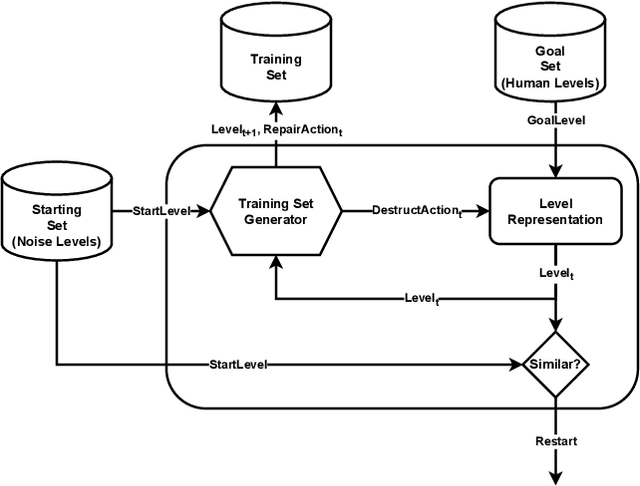
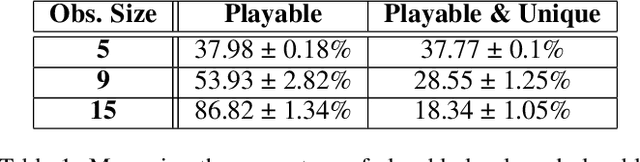
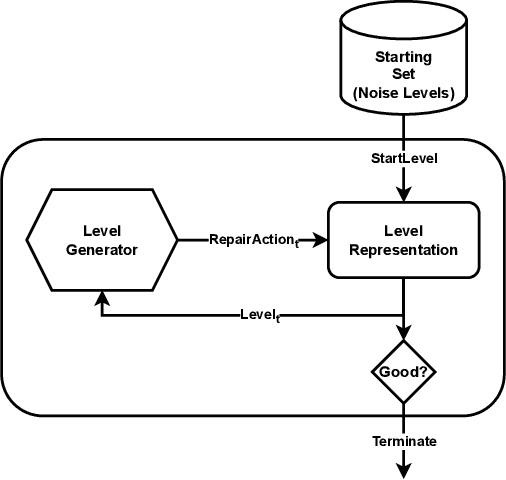
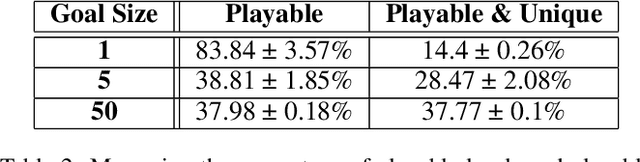
We propose a new procedural content generation method which learns iterative level generators from a dataset of existing levels. The Path of Destruction method, as we call it, views level generation as repair; levels are created by iteratively repairing from a random starting state. The first step is to generate an artificial dataset from the original set of levels by introducing many different sequences of mutations to existing levels. In the generated dataset, features are observations of destroyed levels and targets are the specific actions that repair the mutated tile in the middle of the observations. Using this dataset, a convolutional network is trained to map from observations to their respective appropriate repair actions. The trained network is then used to iteratively produce levels from random starting states. We demonstrate this method by applying it to generate unique and playable tile-based levels for several 2D games (Zelda, Danger Dave, and Sokoban) and vary key hyperparameters.