 Add to Chrome
 Add to Firefox
 Add to Edge
SAME: A Semantically-Aligned Music Autoencoder
May 18, 2026
Latent representations are at the heart of the majority of modern generative models. In the audio domain they are typically produced by a neural-audio-codec autoencoder. In this work we introduce SAME (Semantically-Aligned Music autoEncoder), an autoencoder for stereo music and general audio that reaches a 4096$\times$ temporal compression ratio while maintaining reconstruction quality and downstream generative performance. We achieve this by combining a tranformer-based backbone with set of semantic regularisation approaches, phase-aware reconstruction losses and improved discriminator designs. The architecture delivers substantial computational cost benefits, through both its high compression ratio and its reliance on well-optimised transformer primitives. Two variants (a large SAME-L and a CPU-deployable SAME-S) are released in open-weights form.

General Purpose Audio Effect Removal
Aug 30, 2023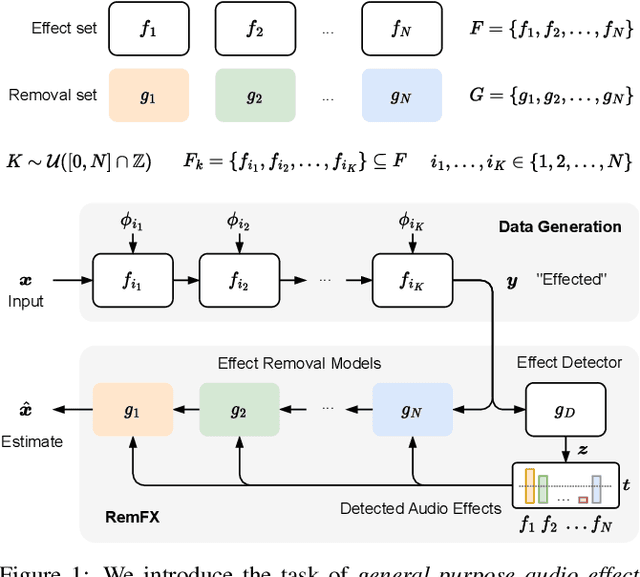
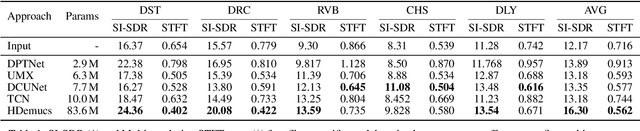
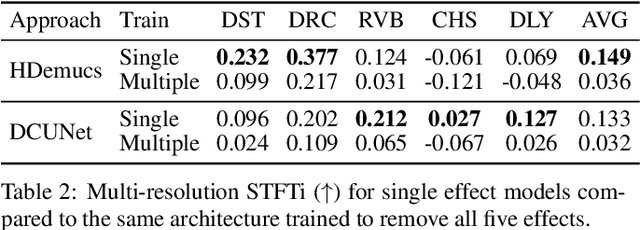
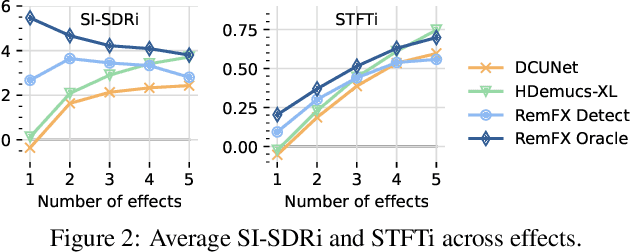
Although the design and application of audio effects is well understood, the inverse problem of removing these effects is significantly more challenging and far less studied. Recently, deep learning has been applied to audio effect removal; however, existing approaches have focused on narrow formulations considering only one effect or source type at a time. In realistic scenarios, multiple effects are applied with varying source content. This motivates a more general task, which we refer to as general purpose audio effect removal. We developed a dataset for this task using five audio effects across four different sources and used it to train and evaluate a set of existing architectures. We found that no single model performed optimally on all effect types and sources. To address this, we introduced RemFX, an approach designed to mirror the compositionality of applied effects. We first trained a set of the best-performing effect-specific removal models and then leveraged an audio effect classification model to dynamically construct a graph of our models at inference. We found our approach to outperform single model baselines, although examples with many effects present remain challenging.