 Add to Chrome
 Add to Firefox
 Add to Edge
BEAST3D: Animal behavioral analysis and neural encoding from multi-view video via Gaussian splatting
Jun 01, 2026
Multi-view video recordings are increasingly used to capture the 3D movements of animals in experimental settings, yet extracting rich 3D representations from these recordings remains challenging. Supervised pose estimation requires extensive manual annotation, while general-purpose 3D reconstruction models trained on generic scene datasets fail on the specialized imagery and sparse-view setting of laboratory experiments. We address these limitations with BEAST3D, a self-supervised pretraining framework that learns 3D visual representations from unlabeled, calibrated multi-view video. BEAST3D uses a vision transformer to predict 3D Gaussian splats that reconstruct held-out views through differentiable rendering, while simultaneously segmenting the animal from the background. BEAST3D reconstructs 3D structure with as few as four views by conditioning directly on known camera parameters--unlike general-purpose models, which must estimate camera geometry from dense overlapping viewpoints that are seldom available in lab settings. Through comprehensive evaluation across four species, we demonstrate that BEAST3D produces rich, viewpoint-invariant features that transfer effectively to three downstream tasks: novel view synthesis, which validates the quality of the learned 3D representations; multi-view pose estimation, which provides the sparse keypoint trajectories widely used in behavioral analysis; and neural encoding, which relates 3D behavioral features to simultaneously recorded neural activity. BEAST3D thus establishes a versatile framework for behavioral analysis that leverages 3D structure in modern multi-view laboratory recordings.

A study of animal action segmentation algorithms across supervised, unsupervised, and semi-supervised learning paradigms
Jul 23, 2024


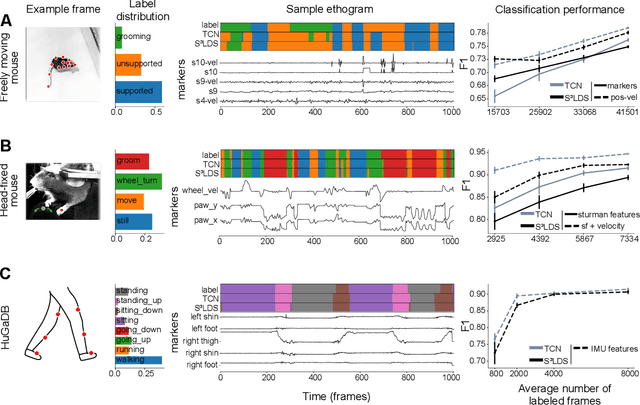
Action segmentation of behavioral videos is the process of labeling each frame as belonging to one or more discrete classes, and is a crucial component of many studies that investigate animal behavior. A wide range of algorithms exist to automatically parse discrete animal behavior, encompassing supervised, unsupervised, and semi-supervised learning paradigms. These algorithms -- which include tree-based models, deep neural networks, and graphical models -- differ widely in their structure and assumptions on the data. Using four datasets spanning multiple species -- fly, mouse, and human -- we systematically study how the outputs of these various algorithms align with manually annotated behaviors of interest. Along the way, we introduce a semi-supervised action segmentation model that bridges the gap between supervised deep neural networks and unsupervised graphical models. We find that fully supervised temporal convolutional networks with the addition of temporal information in the observations perform the best on our supervised metrics across all datasets.