 Add to Chrome
 Add to Firefox
 Add to Edge
A Formative Study of Brief Affective Text as a Complement to Wearable Sensing for Longitudinal Student Health Monitoring
May 14, 2026
Wearable devices capture physiological and behavioral data with increasing fidelity, but the psychological context shaping these outcomes is difficult to recover from sensor data alone, limiting passive sensing utility for digital health. We examined whether ultra-brief naturalistic concern text could serve as a scalable complement to passive sensing. In a year-long study of 458 university students (3,610 person-waves) tracked with Oura rings, participants responded bimonthly to an open-ended prompt about what concerned them most; responses had a median length of three words. We compared dictionary-based, general pretrained, and domain-adapted NLP approaches using within-person mixed-effects models across nine sleep and physical activity outcomes. Weeks dominated by academic concern framing were associated with lower physical activity; weeks characterized by emotional exhaustion language were associated with poorer sleep quality and lower heart rate variability. General pretrained embeddings outperformed domain-adapted models for most outcomes, with domain adaptation showing relative advantage for autonomic outcomes. Zero-shot classification of concern topics produced no significant associations, while affective dimensions across all three methods were consistently associated with outcomes, indicating emotional register rather than topical content carries the signal. These findings offer design guidance: ultra-brief affective prompts enrich the psychological interpretability of passive physiological data at minimal burden.

Quantifying language changes surrounding mental health on Twitter
Jun 02, 2021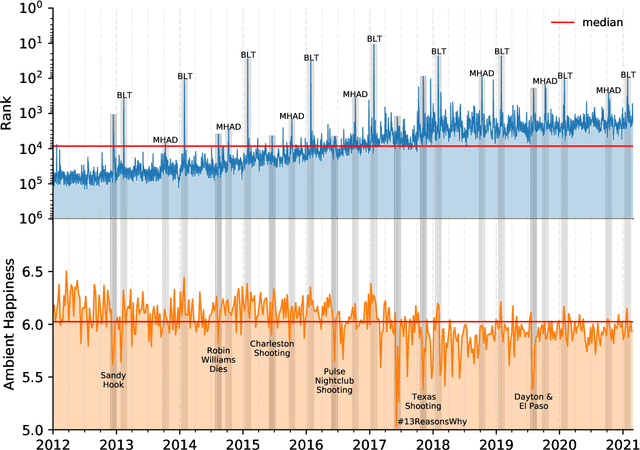
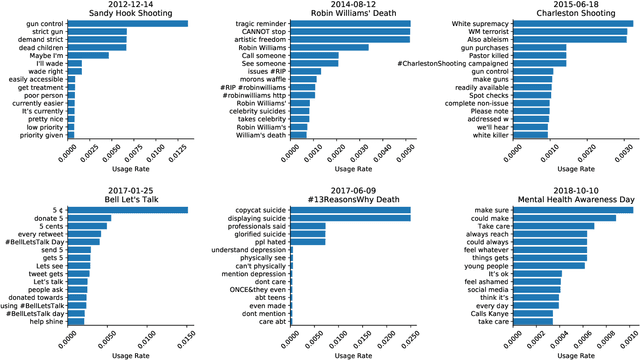
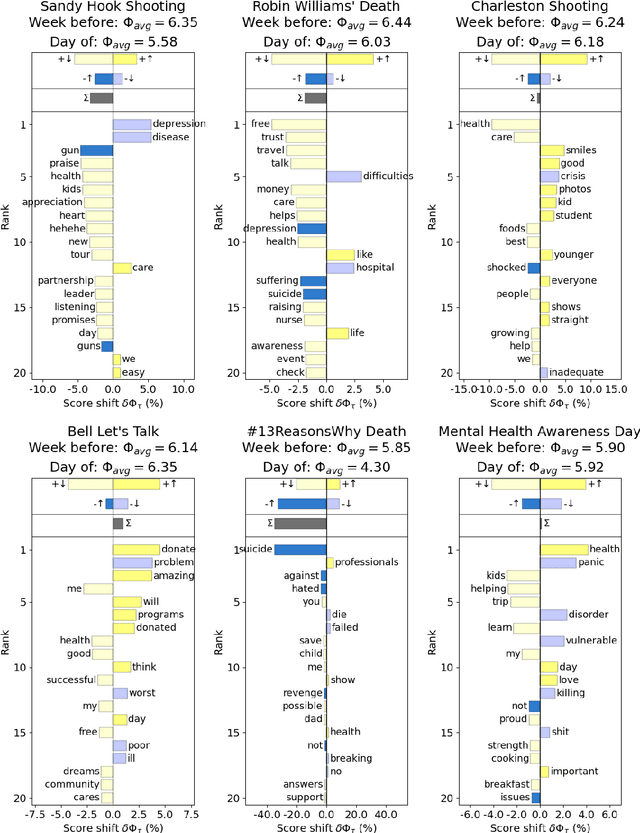
Mental health challenges are thought to afflict around 10% of the global population each year, with many going untreated due to stigma and limited access to services. Here, we explore trends in words and phrases related to mental health through a collection of 1- , 2-, and 3-grams parsed from a data stream of roughly 10% of all English tweets since 2012. We examine temporal dynamics of mental health language, finding that the popularity of the phrase 'mental health' increased by nearly two orders of magnitude between 2012 and 2018. We observe that mentions of 'mental health' spike annually and reliably due to mental health awareness campaigns, as well as unpredictably in response to mass shootings, celebrities dying by suicide, and popular fictional stories portraying suicide. We find that the level of positivity of messages containing 'mental health', while stable through the growth period, has declined recently. Finally, we use the ratio of original tweets to retweets to quantify the fraction of appearances of mental health language due to social amplification. Since 2015, mentions of mental health have become increasingly due to retweets, suggesting that stigma associated with discussion of mental health on Twitter has diminished with time.