 Add to Chrome
 Add to Firefox
 Add to Edge
GenPANIS: A Latent-Variable Generative Framework for Forward and Inverse PDE Problems in Multiphase Media
Feb 16, 2026
Inverse problems and inverse design in multiphase media, i.e., recovering or engineering microstructures to achieve target macroscopic responses, require operating on discrete-valued material fields, rendering the problem non-differentiable and incompatible with gradient-based methods. Existing approaches either relax to continuous approximations, compromising physical fidelity, or employ separate heavyweight models for forward and inverse tasks. We propose GenPANIS, a unified generative framework that preserves exact discrete microstructures while enabling gradient-based inference through continuous latent embeddings. The model learns a joint distribution over microstructures and PDE solutions, supporting bidirectional inference (forward prediction and inverse recovery) within a single architecture. The generative formulation enables training with unlabeled data, physics residuals, and minimal labeled pairs. A physics-aware decoder incorporating a differentiable coarse-grained PDE solver preserves governing equation structure, enabling extrapolation to varying boundary conditions and microstructural statistics. A learnable normalizing flow prior captures complex posterior structure for inverse problems. Demonstrated on Darcy flow and Helmholtz equations, GenPANIS maintains accuracy on challenging extrapolative scenarios - including unseen boundary conditions, volume fractions, and microstructural morphologies, with sparse, noisy observations. It outperforms state-of-the-art methods while using 10 - 100 times fewer parameters and providing principled uncertainty quantification.

Physics-Aware Neural Implicit Solvers for multiscale, parametric PDEs with applications in heterogeneous media
May 29, 2024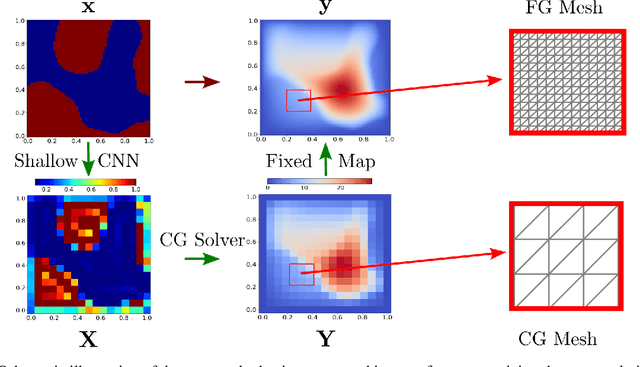
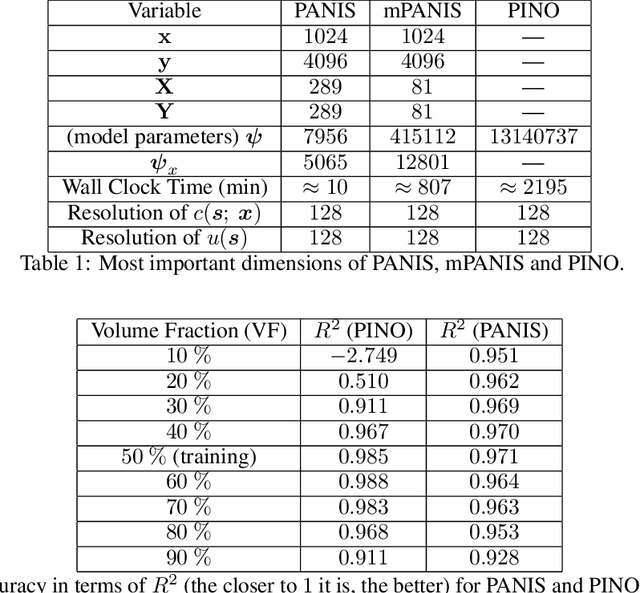
We propose Physics-Aware Neural Implicit Solvers (PANIS), a novel, data-driven framework for learning surrogates for parametrized Partial Differential Equations (PDEs). It consists of a probabilistic, learning objective in which weighted residuals are used to probe the PDE and provide a source of {\em virtual} data i.e. the actual PDE never needs to be solved. This is combined with a physics-aware implicit solver that consists of a much coarser, discretized version of the original PDE, which provides the requisite information bottleneck for high-dimensional problems and enables generalization in out-of-distribution settings (e.g. different boundary conditions). We demonstrate its capability in the context of random heterogeneous materials where the input parameters represent the material microstructure. We extend the framework to multiscale problems and show that a surrogate can be learned for the effective (homogenized) solution without ever solving the reference problem. We further demonstrate how the proposed framework can accommodate and generalize several existing learning objectives and architectures while yielding probabilistic surrogates that can quantify predictive uncertainty.