 Add to Chrome
 Add to Firefox
 Add to Edge
Persistence Spheres: a Bi-continuous Linear Representation of Measures for Partial Optimal Transport
Mar 16, 2026
We improve and extend persistence spheres, introduced in~\cite{pegoraro2025persistence}. Persistence spheres map an integrable measure $μ$ on the upper half-plane, including persistence diagrams (PDs) as counting measures, to a function $S(μ)\in C(\mathbb{S}^2)$, and the map is stable with respect to 1-Wasserstein partial transport distance $\mathrm{POT}_1$. Moreover, to the best of our knowledge, persistence spheres are the first explicit representation used in topological machine learning for which continuity of the inverse on the image is established at every compactly supported target. Recent bounded-cardinality bi-Lipschitz embedding results in partial transport spaces, despite being powerful, are not given by the kind of explicit summary map considered here. Our construction is rooted in convex geometry: for positive measures, the defining ReLU integral is the support function of the lift zonoid. Building on~\cite{pegoraro2025persistence}, we refine the definition to better match the $\mathrm{POT}_1$ deletion mechanism, encoding partial transport via a signed diagonal augmentation. In particular, for integrable $μ$, the uniform norm between $S(0)$ and $S(μ)$ depends only on the persistence of $μ$, without any need of ad-hoc re-weightings, reflecting optimal transport to the diagonal at persistence cost. This yields a parameter-free representation at the level of measures (up to numerical discretization), while accommodating future extensions where $μ$ is a smoothed measure derived from PDs (e.g., persistence intensity functions~\citep{wu2024estimation}). Across clustering, regression, and classification tasks involving functional data, time series, graphs, meshes, and point clouds, the updated persistence spheres are competitive and often improve upon persistence images, persistence landscapes, persistence splines, and sliced Wasserstein kernel baselines.

Imaging-based representation and stratification of intra-tumor Heterogeneity via tree-edit distance
Aug 09, 2022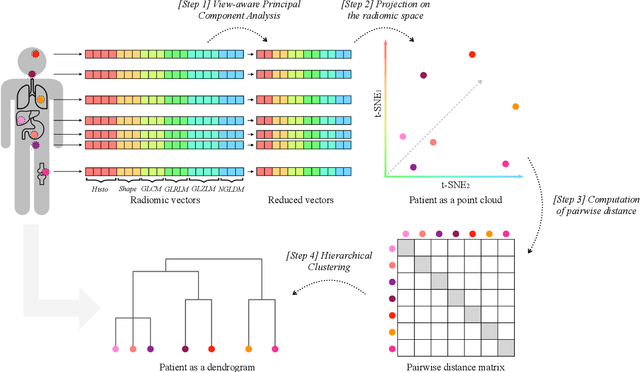
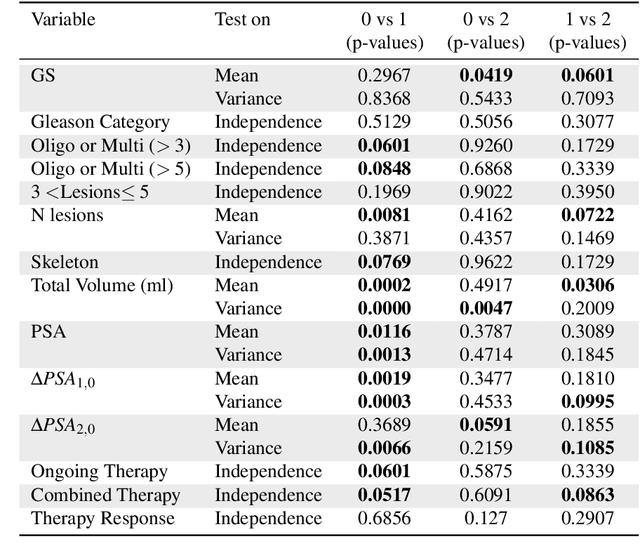
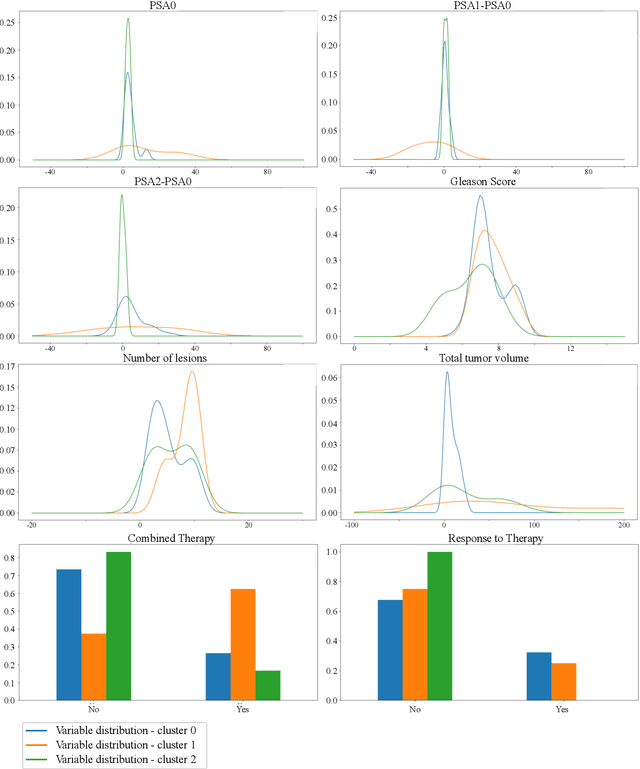
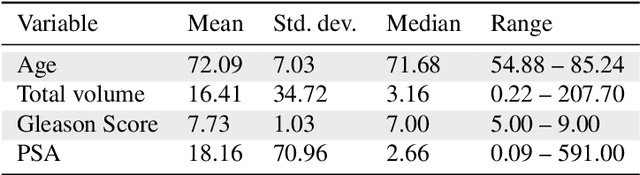
Personalized medicine is the future of medical practice. In oncology, tumor heterogeneity assessment represents a pivotal step for effective treatment planning and prognosis prediction. Despite new procedures for DNA sequencing and analysis, non-invasive methods for tumor characterization are needed to impact on daily routine. On purpose, imaging texture analysis is rapidly scaling, holding the promise to surrogate histopathological assessment of tumor lesions. In this work, we propose a tree-based representation strategy for describing intra-tumor heterogeneity of patients affected by metastatic cancer. We leverage radiomics information extracted from PET/CT imaging and we provide an exhaustive and easily readable summary of the disease spreading. We exploit this novel patient representation to perform cancer subtyping according to hierarchical clustering technique. To this purpose, a new heterogeneity-based distance between trees is defined and applied to a case study of Prostate Cancer (PCa). Clusters interpretation is explored in terms of concordance with severity status, tumor burden and biological characteristics. Results are promising, as the proposed method outperforms current literature approaches. Ultimately, the proposed methods draws a general analysis framework that would allow to extract knowledge from daily acquired imaging data of patients and provide insights for effective treatment planning.
Projected Statistical Methods for Distributional Data on the Real Line with the Wasserstein Metric
Jan 22, 2021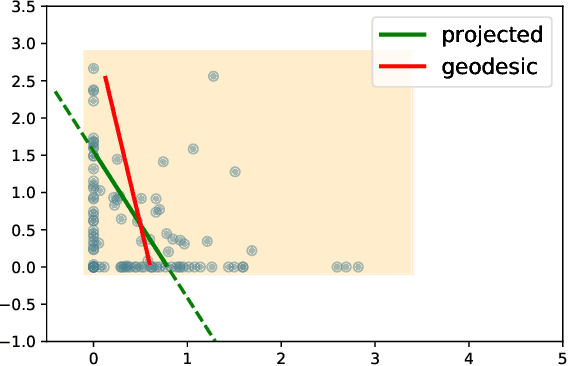

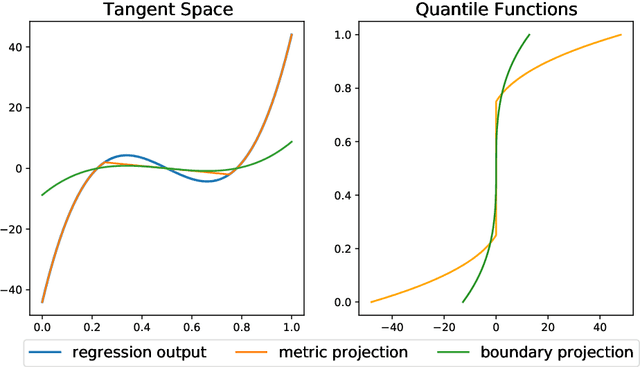

We present a novel class of projected methods, to perform statistical analysis on a data set of probability distributions on the real line, with the 2-Wasserstein metric. We focus in particular on Principal Component Analysis (PCA) and regression. To define these models, we exploit a representation of the Wasserstein space closely related to its weak Riemannian structure, by mapping the data to a suitable linear space and using a metric projection operator to constrain the results in the Wasserstein space. By carefully choosing the tangent point, we are able to derive fast empirical methods, exploiting a constrained B-spline approximation. As a byproduct of our approach, we are also able to derive faster routines for previous work on PCA for distributions. By means of simulation studies, we compare our approaches to previously proposed methods, showing that our projected PCA has similar performance for a fraction of the computational cost and that the projected regression is extremely flexible even under misspecification. Several theoretical properties of the models are investigated and asymptotic consistency is proven. Two real world applications to Covid-19 mortality in the US and wind speed forecasting are discussed.