 Add to Chrome
 Add to Firefox
 Add to Edge
A Geometric View of Counterfactual Behavior: Interaction of Boundary Proximity and Local Support
Jun 02, 2026
Counterfactual explanations seek small, semantically meaningful changes to an input that alter a model's prediction, and are widely used to interpret and audit machine learning systems. In modern vision, language, and multimodal systems, pretrained encoders map inputs to representation spaces, and downstream classifier heads impose decision boundaries within those spaces. As a result, the feasibility and distance of nearby counterfactuals depend on boundary placement relative to the data. Yet models with similar predictive performance can differ substantially in whether such changes are achievable and how far representations must move. This work examines this variation using a standardized local search probe across several pretrained encoders and linear classifier heads. Results show that despite similar predictive performance, models differ substantially in their counterfactual behavior. Under fixed representations, varying only the classifier head alters counterfactual outcomes while leaving predictive performance largely unchanged. This variation is explained by the interaction of decision-boundary proximity and local data support, which jointly determine whether prediction changes are both feasible and lie in regions supported by the data, and can also improve counterfactual search within fixed models. Together, these findings identify counterfactual behavior as a distinct dimension beyond predictive performance and show that it can be altered without changing accuracy, with implications for model selection, robustness, and the reliability of counterfactual methods.

Improving Adversarial Robustness of Attribution via Implicit Regularization
May 28, 2026The adversarial robustness of attributions is a fundamental requirement for reliable explainability in deep learning, yet existing approaches typically rely on computationally expensive explicit regularization. In this work, we show that attribution robustness can arise implicitly from the learning dynamics of standard stochastic gradient descent. We theoretically motivate this effect through connections between parameter-space and input-space curvature, and validate it across architectures, datasets, and attribution methods, with negligible computational overhead. In contrast, we prove that such robustness gains often does not transfer to attention-based attribution under softmax normalization, due to inherent entropy constraints, and we validate this limitation experimentally. Finally, we show that replacing softmax attention with kernel-based attention restores the robustness gains in transformer models. Our results highlight learning dynamics as a principled and practical mechanism for robust explainability, and reveal fundamental limitations of attention-based attribution under normalization.
Bayesian Self-Distillation for Image Classification
Dec 30, 2025Supervised training of deep neural networks for classification typically relies on hard targets, which promote overconfidence and can limit calibration, generalization, and robustness. Self-distillation methods aim to mitigate this by leveraging inter-class and sample-specific information present in the model's own predictions, but often remain dependent on hard targets, reducing their effectiveness. With this in mind, we propose Bayesian Self-Distillation (BSD), a principled method for constructing sample-specific target distributions via Bayesian inference using the model's own predictions. Unlike existing approaches, BSD does not rely on hard targets after initialization. BSD consistently yields higher test accuracy (e.g. +1.4% for ResNet-50 on CIFAR-100) and significantly lower Expected Calibration Error (ECE) (-40% ResNet-50, CIFAR-100) than existing architecture-preserving self-distillation methods for a range of deep architectures and datasets. Additional benefits include improved robustness against data corruptions, perturbations, and label noise. When combined with a contrastive loss, BSD achieves state-of-the-art robustness under label noise for single-stage, single-network methods.
On the Lipschitz Constant of Deep Networks and Double Descent
Feb 16, 2023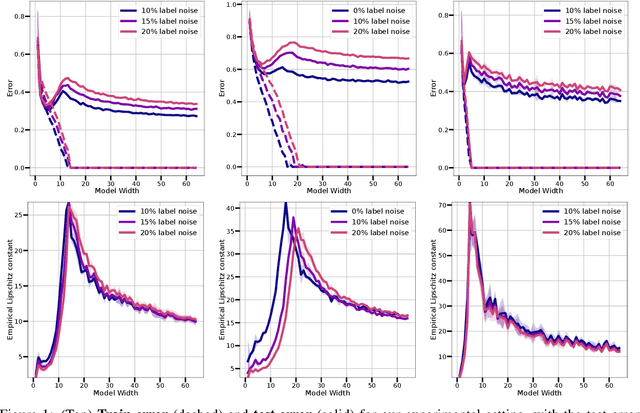
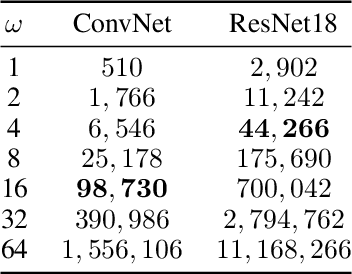
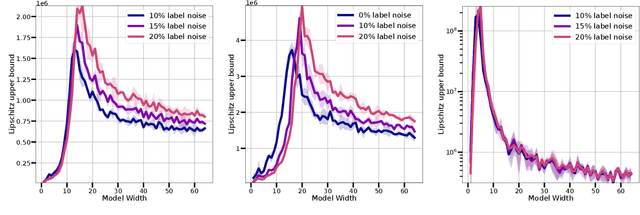
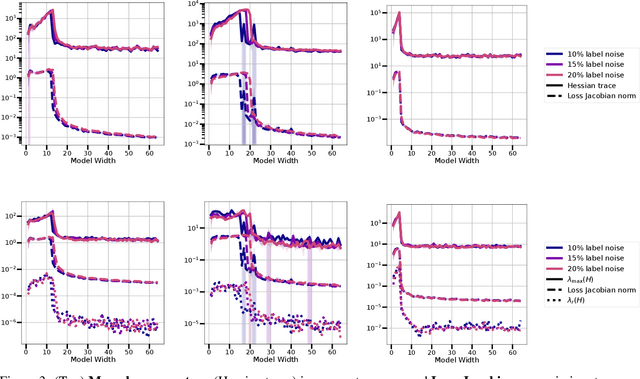
Existing bounds on the generalization error of deep networks assume some form of smooth or bounded dependence on the input variable, falling short of investigating the mechanisms controlling such factors in practice. In this work, we present an extensive experimental study of the empirical Lipschitz constant of deep networks undergoing double descent, and highlight non-monotonic trends strongly correlating with the test error. Building a connection between parameter-space and input-space gradients for SGD around a critical point, we isolate two important factors -- namely loss landscape curvature and distance of parameters from initialization -- respectively controlling optimization dynamics around a critical point and bounding model function complexity, even beyond the training data. Our study presents novels insights on implicit regularization via overparameterization, and effective model complexity for networks trained in practice.
Deep Double Descent via Smooth Interpolation
Sep 21, 2022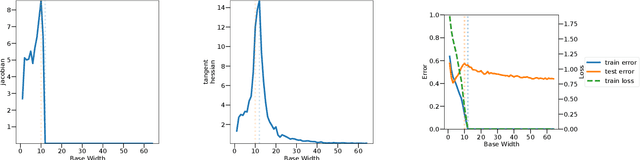
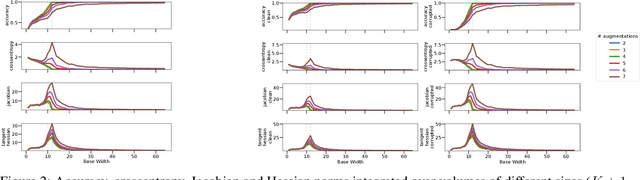
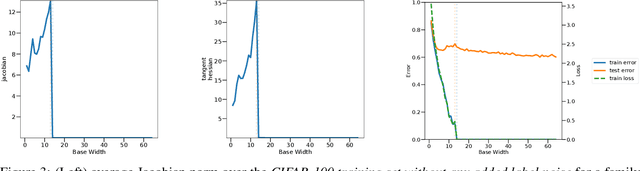
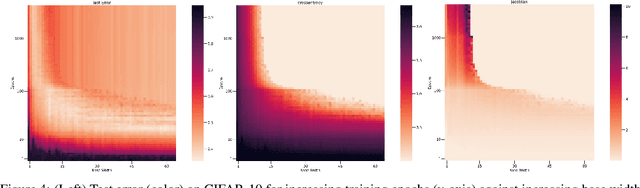
Overparameterized deep networks are known to be able to perfectly fit the training data while at the same time showing good generalization performance. A common paradigm drawn from intuition on linear regression suggests that large networks are able to interpolate even noisy data, without considerably deviating from the ground-truth signal. At present, a precise characterization of this phenomenon is missing. In this work, we present an empirical study of sharpness of the loss landscape of deep networks as we systematically control the number of model parameters and training epochs. We extend our study to neighbourhoods of the training data, as well as around cleanly- and noisily-labelled samples. Our findings show that the loss sharpness in the input space follows both model- and epoch-wise double descent, with worse peaks observed around noisy labels. While small interpolating models sharply fit both clean and noisy data, large models express a smooth and flat loss landscape, in contrast with existing intuition.
Are All Linear Regions Created Equal?
Feb 23, 2022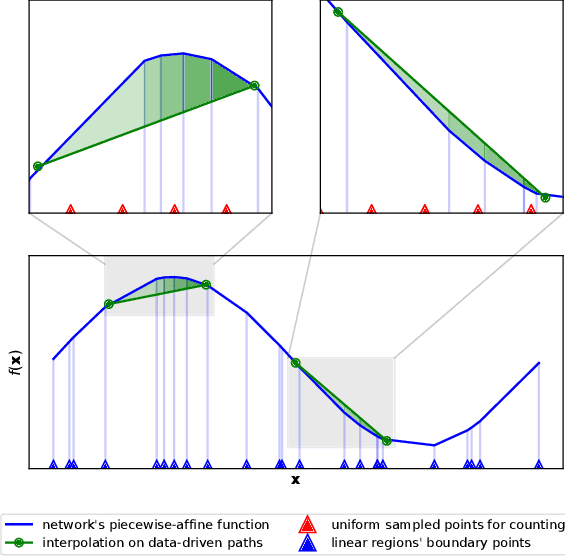
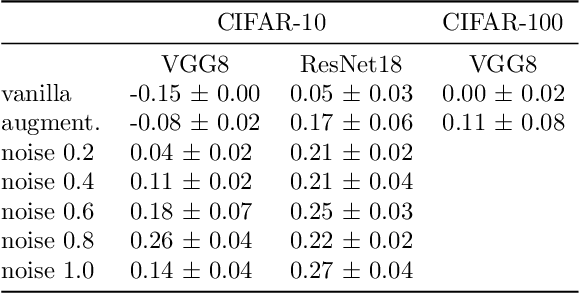
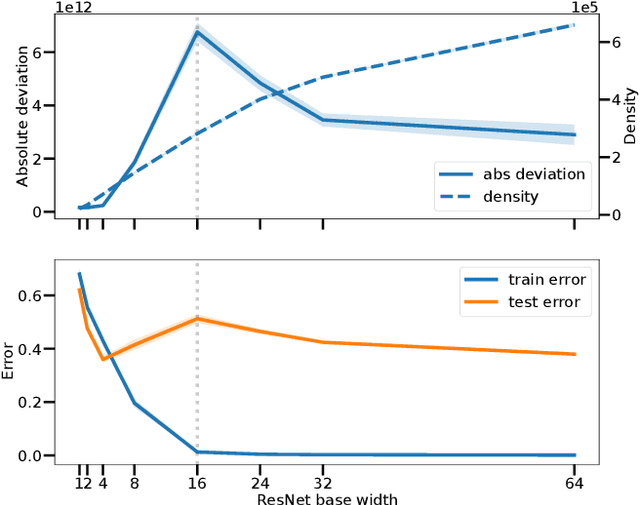
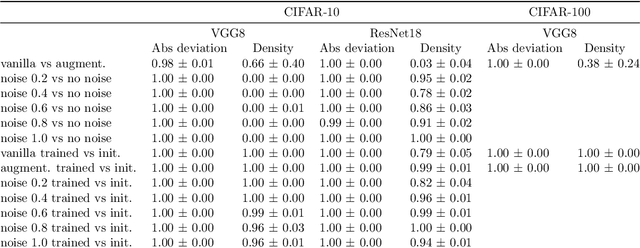
The number of linear regions has been studied as a proxy of complexity for ReLU networks. However, the empirical success of network compression techniques like pruning and knowledge distillation, suggest that in the overparameterized setting, linear regions density might fail to capture the effective nonlinearity. In this work, we propose an efficient algorithm for discovering linear regions and use it to investigate the effectiveness of density in capturing the nonlinearity of trained VGGs and ResNets on CIFAR-10 and CIFAR-100. We contrast the results with a more principled nonlinearity measure based on function variation, highlighting the shortcomings of linear regions density. Furthermore, interestingly, our measure of nonlinearity clearly correlates with model-wise deep double descent, connecting reduced test error with reduced nonlinearity, and increased local similarity of linear regions.
Hyperplane Arrangements of Trained ConvNets Are Biased
Mar 17, 2020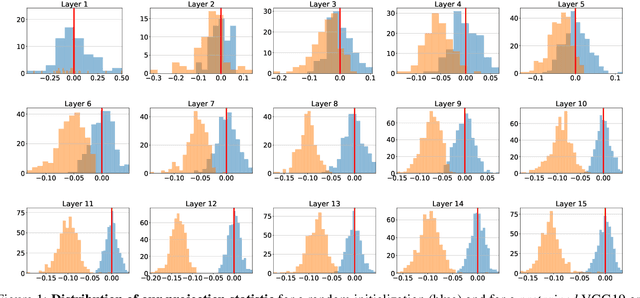
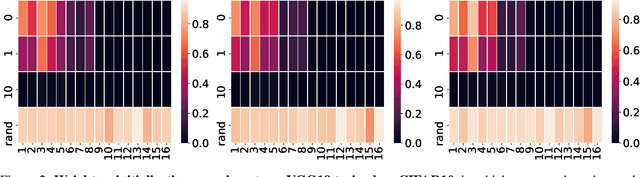
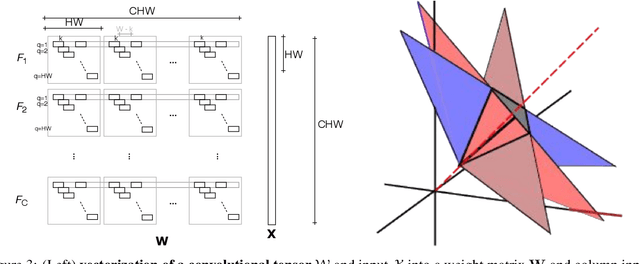

We investigate the geometric properties of the functions learned by trained ConvNets in the preactivation space of their convolutional layers, by performing an empirical study of hyperplane arrangements induced by a convolutional layer. We introduce statistics over the weights of a trained network to study local arrangements and relate them to the training dynamics. We observe that trained ConvNets show a significant statistical bias towards regular hyperplane configurations. Furthermore, we find that layers showing biased configurations are critical to validation performance for the architectures considered, trained on CIFAR10, CIFAR100 and ImageNet.