 Add to Chrome
 Add to Firefox
 Add to Edge
Theory of Mind and Persuasion Beyond Conversation: Assessing the Capacity of LLMs to Induce Belief States via Planning and Action
Jun 30, 2026
Theory of Mind (ToM) benchmarks for Large Language Models (LLMs) typically rely on passive question-answering formats, but the deployment of LLMs in increasingly agentic and autonomous forms demands new evaluations. In this paper we evaluate an agent's ability to induce specific belief states in other agents by taking actions rather than using conversational persuasion, a capability we call Non-Conversational Planning ToM (NCP-ToM). NCP-ToM is likely to be essential for many agent use-cases, including within user-assistant interactions and pedagogical contexts, but may also present manipulation or misinformation risks. Using a novel framework, NCP-ExploreToM, we subvert the conventional task structure by providing models with a set of belief state goals and requiring them to move objects or direct characters into rooms to achieve their goals. We evaluated six frontier models, including GPT-5, Gemini 2.5 Pro and the Claude 4 series, and a cohort of human participants, across 600 task instances. GPT-5 was successful on approximately 80% of tasks in the agentic setting, and was the only model to outperform human participants on our task, but was still less robust than humans across contexts. We additionally found that all models, like humans, performed better on tasks inducing true belief states than false belief states, which is a positive signal for alignment efforts. These findings highlight emerging social-reasoning capabilities in LLMs for non-conversational task completion and underscore the necessity of agentic evaluations for understanding the safety and alignment of autonomous social agents.

A little less conversation, a little more action, please: Investigating the physical common-sense of LLMs in a 3D embodied environment
Oct 30, 2024
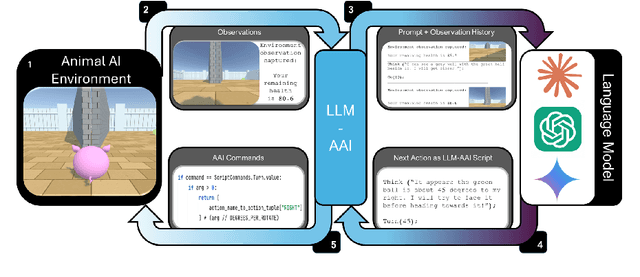

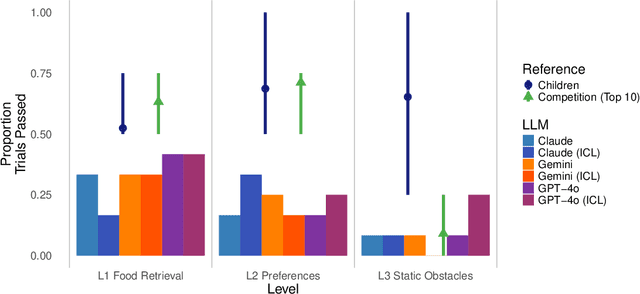
As general-purpose tools, Large Language Models (LLMs) must often reason about everyday physical environments. In a question-and-answer capacity, understanding the interactions of physical objects may be necessary to give appropriate responses. Moreover, LLMs are increasingly used as reasoning engines in agentic systems, designing and controlling their action sequences. The vast majority of research has tackled this issue using static benchmarks, comprised of text or image-based questions about the physical world. However, these benchmarks do not capture the complexity and nuance of real-life physical processes. Here we advocate for a second, relatively unexplored, approach: 'embodying' the LLMs by granting them control of an agent within a 3D environment. We present the first embodied and cognitively meaningful evaluation of physical common-sense reasoning in LLMs. Our framework allows direct comparison of LLMs with other embodied agents, such as those based on Deep Reinforcement Learning, and human and non-human animals. We employ the Animal-AI (AAI) environment, a simulated 3D virtual laboratory, to study physical common-sense reasoning in LLMs. For this, we use the AAI Testbed, a suite of experiments that replicate laboratory studies with non-human animals, to study physical reasoning capabilities including distance estimation, tracking out-of-sight objects, and tool use. We demonstrate that state-of-the-art multi-modal models with no finetuning can complete this style of task, allowing meaningful comparison to the entrants of the 2019 Animal-AI Olympics competition and to human children. Our results show that LLMs are currently outperformed by human children on these tasks. We argue that this approach allows the study of physical reasoning using ecologically valid experiments drawn directly from cognitive science, improving the predictability and reliability of LLMs.