 Add to Chrome
 Add to Firefox
 Add to Edge
Large language models can disambiguate opioid slang on social media
Mar 11, 2026
Social media text shows promise for monitoring trends in the opioid overdose crisis; however, the overwhelming majority of social media text is unrelated to opioids. When leveraging social media text to monitor trends in the ongoing opioid overdose crisis, a common strategy for identifying relevant content is to use a lexicon of opioid-related terms as inclusion criteria. However, many slang terms for opioids, such as "smack" or "blues," have common non-opioid meanings, making them ambiguous. The advanced textual reasoning capability of large language models (LLMs) presents an opportunity to disambiguate these slang terms at scale. We present three tasks on which to evaluate four state-of-the-art LLMs (GPT-4, GPT-5, Gemini 2.5 Pro, and Claude Sonnet 4.5): a lexicon-based setting, in which the LLM must disambiguate a specific term within the context of a given post; a lexicon-free setting, in which the LLM must identify opioid-related posts from context without a lexicon; and an emergent slang setting, in which the LLM must identify opioid-related posts with simulated new slang terms. All four LLMs showed excellent performance across all tasks. In both subtasks of the lexicon-based setting, LLM F1 scores ("fenty" subtask: 0.824-0.972; "smack" subtask: 0.540-0.862) far exceeded those of the best lexicon strategy (0.126 and 0.009, respectively). In the lexicon-free task, LLM F1 scores (0.544-0.769) surpassed those of lexicons (0.080-0.540), and LLMs demonstrated uniformly higher recall. On emergent slang, all LLMs had higher accuracy (average: 0.784), F1 score (average: 0.712), precision (average: 0.981), and recall (average: 0.587) than the two lexicons assessed. Our results show that LLMs can be used to identify relevant content for low-prevalence topics, including but not limited to opioid references, enhancing data provided to downstream analyses and predictive models.

AI for Anticipatory Action: Moving Beyond Climate Forecasting
Jul 28, 2023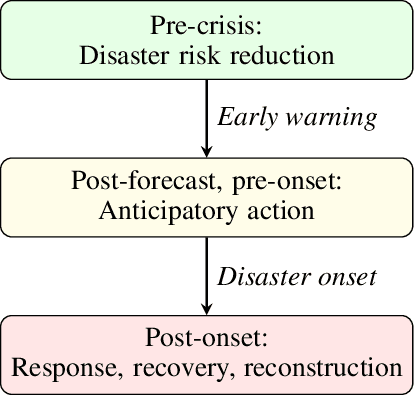
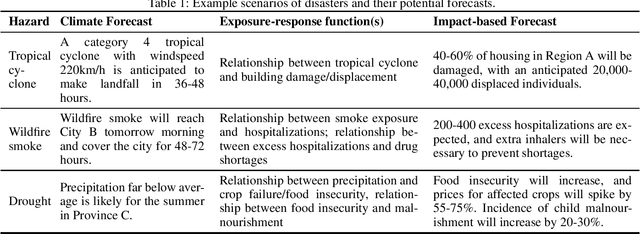
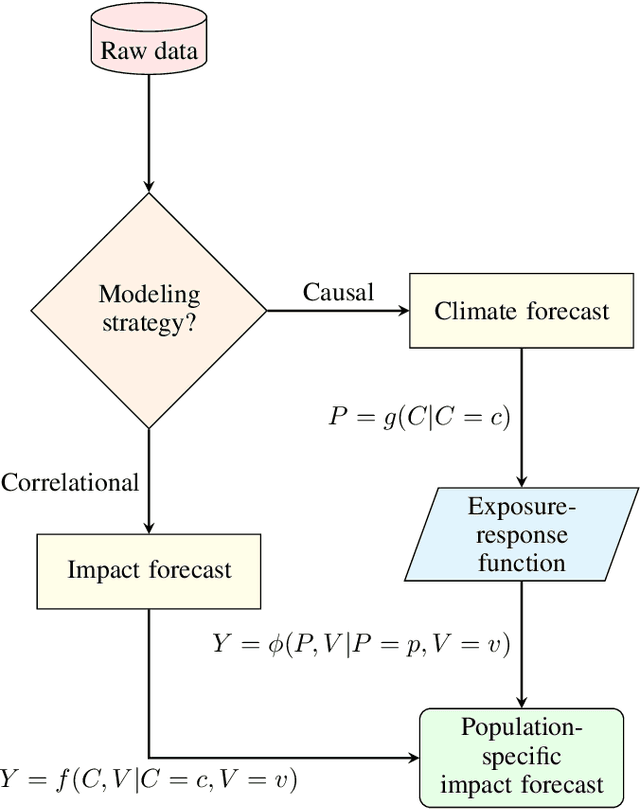
Disaster response agencies have been shifting from a paradigm of climate forecasting towards one of anticipatory action: assessing not just what the climate will be, but how it will impact specific populations, thereby enabling proactive response and resource allocation. Machine learning models are becoming exceptionally powerful at climate forecasting, but methodological gaps remain in terms of facilitating anticipatory action. Here we provide an overview of anticipatory action, review relevant applications of machine learning, identify common challenges, and highlight areas where machine learning can uniquely contribute to advancing disaster response for populations most vulnerable to climate change.