 Add to Chrome
 Add to Firefox
 Add to Edge
From Leaderboard to Deployment: Code Quality Challenges in AV Perception Repositories
Mar 02, 2026
Autonomous vehicle (AV) perception models are typically evaluated solely on benchmark performance metrics, with limited attention to code quality, production readiness and long-term maintainability. This creates a significant gap between research excellence and real-world deployment in safety-critical systems subject to international safety standards. To address this gap, we present the first large-scale empirical study of software quality in AV perception repositories, systematically analyzing 178 unique models from the KITTI and NuScenes 3D Object Detection leaderboards. Using static analysis tools (Pylint, Bandit, and Radon), we evaluated code errors, security vulnerabilities, maintainability, and development practices. Our findings revealed that only 7.3% of the studied repositories meet basic production-readiness criteria, defined as having zero critical errors and no high-severity security vulnerabilities. Security issues are highly concentrated, with the top five issues responsible for almost 80% of occurrences, which prompted us to develop a set of actionable guidelines to prevent them. Additionally, the adoption of Continuous Integration/Continuous Deployment pipelines was correlated with better code maintainability. Our findings highlight that leaderboard performance does not reflect production readiness and that targeted interventions could substantially improve the quality and safety of AV perception code.

Adver-City: Open-Source Multi-Modal Dataset for Collaborative Perception Under Adverse Weather Conditions
Oct 08, 2024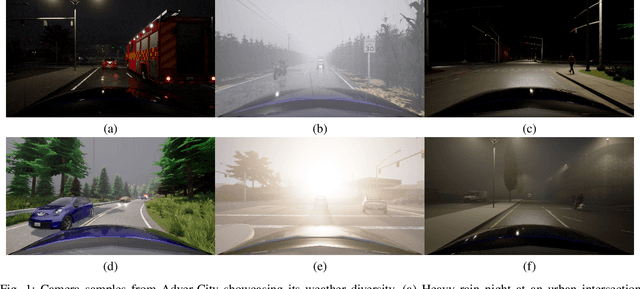
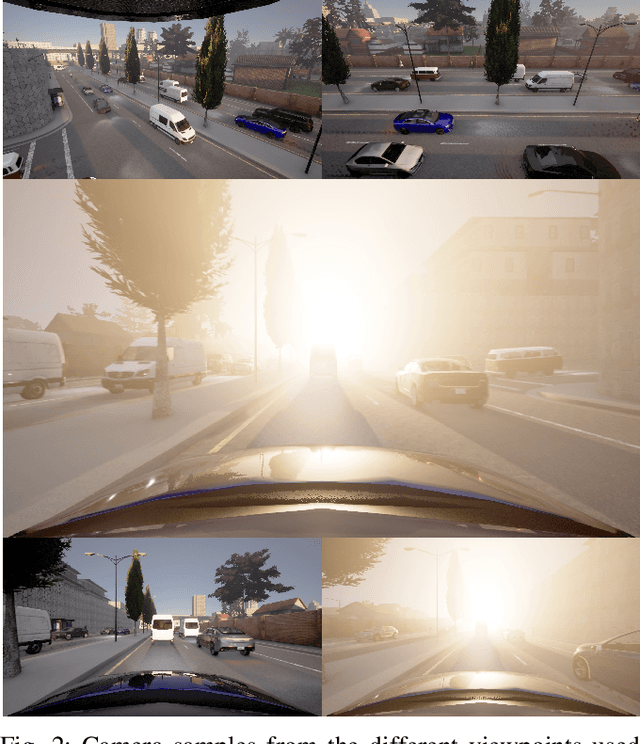
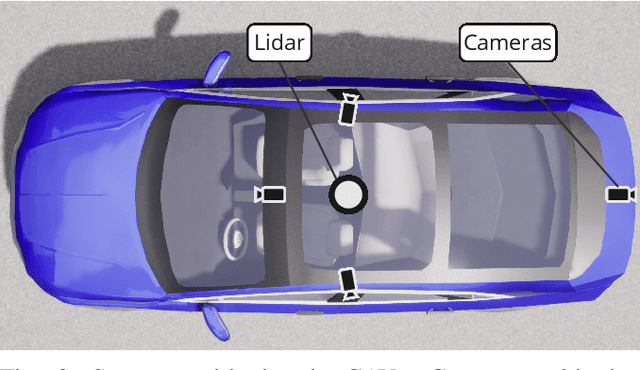
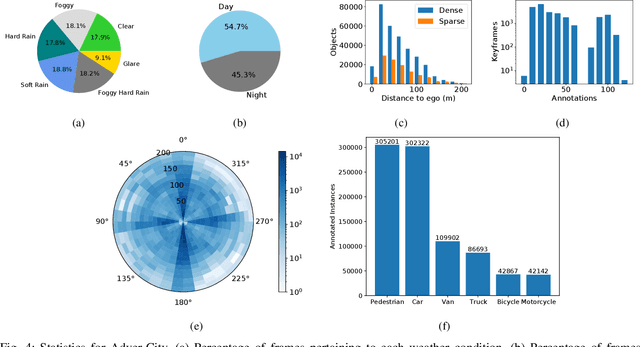
Adverse weather conditions pose a significant challenge to the widespread adoption of Autonomous Vehicles (AVs) by impacting sensors like LiDARs and cameras. Even though Collaborative Perception (CP) improves AV perception in difficult conditions, existing CP datasets lack adverse weather conditions. To address this, we introduce Adver-City, the first open-source synthetic CP dataset focused on adverse weather conditions. Simulated in CARLA with OpenCDA, it contains over 24 thousand frames, over 890 thousand annotations, and 110 unique scenarios across six different weather conditions: clear weather, soft rain, heavy rain, fog, foggy heavy rain and, for the first time in a synthetic CP dataset, glare. It has six object categories including pedestrians and cyclists, and uses data from vehicles and roadside units featuring LiDARs, RGB and semantic segmentation cameras, GNSS, and IMUs. Its scenarios, based on real crash reports, depict the most relevant road configurations for adverse weather and poor visibility conditions, varying in object density, with both dense and sparse scenes, allowing for novel testing conditions of CP models. Benchmarks run on the dataset show that weather conditions created challenging conditions for perception models, reducing multi-modal object detection performance by up to 19%, while object density affected LiDAR-based detection by up to 29%. The dataset, code and documentation are available at https://labs.cs.queensu.ca/quarrg/datasets/adver-city/.