 Add to Chrome
 Add to Firefox
 Add to Edge
Multi-Way Representation Alignment
Feb 05, 2026
The Platonic Representation Hypothesis suggests that independently trained neural networks converge to increasingly similar latent spaces. However, current strategies for mapping these representations are inherently pairwise, scaling quadratically with the number of models and failing to yield a consistent global reference. In this paper, we study the alignment of $M \ge 3$ models. We first adapt Generalized Procrustes Analysis (GPA) to construct a shared orthogonal universe that preserves the internal geometry essential for tasks like model stitching. We then show that strict isometric alignment is suboptimal for retrieval, where agreement-maximizing methods like Canonical Correlation Analysis (CCA) typically prevail. To bridge this gap, we finally propose Geometry-Corrected Procrustes Alignment (GCPA), which establishes a robust GPA-based universe followed by a post-hoc correction for directional mismatch. Extensive experiments demonstrate that GCPA consistently improves any-to-any retrieval while retaining a practical shared reference space.

Social Network Structure Shapes Innovation: Experience-sharing in RL with SAPIENS
Jun 10, 2022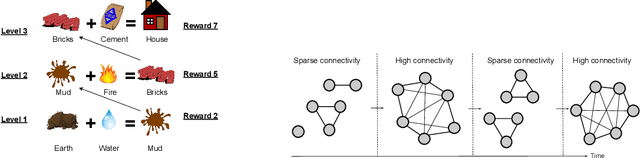
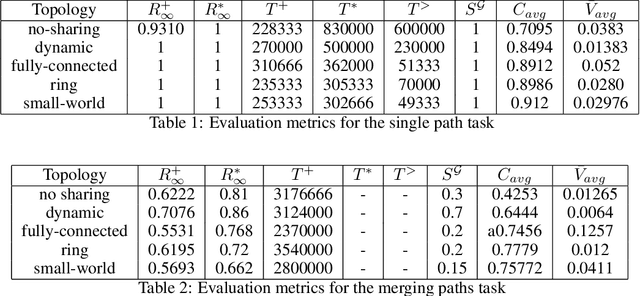
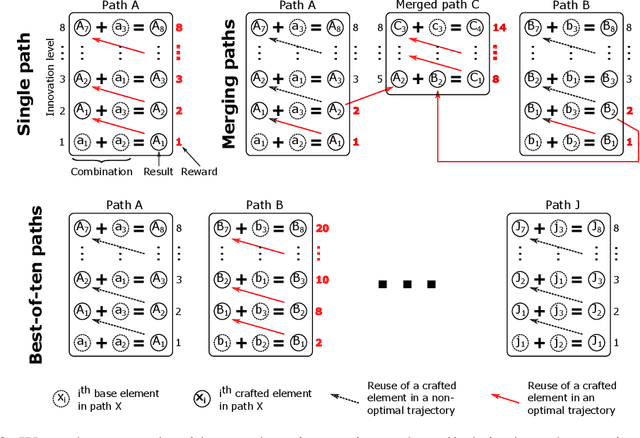
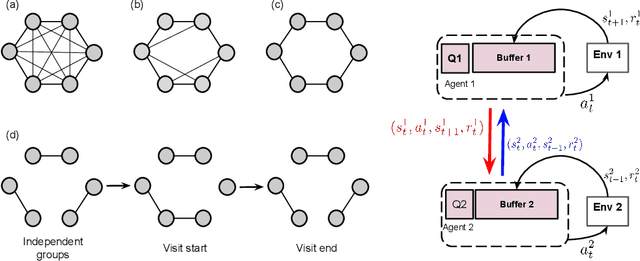
The human cultural repertoire relies on innovation: our ability to continuously and hierarchically explore how existing elements can be combined to create new ones. Innovation is not solitary, it relies on collective accumulation and merging of previous solutions. Machine learning approaches commonly assume that fully connected multi-agent networks are best suited for innovation. However, human laboratory and field studies have shown that hierarchical innovation is more robustly achieved by dynamic communication topologies. In dynamic topologies, humans oscillate between innovating individually or in small clusters, and then sharing outcomes with others. To our knowledge, the role of multi-agent topology on innovation has not been systematically studied in machine learning. It remains unclear a) which communication topologies are optimal for which innovation tasks, and b) which properties of experience sharing improve multi-level innovation. Here we use a multi-level hierarchical problem setting (WordCraft), with three different innovation tasks. We systematically design networks of DQNs sharing experiences from their replay buffers in varying topologies (fully connected, small world, dynamic, ring). Comparing the level of innovation achieved by different experience-sharing topologies across different tasks shows that, first, consistent with human findings, experience sharing within a dynamic topology achieves the highest level of innovation across tasks. Second, experience sharing is not as helpful when there is a single clear path to innovation. Third, two metrics we propose, conformity and diversity of shared experience, can explain the success of different topologies on different tasks. These contributions can advance our understanding of optimal AI-AI, human-human, and human-AI collaborative networks, inspiring future tools for fostering collective innovation in large organizations.