 Add to Chrome
 Add to Firefox
 Add to Edge
BC-NMPC: Battery-Constrained NMPC with Propulsion Prediction and Replanning for High-Speed Flight
Jul 26, 2026
Trajectory tracking performance of Uncrewed Aerial Vehicles (UAVs) degrades during high-speed and agile flight due to the depletion of the battery and subsequent loss of maximum available thrust. In applications such as drone racing, the consequent trajectory tracking error leads to a collision with obstacles and a subsequent failure to complete the race. In this paper, we present a novel method for integrating battery and propulsion system models into a Nonlinear Model Predictive Controller (NMPC) framework to enable real-time prediction of the voltage, consumed current, power, and maximum available thrust of the platform. This enables our approach to account for the dynamic variations in the maximum available thrust of the UAV caused by battery discharge, allowing it to plan for the depleting thrust and improve trajectory tracking performance. A trajectory planning algorithm is implemented to replan the trajectory in-flight based on evolving thrust limits. The accuracy of the proposed model is verified in real-world flight experiments, while the effectiveness of the replanning algorithm is evaluated in simulation. Compared to an uncompensated flight, our novel approach demonstrates achieves a collision-free flight to achieve a 6-fold decrease in tracking Root Mean Square Error (RMSE), a 46 % increase in flight distance, and a 100 % increase in flight time in an obstacle-ridden environment.

Dynamical Vehicle Orienteering Problem for Multi-Rotor Unmanned Aerial Vehicles
Jul 15, 2026This paper introduces the Dynamical Vehicle Orienteering Problem (DVOP), a generalization of the Orienteering Problem (OP). The OP maximizes the reward collected from spatial targets under a limited travel budget; the DVOP extends it by accounting for both external and vehicle-actuated forces. We study the DVOP in the context of multi-rotor Unmanned Aerial Vehicle (UAV) flight planning, using a three-dimensional Point-Mass Model (PMM) constrained by maximum velocity and acceleration magnitudes and subject to gravitational acceleration, with the travel budget expressed as a maximum flight time. Because the DVOP couples reward maximization with time-optimal trajectory planning, it cannot be formulated as a simple graph problem and solved exactly without relaxing or under-actuating the vehicle dynamics. We therefore propose two solution approaches: a Branch-and-Bound (BnB) procedure that combines Non-Linear Programming (NLP) and Mixed-Integer Linear Programming (MILP) to provide high-quality solutions, and a Large Neighborhood Search (LNS) metaheuristic that supplies an initial reward bound and scales to instances intractable for the BnB. The BnB relies on a novel MILP formulation of travel costs based on minimum-time trajectory primitives through target triplets, yielding a tight reward upper bound, while the LNS uses limited thrust decomposition to compute fast, high-quality PMM trajectories. Experiments on benchmark instances show improvements of up to 37 % over state-of-the-art solutions for the Kinematic Orienteering Problem, and a real-world deployment on a multi-rotor UAV verifies the proposed PMM solution trajectories.
Vision-only UAV State Estimation for Fast Flights Without External Localization Systems: A2RL Drone Racing Finalist Approach
Feb 02, 2026Fast flights with aggressive maneuvers in cluttered GNSS-denied environments require fast, reliable, and accurate UAV state estimation. In this paper, we present an approach for onboard state estimation of a high-speed UAV using a monocular RGB camera and an IMU. Our approach fuses data from Visual-Inertial Odometry (VIO), an onboard landmark-based camera measurement system, and an IMU to produce an accurate state estimate. Using onboard measurement data, we estimate and compensate for VIO drift through a novel mathematical drift model. State-of-the-art approaches often rely on more complex hardware (e.g., stereo cameras or rangefinders) and use uncorrected drifting VIO velocities, orientation, and angular rates, leading to errors during fast maneuvers. In contrast, our method corrects all VIO states (position, orientation, linear and angular velocity), resulting in accurate state estimation even during rapid and dynamic motion. Our approach was thoroughly validated through 1600 simulations and numerous real-world experiments. Furthermore, we applied the proposed method in the A2RL Drone Racing Challenge 2025, where our team advanced to the final four out of 210 teams and earned a medal.
Real-time Planning of Minimum-time Trajectories for Agile UAV Flight
Sep 24, 2024We address the challenge of real-time planning of minimum-time trajectories over multiple waypoints, onboard multirotor UAVs. Previous works demonstrated that achieving a truly time-optimal trajectory is computationally too demanding to enable frequent replanning during agile flight, especially on less powerful flight computers. Our approach overcomes this stumbling block by utilizing a point-mass model with a novel iterative thrust decomposition algorithm, enabling the UAV to use all of its collective thrust, something previous point-mass approaches could not achieve. The approach enables gravity and drag modeling integration, significantly reducing tracking errors in high-speed trajectories, which is proven through an ablation study. When combined with a new multi-waypoint optimization algorithm, which uses a gradient-based method to converge to optimal velocities in waypoints, the proposed method generates minimum-time multi-waypoint trajectories within milliseconds. The proposed approach, which we provide as open-source package, is validated both in simulation and in real-world, using Nonlinear Model Predictive Control. With accelerations of up to 3.5g and speeds over 100 km/h, trajectories generated by the proposed method yield similar or even smaller tracking errors than the trajectories generated for a full multirotor model.
CTopPRM: Clustering Topological PRM for Planning Multiple Distinct Paths in 3D Environments
May 23, 2023


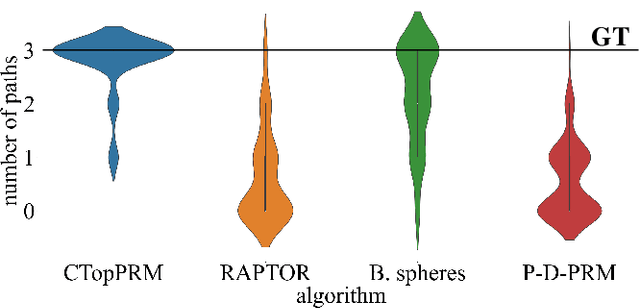
In this paper, we propose a new method called Clustering Topological PRM (CTopPRM) for finding multiple homotopically distinct paths in 3D cluttered environments. Finding such distinct paths, e.g., going around an obstacle from a different side, is useful in many applications. Among others, using multiple distinct paths is necessary for optimization-based trajectory planners where found trajectories are restricted to only a single homotopy class of a given path. Distinct paths can also be used to guide sampling-based motion planning and thus increase the effectiveness of planning in environments with narrow passages. Graph-based representation called roadmap is a common representation for path planning and also for finding multiple distinct paths. However, challenging environments with multiple narrow passages require a densely sampled roadmap to capture the connectivity of the environment. Searching such a dense roadmap for multiple paths is computationally too expensive. Therefore, the majority of existing methods construct only a sparse roadmap which, however, struggles to find all distinct paths in challenging environments. To this end, we propose the CTopPRM which creates a sparse graph by clustering an initially sampled dense roadmap. Such a reduced roadmap allows fast identification of homotopically distinct paths captured in the dense roadmap. We show, that compared to the existing methods the CTopPRM improves the probability of finding all distinct paths by almost 20% in tested environments, during same run-time. The source code of our method is released as an open-source package.