 Add to Chrome
 Add to Firefox
 Add to Edge
Precision-Varying Prediction (PVP): Robustifying ASR systems against adversarial attacks
Mar 23, 2026
With the increasing deployment of automated and agentic systems, ensuring the adversarial robustness of automatic speech recognition (ASR) models has become critical. We observe that changing the precision of an ASR model during inference reduces the likelihood of adversarial attacks succeeding. We take advantage of this fact to make the models more robust by simple random sampling of the precision during prediction. Moreover, the insight can be turned into an adversarial example detection strategy by comparing outputs resulting from different precisions and leveraging a simple Gaussian classifier. An experimental analysis demonstrates a significant increase in robustness and competitive detection performance for various ASR models and attack types.

Single-Model Attribution for Spoofed Speech via Vocoder Fingerprints in an Open-World Setting
Nov 21, 2024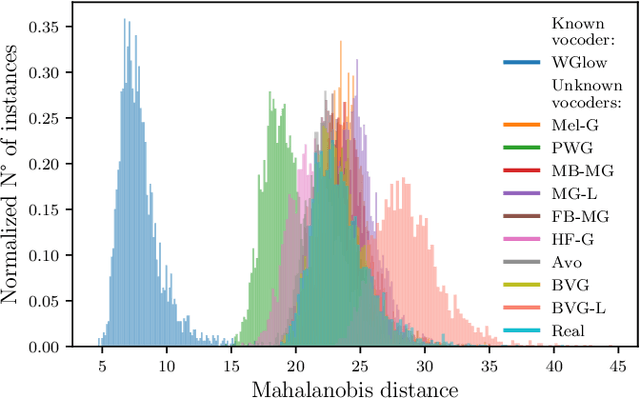
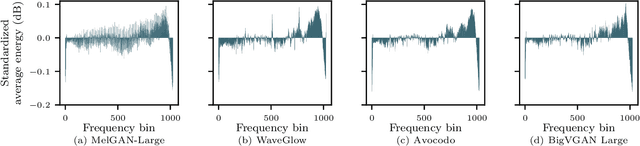
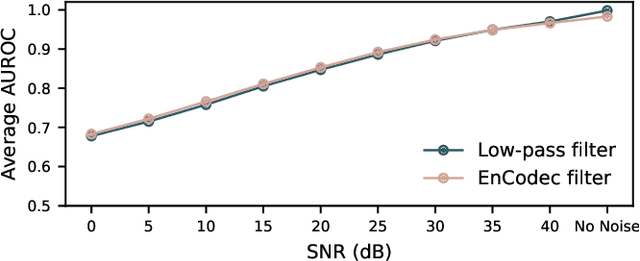
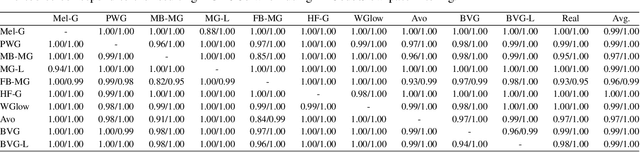
As speech generation technology advances, so do the potential threats of misusing spoofed speech signals. One way to address these threats is by attributing the signals to their source generative model. In this work, we are the first to tackle the single-model attribution task in an open-world setting, that is, we aim at identifying whether spoofed speech signals from unknown sources originate from a specific vocoder. We show that the standardized average residual between audio signals and their low-pass filtered or EnCodec filtered versions can serve as powerful vocoder fingerprints. The approach only requires data from the target vocoder and allows for simple but highly accurate distance-based model attribution. We demonstrate its effectiveness on LJSpeech and JSUT, achieving an average AUROC of over 99% in most settings. The accompanying robustness study shows that it is also resilient to noise levels up to a certain degree.