 Add to Chrome
 Add to Firefox
 Add to Edge
Fast and Accurate Anomaly Detection in Time Series
Jul 02, 2026
Anomaly detection is a critical and evolving field in Machine Learning, with applications targeting different domains such as cybersecurity, finance, healthcare, manufacturing and IoT (Internet of Things) systems. Traditionally, anomaly detection algorithms have been designed using both supervised and unsupervised learning paradigms. The fundamental challenge in real-world anomaly detection scenarios is related to the inherent class imbalance (anomalies are typically rare) and, for supervised methods, to the scarcity of labelled anomalous data. Indeed, labelling is both expensive and time-consuming. Conversely unsupervised methods do not require labelling, but may suffer from high false positive rates when deployed in safety-critical applications. In this work we introduce a novel unsupervised algorithm for anomaly detection in time series based on the Haar discrete wavelet and a suitably designed $t$-test. We establish the theoretical foundation of the proposed $t$-test and, through extensive experimentation across 343 datasets, demonstrate that our algorithm outperforms state-of-the-art unsupervised and self-supervised benchmarks.

Just In Time Transformers
Oct 22, 2024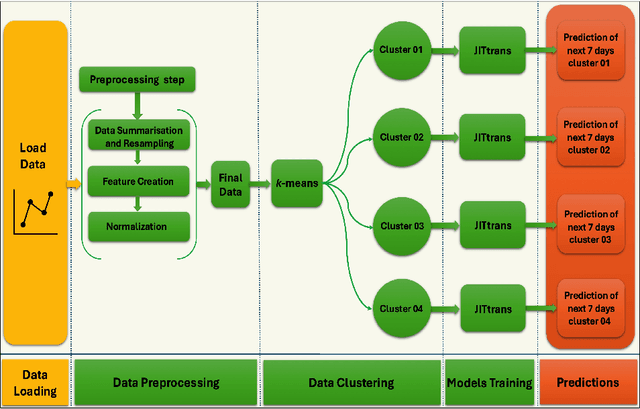
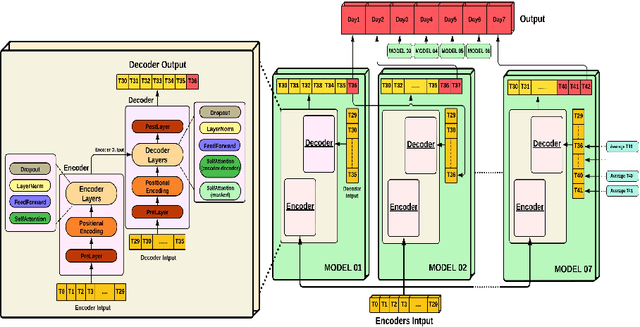

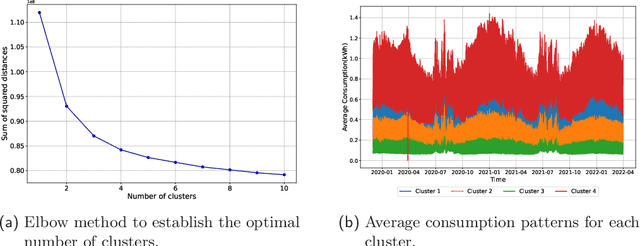
Precise energy load forecasting in residential households is crucial for mitigating carbon emissions and enhancing energy efficiency; indeed, accurate forecasting enables utility companies and policymakers, who advocate sustainable energy practices, to optimize resource utilization. Moreover, smart meters provide valuable information by allowing for granular insights into consumption patterns. Building upon available smart meter data, our study aims to cluster consumers into distinct groups according to their energy usage behaviours, effectively capturing a diverse spectrum of consumption patterns. Next, we design JITtrans (Just In Time transformer), a novel transformer deep learning model that significantly improves energy consumption forecasting accuracy, with respect to traditional forecasting methods. Extensive experimental results validate our claims using proprietary smart meter data. Our findings highlight the potential of advanced predictive technologies to revolutionize energy management and advance sustainable power systems: the development of efficient and eco-friendly energy solutions critically depends on such technologies.