 Add to Chrome
 Add to Firefox
 Add to Edge
Heterogeneous Layered Structures Can Modulate Human Softness Perception
Apr 22, 2026
Human softness perception in haptics has mainly been studied using mechanically homogeneous objects, despite the fact that many real-world objects exhibit heterogeneous layered structures with nonuniform stiffness. This study examined how layered heterogeneity modulates haptic softness perception. Sixteen lattice-structured stimuli were fabricated by 3D printing, with the stiffness of the upper four layers systematically varied while the bottom two layers remained fixed. Twenty-two participants evaluated the softness of the stimuli in a psychophysical task, and compression tests were conducted to quantify their mechanical properties. Perceived softness was significantly predicted by displacement under load, however, perceptual ranking did not fully coincide with the physical ranking. Linear mixed-effects analyses showed that the softness of the outermost layer had the greatest impact on the perceived softness. Perceived softness also increased as the number of soft subsurface layers increased, although this contribution decreased with depth. Layers 2 and 3 showed significant effects, whereas Layer 4 did not. These findings suggest that haptic softness perception depends not only on the overall stiffness but also on the depth-dependent distribution of compliance within layered structures.

Computational Models for SA, RA, PC Afferent to Reproduce Neural Responses to Dynamic Stimulus Using FEM Analysis and a Leaky Integrate-and-Fire Model
Aug 01, 2022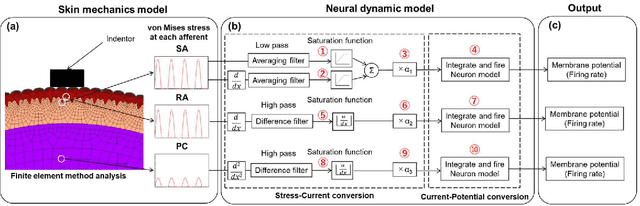
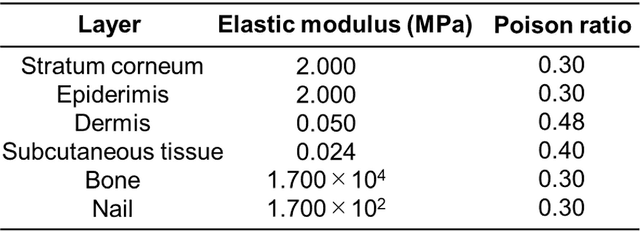
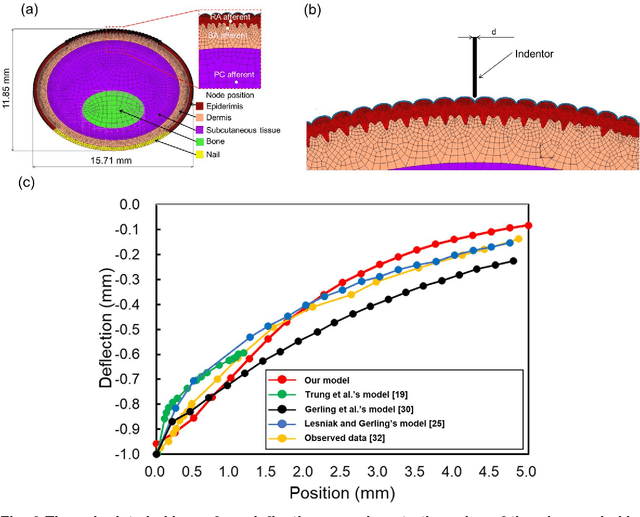

Tactile afferents such as (RA), and Pacinian (PC) afferents that respond to external stimuli enable complicated actions such as grasping, stroking and identifying an object. To understand the tactile sensation induced by these actions deeply, the activities of the tactile afferents need to be revealed. For this purpose, we develop a computational model for each tactile afferent for vibration stimuli, combining finite element analysis finite element method (FEM) analysis and a leaky integrate-and-fire model that represents the neural characteristics. This computational model can easily estimate the neural activities of the tactile afferents without measuring biological data. Skin deformation calculated using FEM analysis is substituted into the integrate-and-fire model as current input to calculate the membrane potential of each tactile afferent. We optimized parameters in the integrate-and-fire models using reported biological data. Then, we calculated the responses of the numerical models to sinusoidal, diharmonic, and white-noise-like mechanical stimuli to validate the proposed numerical models. From the result, the computational models well reproduced the neural responses to vibration stimuli such as sinusoidal, diharmonic, and noise stimuli and compare favorably with the similar computational models that can simulate the responses to vibration stimuli.