 Add to Chrome
 Add to Firefox
 Add to Edge
Intervention-Aware Clinical World Model for Post-Op Outcome Forecasting in Cardiology
Aug 13, 2026
Many clinical prediction models treat post-intervention outcomes as a one-step mapping from baseline measurements to a future endpoint. However, recovery after a procedure often unfolds as an irregular trajectory: clinical observations, medication changes, repeat interventions, and physiological measurements are recorded asynchronously and can change risk assessment over time. We propose an intervention-aware clinical world model that represents each patient with a structured latent state and evolves it through time-ordered post-intervention events. The model first encodes baseline imaging into a 3D spatial latent state. It then updates this state using procedural context, static covariates, elapsed time, and peri-event physiological embeddings. Follow-up imaging provides training-only supervision through a latent forecasting objective. We apply the framework to atrial fibrillation ablation. During the 90-day recovery window, irregular post-procedure records provide clinically meaningful evidence for long-term recurrence risk. In repeated internal cross-validation on DECAAF-II, our model achieves AUROC 0.756 and AUPRC 0.777 for recurrence prediction. It also achieves a scar-extent MAE of 2.971 percentage points without requiring follow-up MRI intensities at inference. The learned state supports recurrence-risk queries at different horizons and retrospective input editing of blanking-period records.

Latent PDE mapping for efficient physics-informed learning across geometries with limited data
Jul 24, 2026In this study, we introduce latent PDE mapping, a broadly applicable physics-informed learning technique designed to enable efficient geometric generalization with sparse training data. Latent PDE mapping pulls back geometry-specific PDE residuals and boundary conditions to a predefined latent geometry via the deformation gradient, thereby enabling the automated calculation of geometry-consistent shape gradients that are missing in conventional physics-informed machine learning formulations. We demonstrate the utility of latent PDE mapping in solving the anisotropic Aliev-Panfilov PDE of cardiac electrophysiology using both physics-informed neural networks and physics-informed deep operator networks. The Aliev-Panfilov PDE serves as a challenging exemplar: a nonlinear, time-dependent PDE benchmark with sharp gradients that are expensive to capture using traditional numerical solvers. To represent the limited data regime, we train the networks using just fifteen geometric samples drawn from parameterized distributions in two and three spatial dimensions. While modest improvements appear for geometries parameterized by affine and shear deformations, latent PDE mapping demonstrates significant benefits on select geometric families, achieving a factor ~4-6 reduction in mean relative L2 error. Furthermore, our results show that the computational cost of applying latent PDE mapping was modest during network training, and negligible at inference. Taken together, our study highlights how latent PDE mapping facilitates the creation of generalizable physics-informed machine learning models from limited sets of training geometries.
Balancing Fidelity, Utility, and Privacy in Synthetic Cardiac MRI Generation: A Comparative Study
Mar 04, 2026Deep learning in cardiac MRI (CMR) is fundamentally constrained by both data scarcity and privacy regulations. This study systematically benchmarks three generative architectures: Denoising Diffusion Probabilistic Models (DDPM), Latent Diffusion Models (LDM), and Flow Matching (FM) for synthetic CMR generation. Utilizing a two-stage pipeline where anatomical masks condition image synthesis, we evaluate generated data across three critical axes: fidelity, utility, and privacy. Our results show that diffusion-based models, particularly DDPM, provide the most effective balance between downstream segmentation utility, image fidelity, and privacy preservation under limited-data conditions, while FM demonstrates promising privacy characteristics with slightly lower task-level performance. These findings quantify the trade-offs between cross-domain generalization and patient confidentiality, establishing a framework for safe and effective synthetic data augmentation in medical imaging.
Generative Modeling with Conditional Autoencoders: Building an Integrated Cell
Apr 28, 2017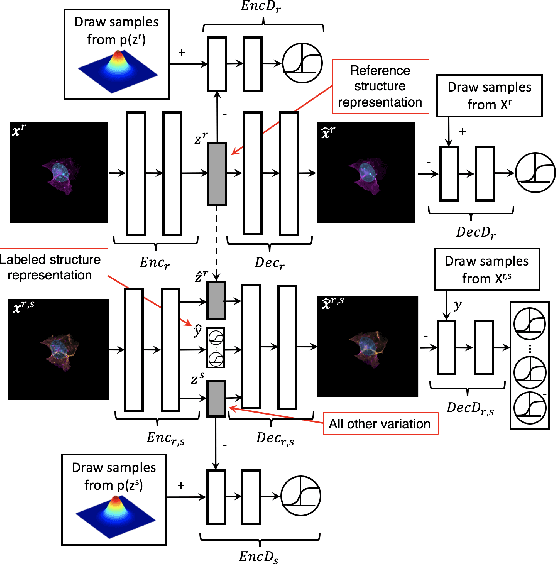
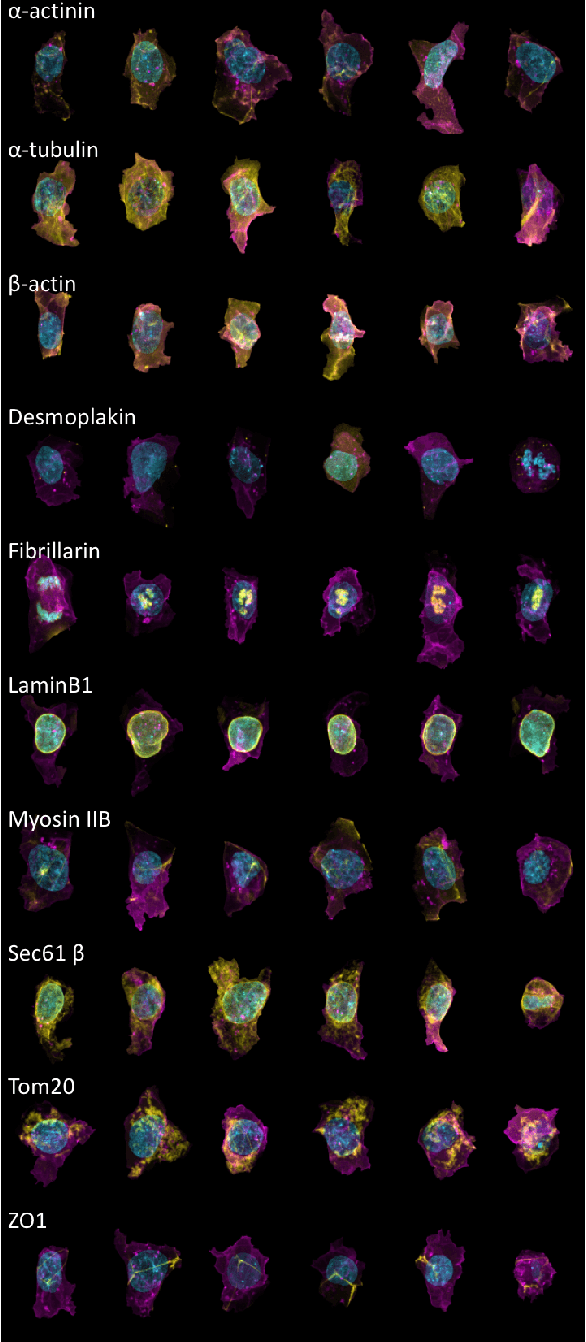
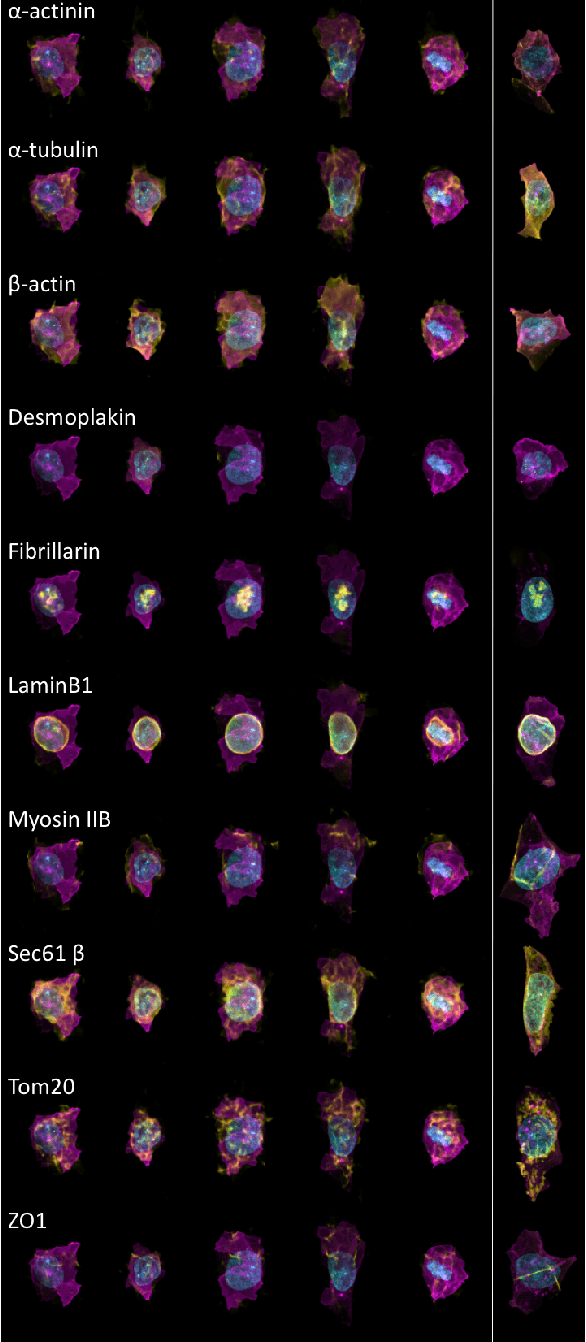
We present a conditional generative model to learn variation in cell and nuclear morphology and the location of subcellular structures from microscopy images. Our model generalizes to a wide range of subcellular localization and allows for a probabilistic interpretation of cell and nuclear morphology and structure localization from fluorescence images. We demonstrate the effectiveness of our approach by producing photo-realistic cell images using our generative model. The conditional nature of the model provides the ability to predict the localization of unobserved structures given cell and nuclear morphology.