 Add to Chrome
 Add to Firefox
 Add to Edge
A Hybridizable Neural Time Integrator for Stable Autoregressive Forecasting
Apr 22, 2026
For autoregressive modeling of chaotic dynamical systems over long time horizons, the stability of both training and inference is a major challenge in building scientific foundation models. We present a hybrid technique in which an autoregressive transformer is embedded within a novel shooting-based mixed finite element scheme, exposing topological structure that enables provable stability. For forward problems, we prove preservation of discrete energies, while for training we prove uniform bounds on gradients, provably avoiding the exploding gradient problem. Combined with a vision transformer, this yields latent tokens admitting structure-preserving dynamics. We outperform modern foundation models with a $65\times$ reduction in model parameters and long-horizon forecasting of chaotic systems. A "mini-foundation" model of a fusion component shows that 12 simulations suffice to train a real-time surrogate, achieving a $9{,}000\times$ speedup over particle-in-cell simulation.

Learning mechanical systems from real-world data using discrete forced Lagrangian dynamics
May 26, 2025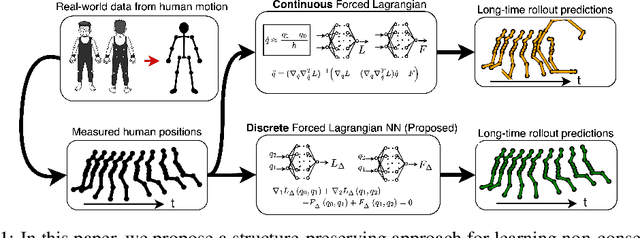

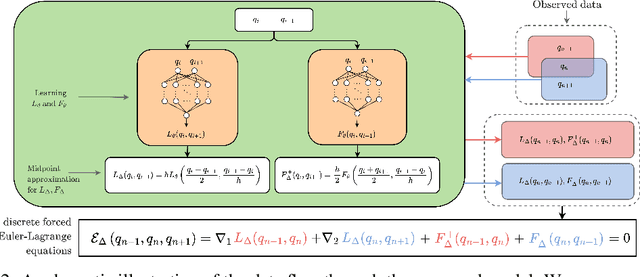
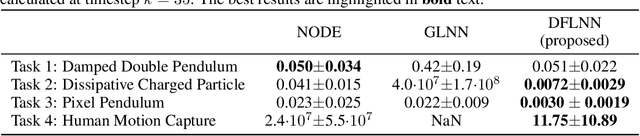
We introduce a data-driven method for learning the equations of motion of mechanical systems directly from position measurements, without requiring access to velocity data. This is particularly relevant in system identification tasks where only positional information is available, such as motion capture, pixel data or low-resolution tracking. Our approach takes advantage of the discrete Lagrange-d'Alembert principle and the forced discrete Euler-Lagrange equations to construct a physically grounded model of the system's dynamics. We decompose the dynamics into conservative and non-conservative components, which are learned separately using feed-forward neural networks. In the absence of external forces, our method reduces to a variational discretization of the action principle naturally preserving the symplectic structure of the underlying Hamiltonian system. We validate our approach on a variety of synthetic and real-world datasets, demonstrating its effectiveness compared to baseline methods. In particular, we apply our model to (1) measured human motion data and (2) latent embeddings obtained via an autoencoder trained on image sequences. We demonstrate that we can faithfully reconstruct and separate both the conservative and forced dynamics, yielding interpretable and physically consistent predictions.