 Add to Chrome
 Add to Firefox
 Add to Edge
Scientific Explanations in Health Sciences: Causality, Trust, and Epistemic Adequacy
Jun 30, 2026
Medical Artificial Intelligence (AI) is widely expected to transform clinical practice, yet the decision-making processes of many Machine Learning (ML) models remain opaque. Explainability has been advanced as a partial remedy to clarify why AI generates predictions, particularly in high-stakes contexts. Despite ongoing efforts, debates on what constitutes an adequate medical explanation remain unsettled. Yet, explanation has long been a central topic of inquiry in the philosophy of science and medicine. The insights developed in these fields, however, have been largely overlooked in contemporary explainable AI (XAI) research, leaving its foundational assumptions insufficiently examined. To address this gap, this paper develops a critical review at the intersection of philosophy of science and XAI. It examines prevailing accounts of what counts as an explanation in the health sciences and assesses their adequacy for informing XAI in medicine, arguing that they provide necessary conditions for a philosophically grounded approach to explainability in this domain. Building on this foundational philosophical literature, the discussion identifies three central axes of analysis: the role of causality in medical reasoning, the epistemic and relational dimensions of medical trust, and the criteria of explanatory adequacy as shaped by the pragmatic needs of diverse stakeholders. By integrating philosophical analysis with current developments in medical AI, the paper outlines principles for designing XAI systems that offer explanations that are not only epistemically robust but also aligned with the epistemic and practical requirements of clinical decision-making, shaping ongoing debates in medical XAI toward underexplored conceptual foundations.

Understanding XAI Through the Philosopher's Lens: A Historical Perspective
Jul 26, 2024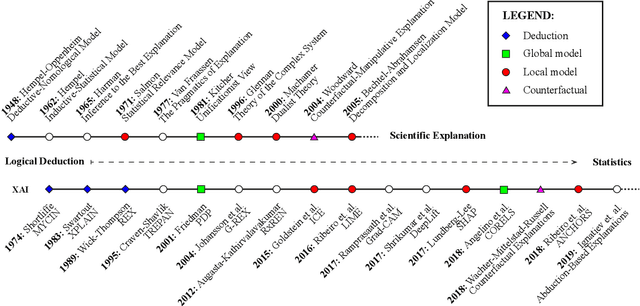
Despite explainable AI (XAI) has recently become a hot topic and several different approaches have been developed, there is still a widespread belief that it lacks a convincing unifying foundation. On the other hand, over the past centuries, the very concept of explanation has been the subject of extensive philosophical analysis in an attempt to address the fundamental question of "why" in the context of scientific law. However, this discussion has rarely been connected with XAI. This paper tries to fill in this gap and aims to explore the concept of explanation in AI through an epistemological lens. By comparing the historical development of both the philosophy of science and AI, an intriguing picture emerges. Specifically, we show that a gradual progression has independently occurred in both domains from logical-deductive to statistical models of explanation, thereby experiencing in both cases a paradigm shift from deterministic to nondeterministic and probabilistic causality. Interestingly, we also notice that similar concepts have independently emerged in both realms such as, for example, the relation between explanation and understanding and the importance of pragmatic factors. Our study aims to be the first step towards understanding the philosophical underpinnings of the notion of explanation in AI, and we hope that our findings will shed some fresh light on the elusive nature of XAI.