 Add to Chrome
 Add to Firefox
 Add to Edge
A Bayesian Framework for Post-disruption Travel Time Prediction in Metro Networks
Feb 23, 2026
Disruptions are an inherent feature of transportation systems, occurring unpredictably and with varying durations. Even after an incident is reported as resolved, disruptions can induce irregular train operations that generate substantial uncertainty in passenger waiting and travel times. Accurately forecasting post-disruption travel times therefore remains a critical challenge for transit operators and passenger information systems. This paper develops a Bayesian spatiotemporal modeling framework for post-disruption train travel times that explicitly captures train interactions, headway imbalance, and non-Gaussian distributional characteristics observed during recovery periods. The proposed model decomposes travel times into delay and journey components and incorporates a moving-average error structure to represent dependence between consecutive trains. Skew-normal and skew-$t$ distributions are employed to flexibly accommodate heteroskedasticity, skewness, and heavy-tailed behavior in post-disruption travel times. The framework is evaluated using high-resolution track-occupancy and disruption log data from the Montréal metro system, covering two lines in both travel directions. Empirical results indicate that post-disruption travel times exhibit pronounced distributional asymmetries that vary with traveled distance, as well as significant error dependence across trains. The proposed models consistently outperform baseline specifications in both point prediction accuracy and uncertainty quantification, with the skew-$t$ model demonstrating the most robust performance for longer journeys. These findings underscore the importance of incorporating both distributional flexibility and error dependence when forecasting post-disruption travel times in urban rail systems.

Forecasting of the Montreal Subway Smart Card Entry Logs with Event Data
Aug 22, 2020
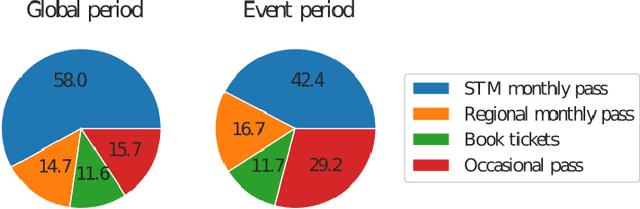
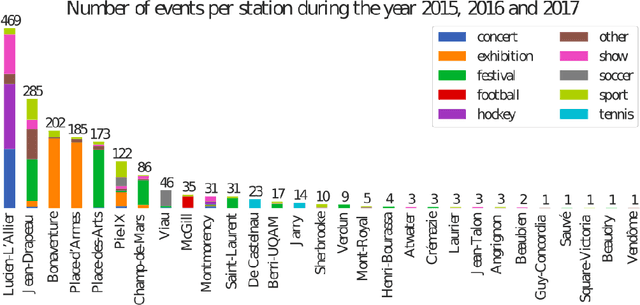

One of the major goals of transport operators is to adapt the transport supply scheduling to the passenger demand for existing transport networks during each specific period. Another problem mentioned by operators is accurately estimating the demand for disposable ticket or pass to adapt ticket availability to passenger demand. In this context, we propose generic data shaping, allowing the use of well-known regression models (basic, statistical and machine learning models) for the long-term forecasting of passenger demand with fine-grained temporal resolution. Specifically, this paper investigates the forecasting until one year ahead of the number of passengers entering each station of a transport network with a quarter-hour aggregation by taking planned events into account (e.g., concerts, shows, and so forth). To compare the models and the quality of the prediction, we use a real smart card and event data set from the city of Montr\'eal, Canada, that span a three-year period with two years for training and one year for testing.