 Add to Chrome
 Add to Firefox
 Add to Edge
Efficient Learning of Sparse Representations from Interactions
Feb 10, 2026
Behavioral patterns captured in embeddings learned from interaction data are pivotal across various stages of production recommender systems. However, in the initial retrieval stage, practitioners face an inherent tradeoff between embedding expressiveness and the scalability and latency of serving components, resulting in the need for representations that are both compact and expressive. To address this challenge, we propose a training strategy for learning high-dimensional sparse embedding layers in place of conventional dense ones, balancing efficiency, representational expressiveness, and interpretability. To demonstrate our approach, we modified the production-grade collaborative filtering autoencoder ELSA, achieving up to 10x reduction in embedding size with no loss of recommendation accuracy, and up to 100x reduction with only a 2.5% loss. Moreover, the active embedding dimensions reveal an interpretable inverted-index structure that segments items in a way directly aligned with the model's latent space, thereby enabling integration of segment-level recommendation functionality (e.g., 2D homepage layouts) within the candidate retrieval model itself. Source codes, additional results, as well as a live demo are available at https://github.com/zombak79/compressed_elsa

From Knots to Knobs: Towards Steerable Collaborative Filtering Using Sparse Autoencoders
Jan 16, 2026Sparse autoencoders (SAEs) have recently emerged as pivotal tools for introspection into large language models. SAEs can uncover high-quality, interpretable features at different levels of granularity and enable targeted steering of the generation process by selectively activating specific neurons in their latent activations. Our paper is the first to apply this approach to collaborative filtering, aiming to extract similarly interpretable features from representations learned purely from interaction signals. In particular, we focus on a widely adopted class of collaborative autoencoders (CFAEs) and augment them by inserting an SAE between their encoder and decoder networks. We demonstrate that such representation is largely monosemantic and propose suitable mapping functions between semantic concepts and individual neurons. We also evaluate a simple yet effective method that utilizes this representation to steer the recommendations in a desired direction.
The Future is Sparse: Embedding Compression for Scalable Retrieval in Recommender Systems
May 16, 2025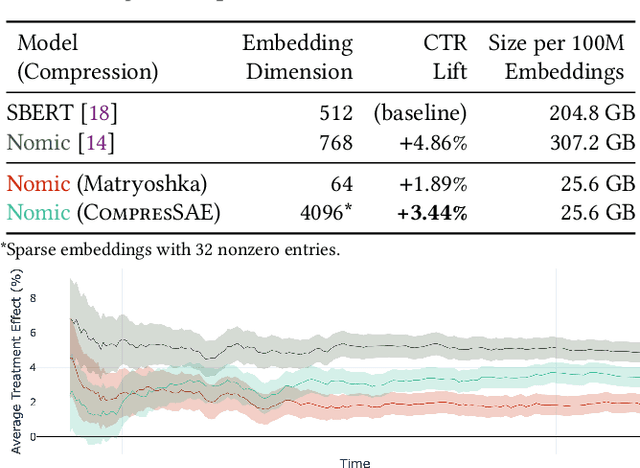
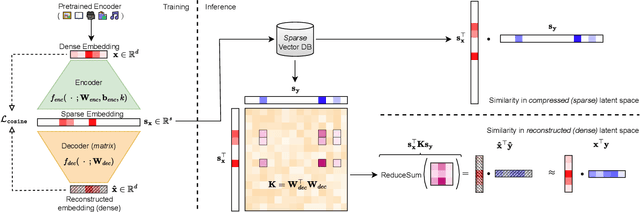
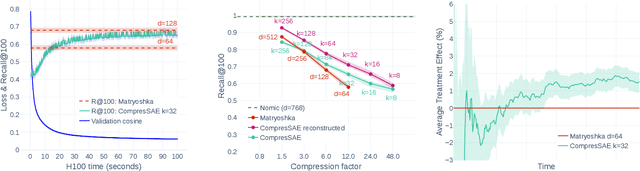
Industry-scale recommender systems face a core challenge: representing entities with high cardinality, such as users or items, using dense embeddings that must be accessible during both training and inference. However, as embedding sizes grow, memory constraints make storage and access increasingly difficult. We describe a lightweight, learnable embedding compression technique that projects dense embeddings into a high-dimensional, sparsely activated space. Designed for retrieval tasks, our method reduces memory requirements while preserving retrieval performance, enabling scalable deployment under strict resource constraints. Our results demonstrate that leveraging sparsity is a promising approach for improving the efficiency of large-scale recommenders. We release our code at https://github.com/recombee/CompresSAE.